

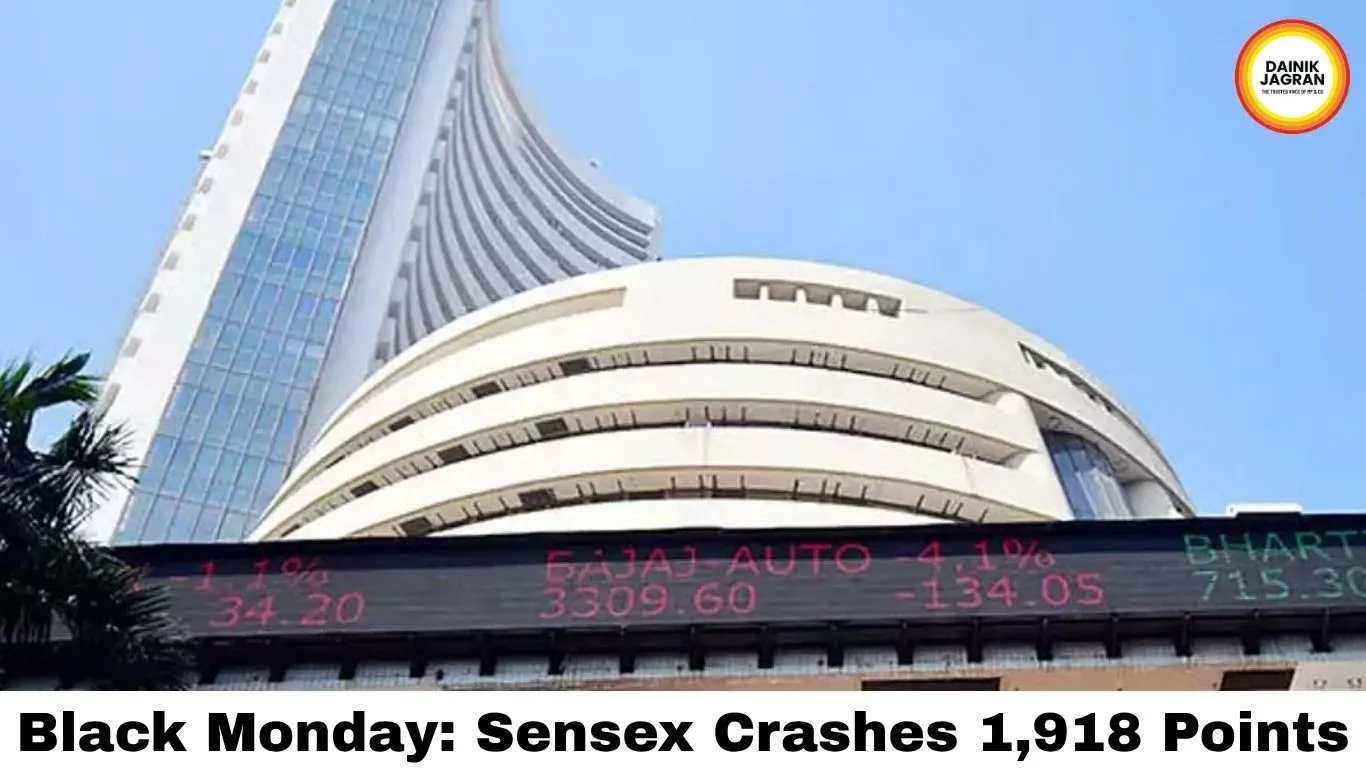
Black Monday: Sensex Crashes 1,918 Points, ₹14 Lakh Crore Wiped Out
Digital Desk
Sensex crashes 1,918 points to 72,614 on Black Monday March 23 — Nifty at 22,489, ₹14 lakh crore wiped, 966 stocks at 52-week lows as Trump's Iran ultimatum expires and Brent hits $113.
Black Monday Returns to Dalal Street: Sensex Crashes 1,918 Points, ₹14 Lakh Crore Wiped Out as Trump's Iran Ultimatum Expires
Sensex tanks to 72,614 and Nifty crashes to 22,489 on March 23 — 966 stocks hit 52-week lows, 27 of 30 Sensex stocks in red, Brent crude at $113 — as investors flee risk assets with Trump's 48-hour power plant deadline running out.
The Bell That Sounded Like a Warning Siren
There are trading sessions when Dalal Street opens and the numbers simply confirm what everyone feared. Monday, March 23, 2026 was one of those sessions — and then some. The BSE Sensex opened sharply lower, plunged to an intraday low of 71,425 points, and ultimately closed down 1,918 points at 72,614 — its lowest close since early 2025. The NSE Nifty 50 crashed 625 points to settle at 22,489 — cracking decisively below the psychologically critical 23,000 mark and closing at levels not seen in nearly a year. Investor wealth of ₹14.19 lakh crore evaporated in a single session. The total BSE market capitalisation fell to ₹414.81 lakh crore — down from ₹429 lakh crore at Friday's close.
The Numbers — Brutal and Broad
The sell-off was not selective. It was systemic. All 16 major sectors on the NSE declined simultaneously, with the broader small-cap and mid-cap indices each falling more than 3 percent. Free Press Journal Of 4,431 stocks traded on Monday, 3,771 were in the red. Only 530 managed to stay green. A staggering 966 stocks hit their 52-week lows during intraday trade — a number that reflects not a sectoral correction but a market-wide crisis of confidence. As many as 346 stocks hit their lower circuits. On the Sensex, 27 of 30 stocks closed in negative territory.
The Nifty Bank index was among the hardest hit — falling sharply, extending its slide from recent highs and touching levels that have prompted analysts to warn of further downside if global cues do not stabilise. The India VIX — the market's fear gauge — spiked significantly, signalling that volatility is likely to persist through the week.
Top losers on the Sensex included InterGlobe Aviation, UltraTech Cement, Titan, Trent, BEL, Adani Ports, Tata Steel, HDFC Bank and Mahindra & Mahindra — all falling between 4 and 6 percent intraday.
What Triggered the Bloodbath — Four Factors at Once
Monday's crash was not the result of a single trigger. Four factors converged simultaneously to produce one of Dalal Street's worst sessions of 2026.
The most immediate was Trump's 48-hour Iran ultimatum — which expired Monday evening at 7:44 pm ET. Markets spent the entire trading session pricing in the risk of what comes next: direct US strikes on Iranian power plants, Iran's vowed permanent closure of the Strait of Hormuz, and the cascading energy shock that a full Hormuz closure would unleash on the global economy. As of the afternoon session, Brent crude was trading at $113 per barrel BollywoodShaadis — up sharply on the day — adding direct pressure on India as one of the world's largest oil importers.
The second factor was the broader global sell-off. Asian markets had already set the tone before Indian exchanges opened — Japan's Nikkei, South Korea's Kospi, and Hong Kong's Hang Seng all falling sharply in Monday morning trade. European futures pointed further south. The global risk-off sentiment arrived in Mumbai fully formed before the opening bell.
The third factor was persistent foreign institutional investor selling. FIIs have now been net sellers of Indian equities for 14 consecutive trading sessions — the longest sustained selling streak in over a year — with the cumulative outflow in March alone running into tens of thousands of crores.
The fourth factor was domestic banking sector fragility. HDFC Bank — India's largest private sector lender by market capitalisation — has been under pressure since the resignation of its chairman in a letter that cited practices within the bank "not in congruence with my personal values and ethics." The RBI has since stated the bank has sound financials, but investor confidence in the stock has been significantly dented.
This Is Dalal Street's Third Black Monday Since February 28
Monday's crash is the third major single-session bloodbath on Dalal Street since the US-Israel-Iran war began on February 28. The first Black Monday on March 2 saw the Sensex plunge over 2,700 points and ₹6 lakh crore wiped out as news of Supreme Leader Khamenei's death hit markets at opening. The second major crash on March 19 saw the Sensex tumble 2,496 points — its worst session since June 2024 — as Iranian strikes on Qatar's Ras Laffan LNG hub and Kuwait's oil refineries sent Brent crude surging 6.75 percent to $114.8 per barrel and wiped out ₹12 lakh crore in a single session. Onmanorama
Monday's session adds ₹14.19 lakh crore to the cumulative losses. The combined market wealth destruction across the three Black Mondays and the broader decline since February 28 now runs into tens of lakh crores — making the West Asia war the most costly external geopolitical event for Indian equity investors since the COVID-19 rout of March 2020.
What the Analysts Are Saying
Market experts are divided on where the floor is. The Nifty's close below 22,500 has broken several key technical support levels that analysts had identified as holding zones. The next support is seen at 22,200 to 22,000 levels. A fall below 22,000 could accelerate selling toward 21,700.
The critical variable is not technical. It is geopolitical. If Trump executes his threat to strike Iranian power plants and Iran retaliates with a permanent Hormuz closure — driving crude toward $130 or $140 per barrel — equity markets globally, and particularly in oil-importing nations like India, face a scenario that no technical analysis can adequately price.
The more optimistic scenario — a diplomatic breakthrough, a partial Hormuz reopening, or a pause in hostilities — could trigger a sharp relief rally. Friday's session, which added ₹3 lakh crore to market cap in a single day on brief peace hopes, demonstrated how quickly sentiment can reverse.
For now, one piece of advice from market analysts is broadly consistent: maintain a disciplined and cautious approach. Fundamentally strong stocks at meaningful declines present accumulation opportunities — but fresh long positions should ideally wait for a decisive Nifty recovery above the 24,500 to 25,000 mark.
The Bigger Picture — War Is Now an Economic Crisis
PM Modi told the Lok Sabha on Monday afternoon that India holds a strategic petroleum reserve of 53 lakh metric tonnes, that two Indian LPG ships have crossed the Strait safely, and that the government is monitoring shipping routes 24/7. Those are meaningful reassurances. But the stock market's verdict is that the underlying exposure — 70 percent crude import dependence, a disrupted global LPG supply chain, and an open-ended war with no ceasefire on the horizon — is a structural risk that no reserve stockpile can fully neutralise.
Dalal Street is not panicking irrationally. It is pricing a genuine and unresolved threat — and doing so, as it always does, before the rest of the economy catches up.
--------
🚨 Beat the News Rush – Join Now!
Get breaking alerts, hot exclusives, and game-changing stories instantly on your phone. No delays, no fluff – just the edge you need. ⚡
Tap to join:
🟢 WhatsApp Channel: Dainik Jagran MP CG
Crave more?
🅕 Facebook: Dainik Jagran MP CG English
🅧 Twitter (X): Dainik Jagran MP CG
🅘 Instagram: Dainik Jagran MP CG
Share the fire – keep your crew ahead! 🗞️🔥
Black Monday: Sensex Crashes 1,918 Points, ₹14 Lakh Crore Wiped Out
Digital Desk
Black Monday Returns to Dalal Street: Sensex Crashes 1,918 Points, ₹14 Lakh Crore Wiped Out as Trump's Iran Ultimatum Expires
Sensex tanks to 72,614 and Nifty crashes to 22,489 on March 23 — 966 stocks hit 52-week lows, 27 of 30 Sensex stocks in red, Brent crude at $113 — as investors flee risk assets with Trump's 48-hour power plant deadline running out.
The Bell That Sounded Like a Warning Siren
There are trading sessions when Dalal Street opens and the numbers simply confirm what everyone feared. Monday, March 23, 2026 was one of those sessions — and then some. The BSE Sensex opened sharply lower, plunged to an intraday low of 71,425 points, and ultimately closed down 1,918 points at 72,614 — its lowest close since early 2025. The NSE Nifty 50 crashed 625 points to settle at 22,489 — cracking decisively below the psychologically critical 23,000 mark and closing at levels not seen in nearly a year. Investor wealth of ₹14.19 lakh crore evaporated in a single session. The total BSE market capitalisation fell to ₹414.81 lakh crore — down from ₹429 lakh crore at Friday's close.
The Numbers — Brutal and Broad
The sell-off was not selective. It was systemic. All 16 major sectors on the NSE declined simultaneously, with the broader small-cap and mid-cap indices each falling more than 3 percent. Free Press Journal Of 4,431 stocks traded on Monday, 3,771 were in the red. Only 530 managed to stay green. A staggering 966 stocks hit their 52-week lows during intraday trade — a number that reflects not a sectoral correction but a market-wide crisis of confidence. As many as 346 stocks hit their lower circuits. On the Sensex, 27 of 30 stocks closed in negative territory.
The Nifty Bank index was among the hardest hit — falling sharply, extending its slide from recent highs and touching levels that have prompted analysts to warn of further downside if global cues do not stabilise. The India VIX — the market's fear gauge — spiked significantly, signalling that volatility is likely to persist through the week.
Top losers on the Sensex included InterGlobe Aviation, UltraTech Cement, Titan, Trent, BEL, Adani Ports, Tata Steel, HDFC Bank and Mahindra & Mahindra — all falling between 4 and 6 percent intraday.
What Triggered the Bloodbath — Four Factors at Once
Monday's crash was not the result of a single trigger. Four factors converged simultaneously to produce one of Dalal Street's worst sessions of 2026.
The most immediate was Trump's 48-hour Iran ultimatum — which expired Monday evening at 7:44 pm ET. Markets spent the entire trading session pricing in the risk of what comes next: direct US strikes on Iranian power plants, Iran's vowed permanent closure of the Strait of Hormuz, and the cascading energy shock that a full Hormuz closure would unleash on the global economy. As of the afternoon session, Brent crude was trading at $113 per barrel BollywoodShaadis — up sharply on the day — adding direct pressure on India as one of the world's largest oil importers.
The second factor was the broader global sell-off. Asian markets had already set the tone before Indian exchanges opened — Japan's Nikkei, South Korea's Kospi, and Hong Kong's Hang Seng all falling sharply in Monday morning trade. European futures pointed further south. The global risk-off sentiment arrived in Mumbai fully formed before the opening bell.
The third factor was persistent foreign institutional investor selling. FIIs have now been net sellers of Indian equities for 14 consecutive trading sessions — the longest sustained selling streak in over a year — with the cumulative outflow in March alone running into tens of thousands of crores.
The fourth factor was domestic banking sector fragility. HDFC Bank — India's largest private sector lender by market capitalisation — has been under pressure since the resignation of its chairman in a letter that cited practices within the bank "not in congruence with my personal values and ethics." The RBI has since stated the bank has sound financials, but investor confidence in the stock has been significantly dented.
This Is Dalal Street's Third Black Monday Since February 28
Monday's crash is the third major single-session bloodbath on Dalal Street since the US-Israel-Iran war began on February 28. The first Black Monday on March 2 saw the Sensex plunge over 2,700 points and ₹6 lakh crore wiped out as news of Supreme Leader Khamenei's death hit markets at opening. The second major crash on March 19 saw the Sensex tumble 2,496 points — its worst session since June 2024 — as Iranian strikes on Qatar's Ras Laffan LNG hub and Kuwait's oil refineries sent Brent crude surging 6.75 percent to $114.8 per barrel and wiped out ₹12 lakh crore in a single session. Onmanorama
Monday's session adds ₹14.19 lakh crore to the cumulative losses. The combined market wealth destruction across the three Black Mondays and the broader decline since February 28 now runs into tens of lakh crores — making the West Asia war the most costly external geopolitical event for Indian equity investors since the COVID-19 rout of March 2020.
What the Analysts Are Saying
Market experts are divided on where the floor is. The Nifty's close below 22,500 has broken several key technical support levels that analysts had identified as holding zones. The next support is seen at 22,200 to 22,000 levels. A fall below 22,000 could accelerate selling toward 21,700.
The critical variable is not technical. It is geopolitical. If Trump executes his threat to strike Iranian power plants and Iran retaliates with a permanent Hormuz closure — driving crude toward $130 or $140 per barrel — equity markets globally, and particularly in oil-importing nations like India, face a scenario that no technical analysis can adequately price.
The more optimistic scenario — a diplomatic breakthrough, a partial Hormuz reopening, or a pause in hostilities — could trigger a sharp relief rally. Friday's session, which added ₹3 lakh crore to market cap in a single day on brief peace hopes, demonstrated how quickly sentiment can reverse.
For now, one piece of advice from market analysts is broadly consistent: maintain a disciplined and cautious approach. Fundamentally strong stocks at meaningful declines present accumulation opportunities — but fresh long positions should ideally wait for a decisive Nifty recovery above the 24,500 to 25,000 mark.
The Bigger Picture — War Is Now an Economic Crisis
PM Modi told the Lok Sabha on Monday afternoon that India holds a strategic petroleum reserve of 53 lakh metric tonnes, that two Indian LPG ships have crossed the Strait safely, and that the government is monitoring shipping routes 24/7. Those are meaningful reassurances. But the stock market's verdict is that the underlying exposure — 70 percent crude import dependence, a disrupted global LPG supply chain, and an open-ended war with no ceasefire on the horizon — is a structural risk that no reserve stockpile can fully neutralise.
Dalal Street is not panicking irrationally. It is pricing a genuine and unresolved threat — and doing so, as it always does, before the rest of the economy catches up.


