


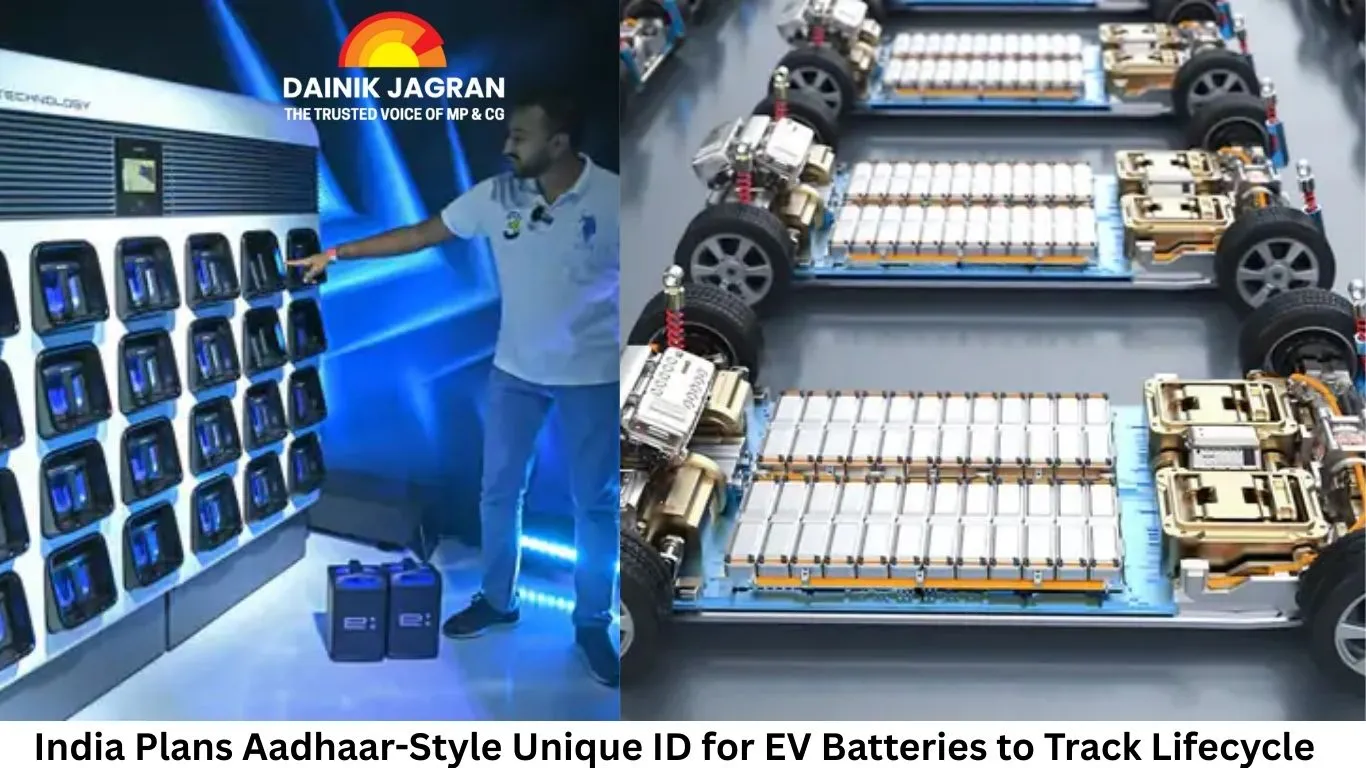
India Plans Aadhaar-Style Unique ID for EV Batteries to Track Lifecycle
Digital Desk
The Ministry of Road Transport has issued draft guidelines stating that it will be mandatory for all battery manufacturers and importers to assign a BPAN to every battery pack, whether sold commercially or manufactured for internal corporate use. The system is designed to track batteries from production and usage to degradation and recycling through a centralized digital platform.
A key requirement is that the BPAN must be clearly displayed on the battery pack, non-removable, and tamper-proof. Manufacturers will also need to upload real-time battery data—including manufacturing details, usage patterns, and performance metrics—to the official BPAN portal. In cases where a battery is recycled or repurposed, a new BPAN will be issued, ensuring transparency and traceability across the battery’s lifecycle.
While the initial focus is on EV batteries, which account for nearly 80–90% of India’s lithium-ion battery demand, the draft guidelines propose extending the BPAN system to industrial batteries with a capacity above 2 kWh. The Automotive Industry Standard (AIS) committee, comprising automakers, battery manufacturers, recyclers, and government representatives, will frame technical standards to ensure consistent implementation.
Experts say the BPAN system has several benefits. It will improve battery safety by enabling better monitoring of quality and performance, allow identification of batteries suitable for second-life applications—such as solar energy storage or home inverters—and promote environmentally responsible recycling. Additionally, consumers will gain access to a battery’s complete history, fostering transparency and trust in the EV ecosystem.
Battery second-life is an emerging concept in India, where EV batteries with 70–80% of their original capacity are no longer ideal for vehicles but remain usable for stationary energy storage. The BPAN system is expected to streamline this process, supporting sustainable energy solutions while reducing environmental impact.
The initiative aligns with India’s broader push toward electric mobility, environmental sustainability, and circular economy practices. Once finalized, the BPAN framework could become a model for comprehensive battery management in the rapidly expanding EV market.
.jpg)




