

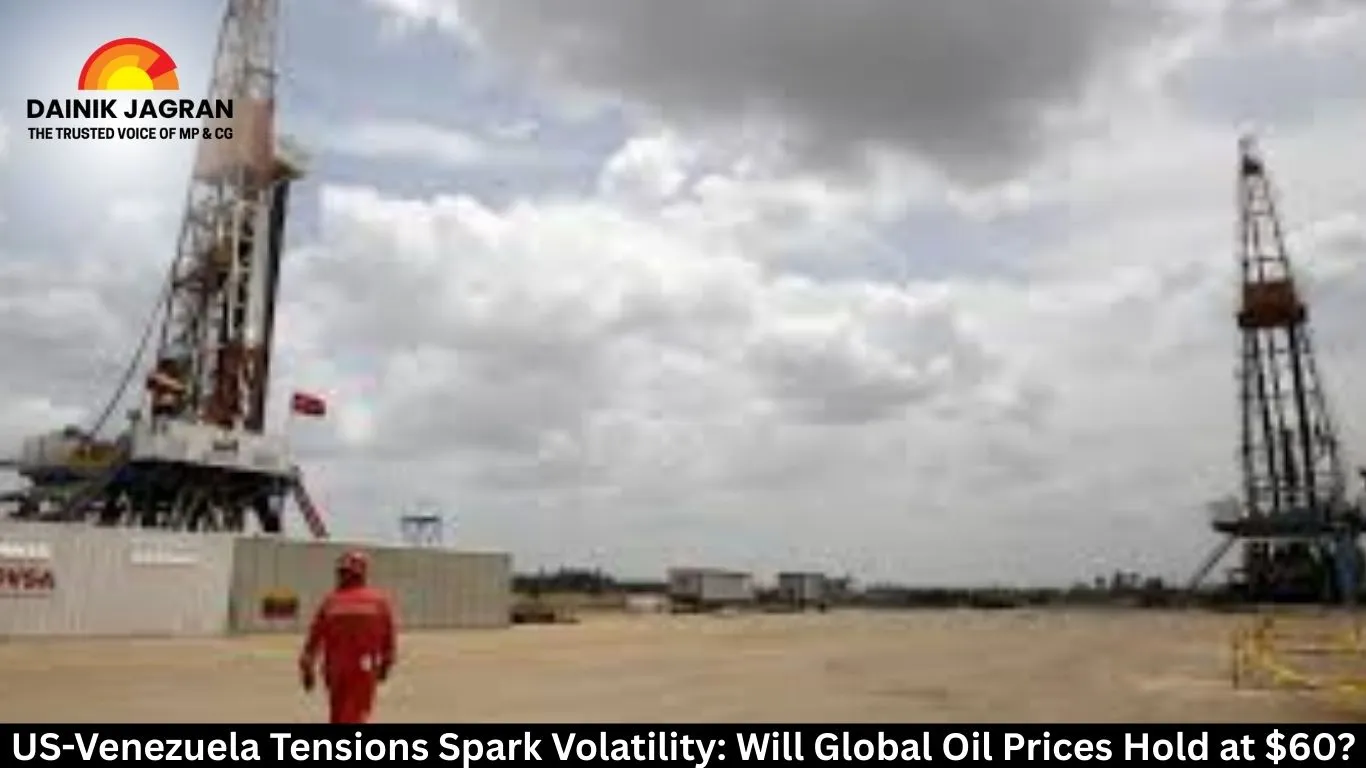
US-Venezuela Tensions Spark Volatility: Will Global Oil Prices Hold at $60?

Digital Desk

US-Venezuela Tensions Spark Volatility: Will Global Oil Prices Hold at $60?

US-Venezuela tensions drive Brent crude to $60 as the MCX reacts. Discover how geopolitical shifts and supply glut fears are shaping global oil prices in 2026.


The global energy landscape shifted overnight as escalating US-Venezuela tensions sent ripples through commodity exchanges. On Monday, January 5, 2026, crude oil futures on the Multi Commodity Exchange (MCX) saw a noticeable uptick, with January delivery contracts rising by ₹42 to settle at ₹5,197 per barrel. Meanwhile, the international benchmark, Brent crude, hovered near the $60 mark, reflecting a market caught between immediate geopolitical "fear premiums" and a looming global supply glut.


Geopolitical Friction Meets Market Caution


The primary driver of this recent volatility is the dramatic US military operation over the weekend, which resulted in the capture of Venezuelan leader Nicolás Maduro. While the news initially sparked a price surge, the rally has been tempered by the reality of Venezuela's current output.

Although Venezuela sits on the world’s largest proven oil reserves, years of underinvestment mean it currently contributes less than 1% to the global supply. However, investors aren't just looking at today’s barrels; they are weighing the "what-ifs" of tomorrow.

  • Supply Blockades: A de facto US naval blockade is currently restricting Venezuelan exports, particularly targeting shipments to China.

  • Quality Gaps: Refineries on the US Gulf Coast, designed for Venezuela’s "heavy-sour" crude, are facing immediate tightness, even as light-sweet crude remains plentiful.

  • Infrastructure Revival: President Trump’s recent signals that American companies may be tapped to "fix" Venezuela’s broken infrastructure suggest a long-term supply increase that could eventually depress prices.


Why Global Oil Prices Are Facing Downward Pressure


Despite the headlines, many analysts believe global oil prices will struggle to maintain an upward trajectory through 2026. Data from the International Energy Agency (IEA) suggests the market is entering a period of significant oversupply.

Experts from SBI Research and the EIA project that Brent could soften further, potentially touching $50–$55 per barrel by mid-year. The reasoning is simple: record production from non-OPEC countries (led by the US) is colliding with a cooling demand outlook in major economies.


Practical Takeaways for Investors and Consumers


For those tracking the MCX and international markets, the current "Venezuela premium" appears to be a tactical bounce rather than a structural shift. Here is what to watch in the coming weeks:

  • Watch the Spreads: The price gap between heavy and light crude is narrowing. If you are invested in energy stocks, companies with access to heavy crude alternatives may outperform.

  • Retail Relief: For consumers in India, the high correlation between Brent and the Indian crude basket suggests that if prices settle near $55, we could see a meaningful drop in fuel prices at the pump by the end of Q1.

  • Safe Havens: While oil remains volatile, gold and silver have surged as investors flee to safety amid the uncertainty in Caracas.


The Bottom Line


The US-Venezuela tensions have reintroduced a political risk that was largely absent during the 2025 bear market. However, with a massive global surplus acting as a ceiling, any price spikes are likely to be short-lived. For now, $60 remains the psychological battleground for Brent crude.


 

--------

🚨 Beat the News Rush – Join Now!

Get breaking alerts, hot exclusives, and game-changing stories instantly on your phone. No delays, no fluff – just the edge you need. ⚡

Tap to join: 

🟢 WhatsApp Channel: Dainik Jagran MP CG

Crave more?

🅕 Facebook: Dainik Jagran MP CG English

🅧 Twitter (X): Dainik Jagran MP CG

🅘 Instagram: Dainik Jagran MP CG

Share the fire – keep your crew ahead! 🗞️🔥

english.dainikjagranmpcg.com
06 Jan 2026 By Abhishek Joshi

US-Venezuela Tensions Spark Volatility: Will Global Oil Prices Hold at $60?

Digital Desk

The global energy landscape shifted overnight as escalating US-Venezuela tensions sent ripples through commodity exchanges. On Monday, January 5, 2026, crude oil futures on the Multi Commodity Exchange (MCX) saw a noticeable uptick, with January delivery contracts rising by ₹42 to settle at ₹5,197 per barrel. Meanwhile, the international benchmark, Brent crude, hovered near the $60 mark, reflecting a market caught between immediate geopolitical "fear premiums" and a looming global supply glut.


Geopolitical Friction Meets Market Caution


The primary driver of this recent volatility is the dramatic US military operation over the weekend, which resulted in the capture of Venezuelan leader Nicolás Maduro. While the news initially sparked a price surge, the rally has been tempered by the reality of Venezuela's current output.

Although Venezuela sits on the world’s largest proven oil reserves, years of underinvestment mean it currently contributes less than 1% to the global supply. However, investors aren't just looking at today’s barrels; they are weighing the "what-ifs" of tomorrow.

  • Supply Blockades: A de facto US naval blockade is currently restricting Venezuelan exports, particularly targeting shipments to China.

  • Quality Gaps: Refineries on the US Gulf Coast, designed for Venezuela’s "heavy-sour" crude, are facing immediate tightness, even as light-sweet crude remains plentiful.

  • Infrastructure Revival: President Trump’s recent signals that American companies may be tapped to "fix" Venezuela’s broken infrastructure suggest a long-term supply increase that could eventually depress prices.


Why Global Oil Prices Are Facing Downward Pressure


Despite the headlines, many analysts believe global oil prices will struggle to maintain an upward trajectory through 2026. Data from the International Energy Agency (IEA) suggests the market is entering a period of significant oversupply.

Experts from SBI Research and the EIA project that Brent could soften further, potentially touching $50–$55 per barrel by mid-year. The reasoning is simple: record production from non-OPEC countries (led by the US) is colliding with a cooling demand outlook in major economies.


Practical Takeaways for Investors and Consumers


For those tracking the MCX and international markets, the current "Venezuela premium" appears to be a tactical bounce rather than a structural shift. Here is what to watch in the coming weeks:

  • Watch the Spreads: The price gap between heavy and light crude is narrowing. If you are invested in energy stocks, companies with access to heavy crude alternatives may outperform.

  • Retail Relief: For consumers in India, the high correlation between Brent and the Indian crude basket suggests that if prices settle near $55, we could see a meaningful drop in fuel prices at the pump by the end of Q1.

  • Safe Havens: While oil remains volatile, gold and silver have surged as investors flee to safety amid the uncertainty in Caracas.


The Bottom Line


The US-Venezuela tensions have reintroduced a political risk that was largely absent during the 2025 bear market. However, with a massive global surplus acting as a ceiling, any price spikes are likely to be short-lived. For now, $60 remains the psychological battleground for Brent crude.


https://english.dainikjagranmpcg.com/business/us-venezuela-tensions-spark-volatility-will-global-oil-prices-hold-at/article-11982

Related Posts

 Oil Outperforms Gold Amid Iran War

Oil Outperforms Gold Amid Iran War

Latest News


