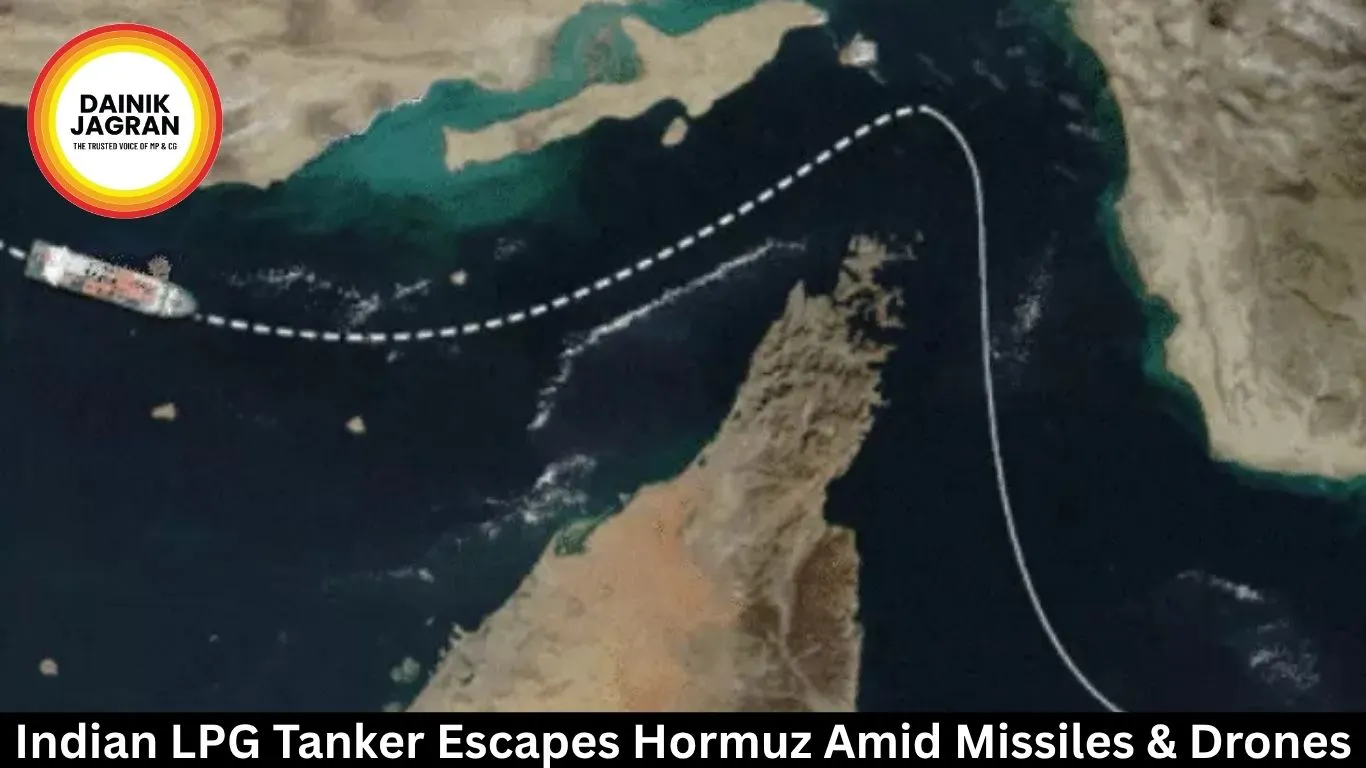
Indian LPG Tanker Escapes Hormuz Amid Missiles & Drones
Digital Desk
Indian-flagged LPG tanker Pine Gas safely exits the Strait of Hormuz via an unusual route. Crew reports daily missiles and drones amid the 2026 Iran conflict.
Missiles overhead, mines below: How Indian LPG tanker survived Hormuz blockade
Indian-flagged vessel Pine Gas navigates high-risk ‘Larak route’ under Navy protection as regional conflict traps 3,200 ships in the Strait of Hormuz.
In a high-stakes maritime breakout, the Indian-flagged LPG tanker Pine Gas has successfully navigated the volatile Strait of Hormuz, escaping a regional blockade that has crippled global energy lanes. The vessel, carrying critical fuel supplies for India, arrived in safe waters this week after a harrowing three-week ordeal marked by daily aerial combat and the threat of sea mines.
The transit comes at a time when the region is reeling from the February 28 joint strikes by the US and Israel on Iran. According to latest news today, the Pine Gas was forced to adopt an unconventional "northern route" past Larak Island to avoid heavily mined international shipping lanes.
Crew witnessed daily combat
The ship’s 27-member Indian crew reported a "war-zone atmosphere" during their time in the Persian Gulf. Chief Officer Sohan Lal confirmed that the crew witnessed missiles and drones flying overhead on a daily basis as regional tensions escalated.
The vessel had loaded its cargo at the UAE’s Ruwais port on February 28, just as hostilities broke out. While the journey to India typically takes a week, the Pine Gas remained stranded for nearly 21 days before receiving clearance to move.
Unusual route via Larak
In a departure from standard maritime protocols, Iran’s Islamic Revolutionary Guard Corps (IRGC) directed the tanker to navigate a narrow channel north of Larak Island. Sources indicated that the IRGC recommended this path because the primary Hormuz passage was reportedly littered with sea mines.
Crucially, the crew noted that the IRGC did not board the vessel, nor was any transit fee charged. This bypass was essential for the vessel's survival as standard routes became impassable for commercial traffic.
Operation Sankalp in action
The Indian Navy played a pivotal role in the rescue, providing a 20-hour continuous escort from the Gulf of Oman to the Arabian Sea. This mission falls under the long-standing Operation Sankalp, which secures sea lanes for Indian-flagged vessels.
Government updates confirmed that the Navy has intensified its presence in the region. Apart from Pine Gas, three other vessels—Shivalik, Nanda Devi, and Jag Laadki—have been safely brought back to Indian waters under naval protection.
Maritime emergency hits trade
The International Maritime Organization (IMO) has officially declared the situation a "maritime emergency." Reports suggest approximately 3,200 vessels remain trapped within the Persian Gulf, unable to navigate the 33-kilometre-wide chokepoint.
The disruption is a significant blow to global energy stability. About 20% of the world’s oil and gas trade passes through the Strait, and for India, the stakes are even higher given its heavy reliance on Gulf suppliers.
India’s energy security risk
The crisis highlights a growing vulnerability in India’s energy map. In the 2024-25 period, 92% of India’s LPG imports originated from four Gulf nations: UAE, Qatar, Saudi Arabia, and Kuwait.
With the UAE now supplying over 40% of India's LPG, any prolonged closure of the Hormuz Strait poses a direct threat to domestic supply chains. This English News Portal India report notes that while demand has surged due to schemes like Ujjwala Yojana, domestic production remains stagnant.
Rising domestic gas demand
Data shows India imported 20.67 million tonnes of LPG in 2024-25, a 40% jump from five years ago. Meanwhile, domestic production has hovered around 12.8 million tonnes, failing to keep pace with the 330 million active gas connections across the country.
As the conflict persists, the Ministry of External Affairs and the Indian Navy remain on high alert. This public interest story will continue to evolve as officials monitor the remaining Indian vessels still awaiting safe passage through the world’s most dangerous waterway.

--------
🚨 Beat the News Rush – Join Now!
Get breaking alerts, hot exclusives, and game-changing stories instantly on your phone. No delays, no fluff – just the edge you need. ⚡
Tap to join:
🟢 WhatsApp Channel: Dainik Jagran MP CG
Crave more?
🅕 Facebook: Dainik Jagran MP CG English
🅧 Twitter (X): Dainik Jagran MP CG
🅘 Instagram: Dainik Jagran MP CG
Share the fire – keep your crew ahead! 🗞️🔥
Indian LPG Tanker Escapes Hormuz Amid Missiles & Drones
Digital Desk
Missiles overhead, mines below: How Indian LPG tanker survived Hormuz blockade
Indian-flagged vessel Pine Gas navigates high-risk ‘Larak route’ under Navy protection as regional conflict traps 3,200 ships in the Strait of Hormuz.
In a high-stakes maritime breakout, the Indian-flagged LPG tanker Pine Gas has successfully navigated the volatile Strait of Hormuz, escaping a regional blockade that has crippled global energy lanes. The vessel, carrying critical fuel supplies for India, arrived in safe waters this week after a harrowing three-week ordeal marked by daily aerial combat and the threat of sea mines.
The transit comes at a time when the region is reeling from the February 28 joint strikes by the US and Israel on Iran. According to latest news today, the Pine Gas was forced to adopt an unconventional "northern route" past Larak Island to avoid heavily mined international shipping lanes.
Crew witnessed daily combat
The ship’s 27-member Indian crew reported a "war-zone atmosphere" during their time in the Persian Gulf. Chief Officer Sohan Lal confirmed that the crew witnessed missiles and drones flying overhead on a daily basis as regional tensions escalated.
The vessel had loaded its cargo at the UAE’s Ruwais port on February 28, just as hostilities broke out. While the journey to India typically takes a week, the Pine Gas remained stranded for nearly 21 days before receiving clearance to move.
Unusual route via Larak
In a departure from standard maritime protocols, Iran’s Islamic Revolutionary Guard Corps (IRGC) directed the tanker to navigate a narrow channel north of Larak Island. Sources indicated that the IRGC recommended this path because the primary Hormuz passage was reportedly littered with sea mines.
Crucially, the crew noted that the IRGC did not board the vessel, nor was any transit fee charged. This bypass was essential for the vessel's survival as standard routes became impassable for commercial traffic.
Operation Sankalp in action
The Indian Navy played a pivotal role in the rescue, providing a 20-hour continuous escort from the Gulf of Oman to the Arabian Sea. This mission falls under the long-standing Operation Sankalp, which secures sea lanes for Indian-flagged vessels.
Government updates confirmed that the Navy has intensified its presence in the region. Apart from Pine Gas, three other vessels—Shivalik, Nanda Devi, and Jag Laadki—have been safely brought back to Indian waters under naval protection.
Maritime emergency hits trade
The International Maritime Organization (IMO) has officially declared the situation a "maritime emergency." Reports suggest approximately 3,200 vessels remain trapped within the Persian Gulf, unable to navigate the 33-kilometre-wide chokepoint.
The disruption is a significant blow to global energy stability. About 20% of the world’s oil and gas trade passes through the Strait, and for India, the stakes are even higher given its heavy reliance on Gulf suppliers.
India’s energy security risk
The crisis highlights a growing vulnerability in India’s energy map. In the 2024-25 period, 92% of India’s LPG imports originated from four Gulf nations: UAE, Qatar, Saudi Arabia, and Kuwait.
With the UAE now supplying over 40% of India's LPG, any prolonged closure of the Hormuz Strait poses a direct threat to domestic supply chains. This English News Portal India report notes that while demand has surged due to schemes like Ujjwala Yojana, domestic production remains stagnant.
Rising domestic gas demand
Data shows India imported 20.67 million tonnes of LPG in 2024-25, a 40% jump from five years ago. Meanwhile, domestic production has hovered around 12.8 million tonnes, failing to keep pace with the 330 million active gas connections across the country.
As the conflict persists, the Ministry of External Affairs and the Indian Navy remain on high alert. This public interest story will continue to evolve as officials monitor the remaining Indian vessels still awaiting safe passage through the world’s most dangerous waterway.