

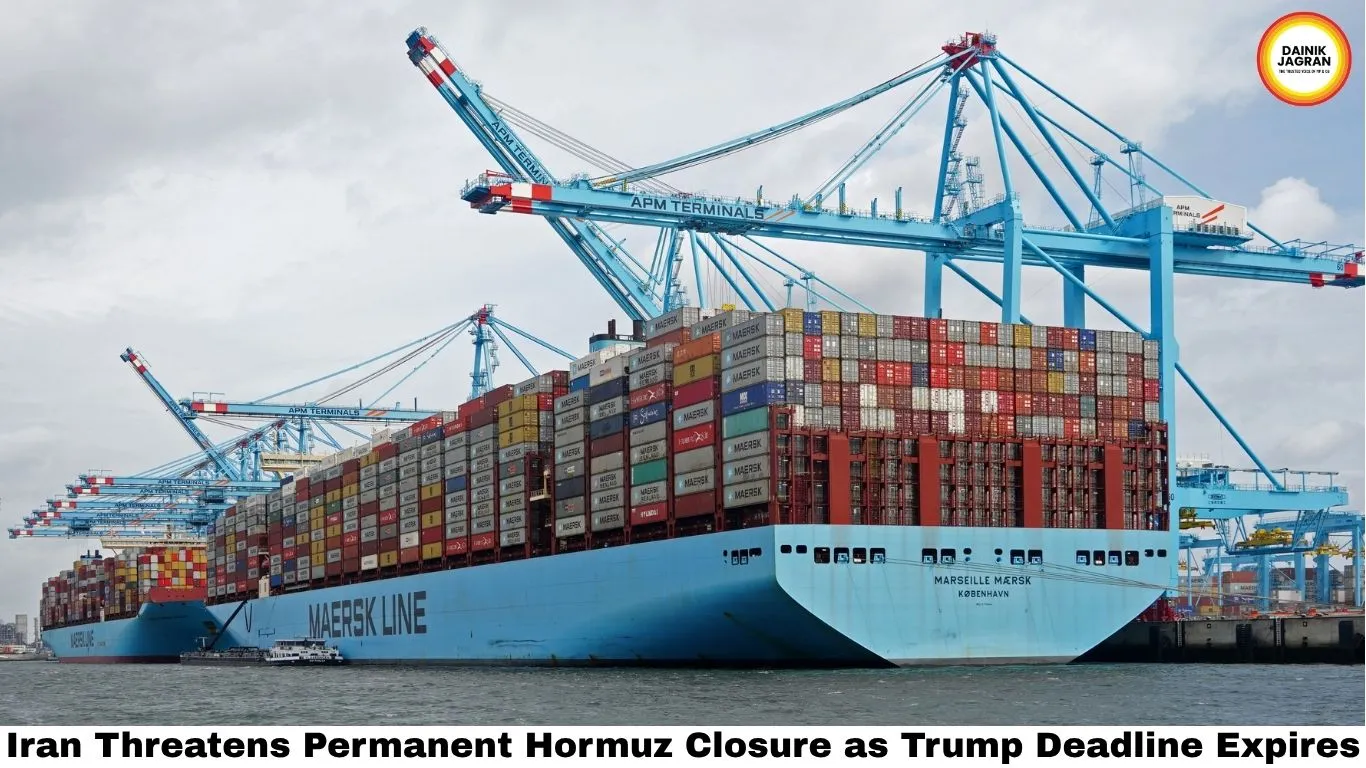
Iran Threatens Permanent Hormuz Closure as Trump Deadline Expires

Digital Desk

Iran Threatens Permanent Hormuz Closure as Trump Deadline Expires

Iran's IRGC vows to permanently close the Strait of Hormuz and strike all US-linked energy infrastructure if Trump bombs power plants — as Day 23 of the US-Israel-Iran war sees Asian markets crash and oil hit $114.

Day 23: Iran Threatens to Permanently Close Strait and Destroy Regional Infrastructure as Trump's Ultimatum Expires

As Trump's 48-hour power plant ultimatum runs out Monday evening, Iran's IRGC vows to completely shut the Strait of Hormuz, strike all US-linked energy infrastructure across the Gulf, and target Israeli power plants — while Asian markets crash and oil crosses $114.


The Deadline That Changed Everything

Monday, March 23, 2026. The 48-hour ultimatum issued by President Donald Trump — reopen the Strait of Hormuz or face the obliteration of Iran's power plants — expires at 7:44 pm ET. As the deadline approached, Iran did not blink. It escalated.

Iran's Islamic Revolutionary Guard Corps issued a formal military statement that if Iranian power plants are struck, Israeli power plants will be targeted, along with electricity infrastructure of every regional country hosting US military bases, and all economic, industrial and energy infrastructure in which Americans hold financial stakes. Iran's Parliament Speaker went further — warning that vital infrastructure across the entire Middle East, including desalination plants that provide drinking water to Gulf nations, could be "irreversibly destroyed." Iran's military separately announced readiness to "completely close" the Strait of Hormuz — indefinitely — if Trump's threat is executed. The strait, it said, will not reopen until any destroyed Iranian power plants are fully rebuilt.

The world is now staring at the most dangerous escalation threshold of this war.


What Happened Overnight — Strikes, Crashes, Civilian Deaths

The 24 hours leading into Monday's deadline were among the war's most violent. Israeli airstrikes launched a broad wave of attacks on Tehran — explosions were reported in the city's eastern districts. The IDF struck dozens of weapon and ballistic missile storage compounds across Iran, completed two waves of strikes in Beirut targeting Hezbollah command centres, and destroyed two major bridges over Lebanon's Litani River — effectively isolating civilians south of the river and cutting off food and medical supply routes.

In Iran, a US-Israeli airstrike hit a residential area in Urmia in the northwest, with the Iranian Red Crescent confirming rescue operations in collapsed buildings. In Khorramabad in western Iran, a separate airstrike struck a residential area — killing several people, including a child whose body was pulled from rubble. Iranian state media confirmed the strikes. Iran's death toll in the war has now surpassed 1,500, according to its health ministry.

Iran struck back. New missile and drone attacks targeted southern Israel and Tel Aviv — with dozens of people injured overnight. Iran also launched missiles toward Riyadh — Saudi Arabia intercepted one of three ballistic missiles and downed six drones headed toward its eastern region, home to major oil installations. A projectile caused an explosion near a bulk carrier off the UAE coast. Iran also launched what the UK described as ballistic missiles toward the joint US-UK base at Diego Garcia in the Indian Ocean — an attack Iran denied responsibility for.


The Numbers — 400 Missiles, 92% Interception, 1,500 Dead

The war's statistics are now staggering in their scale. Israel's military confirmed that Iran has fired over 400 ballistic missiles at Israel since February 28 — with a 92 percent interception rate by Israeli and allied air defence systems. That means roughly 32 ballistic missiles have successfully struck Israeli territory in 23 days. In Israel, 15 people have been killed by Iranian strikes. Iran's death toll exceeds 1,500. Dozens of civilians in Gulf Arab states and the occupied West Bank have also been killed in spillover strikes.

US Central Command confirmed it has now struck over 8,000 military targets in Iran since the war began — including 130 vessels. The US military also dropped multiple 5,000-pound bunker-buster bombs on an underground facility along Iran's coast used to store anti-ship missiles — a direct move to protect Gulf shipping access.


Markets in Freefall — Asia Opens Monday in Panic

The financial markets have delivered their verdict on what a permanent Hormuz closure would mean for the global economy. Asian stocks opened Monday in sharp decline. Japan's Nikkei 225 fell 3.5 percent. South Korea's Kospi plunged 4.9 percent. Hong Kong's Hang Seng shed 2.7 percent. Taiwan's index fell sharply. Oil prices continued their surge — Brent crude climbing to $114.09 per barrel, while US crude crossed $100 per barrel for the first time in years. Goldman Sachs warned Friday that elevated oil prices could persist through 2027. The global economy is now pricing in the possibility that the Strait of Hormuz may not reopen this year.


Iran's Ultimatum to the World — Desalination Plants on the Target List

The most alarming element of Iran's counter-ultimatum is the inclusion of desalination plants in its list of legitimate targets. The Gulf states — Saudi Arabia, UAE, Qatar, Kuwait, Bahrain — depend on desalination for the majority of their drinking water. Striking desalination infrastructure would not merely damage energy economics. It would threaten the survival of civilian populations across some of the world's wealthiest countries. Iran's Parliament Speaker specified these facilities by name. It was not an accidental inclusion. It was a calibrated signal that Iran is prepared to take this war to a level of civilian suffering that has no precedent in the modern Gulf.


Saudi Arabia Expels Iranian Diplomats

Saudi Arabia took a dramatic diplomatic step over the weekend — declaring Iran's military attaché, his deputy, and three other Iranian embassy staff members persona non grata and ordering them to leave the kingdom within 24 hours. The move follows weeks of Iranian missile and drone attacks on Saudi territory. Riyadh cited Iran's "continuing flagrant attacks" as justification. The expulsion effectively ends whatever remained of the back-channel communication between the two countries and signals that Saudi Arabia's patience with Iranian aggression has run out.


Lebanon on the Brink

Israel's destruction of two bridges over the Litani River in Lebanon has added a new and alarming front to the conflict. Lebanese President Joseph Aoun condemned the strikes as a prelude to a ground invasion and a clear violation of Lebanon's sovereignty. The Israeli Defense Minister confirmed that the military will accelerate demolition of homes along the southern Lebanese border. The bridge destruction has cut food and medical supply routes to civilians south of the Litani — a humanitarian crisis now developing alongside the military one.


Netanyahu Calls on World Leaders to Join the War

Standing in the rubble of Arad — the city hit by Iran's missiles on Saturday night — Israeli Prime Minister Netanyahu made a direct public appeal to world leaders to join the US-Israel war on Iran. He claimed some countries were already moving in that direction. He described Iran as a regime that endangers the entire world and accused Tehran of attempting mass murder against civilians. He also warned that Iran has demonstrated the capability to strike long-range targets deep into Europe — a claim that, if accurate, fundamentally reshapes the threat calculus for NATO member states.


What Comes Next — The Most Dangerous Hours of the War

Trump's deadline expires Monday evening. The options before him are stark. Strike Iran's power plants — and trigger the IRGC's vowed retaliation against every US-linked energy asset in the Gulf, the permanent closure of the Strait, and a catastrophic escalation that could plunge the global economy into recession within weeks. Or step back — and face a domestic and international audience that watched him issue a red line that Iran called his bluff on.

Neither option is clean. Both carry consequences that will define the next phase of this war — and the global energy and economic order for years to co

--------

🚨 Beat the News Rush – Join Now!

Get breaking alerts, hot exclusives, and game-changing stories instantly on your phone. No delays, no fluff – just the edge you need. ⚡

Tap to join: 

🟢 WhatsApp Channel: Dainik Jagran MP CG

Crave more?

🅕 Facebook: Dainik Jagran MP CG English

🅧 Twitter (X): Dainik Jagran MP CG

🅘 Instagram: Dainik Jagran MP CG

Share the fire – keep your crew ahead! 🗞️🔥

english.dainikjagranmpcg.com
23 Mar 2026 By Jiya.S

Iran Threatens Permanent Hormuz Closure as Trump Deadline Expires

Digital Desk

Day 23: Iran Threatens to Permanently Close Strait and Destroy Regional Infrastructure as Trump's Ultimatum Expires

As Trump's 48-hour power plant ultimatum runs out Monday evening, Iran's IRGC vows to completely shut the Strait of Hormuz, strike all US-linked energy infrastructure across the Gulf, and target Israeli power plants — while Asian markets crash and oil crosses $114.


The Deadline That Changed Everything

Monday, March 23, 2026. The 48-hour ultimatum issued by President Donald Trump — reopen the Strait of Hormuz or face the obliteration of Iran's power plants — expires at 7:44 pm ET. As the deadline approached, Iran did not blink. It escalated.

Iran's Islamic Revolutionary Guard Corps issued a formal military statement that if Iranian power plants are struck, Israeli power plants will be targeted, along with electricity infrastructure of every regional country hosting US military bases, and all economic, industrial and energy infrastructure in which Americans hold financial stakes. Iran's Parliament Speaker went further — warning that vital infrastructure across the entire Middle East, including desalination plants that provide drinking water to Gulf nations, could be "irreversibly destroyed." Iran's military separately announced readiness to "completely close" the Strait of Hormuz — indefinitely — if Trump's threat is executed. The strait, it said, will not reopen until any destroyed Iranian power plants are fully rebuilt.

The world is now staring at the most dangerous escalation threshold of this war.


What Happened Overnight — Strikes, Crashes, Civilian Deaths

The 24 hours leading into Monday's deadline were among the war's most violent. Israeli airstrikes launched a broad wave of attacks on Tehran — explosions were reported in the city's eastern districts. The IDF struck dozens of weapon and ballistic missile storage compounds across Iran, completed two waves of strikes in Beirut targeting Hezbollah command centres, and destroyed two major bridges over Lebanon's Litani River — effectively isolating civilians south of the river and cutting off food and medical supply routes.

In Iran, a US-Israeli airstrike hit a residential area in Urmia in the northwest, with the Iranian Red Crescent confirming rescue operations in collapsed buildings. In Khorramabad in western Iran, a separate airstrike struck a residential area — killing several people, including a child whose body was pulled from rubble. Iranian state media confirmed the strikes. Iran's death toll in the war has now surpassed 1,500, according to its health ministry.

Iran struck back. New missile and drone attacks targeted southern Israel and Tel Aviv — with dozens of people injured overnight. Iran also launched missiles toward Riyadh — Saudi Arabia intercepted one of three ballistic missiles and downed six drones headed toward its eastern region, home to major oil installations. A projectile caused an explosion near a bulk carrier off the UAE coast. Iran also launched what the UK described as ballistic missiles toward the joint US-UK base at Diego Garcia in the Indian Ocean — an attack Iran denied responsibility for.


The Numbers — 400 Missiles, 92% Interception, 1,500 Dead

The war's statistics are now staggering in their scale. Israel's military confirmed that Iran has fired over 400 ballistic missiles at Israel since February 28 — with a 92 percent interception rate by Israeli and allied air defence systems. That means roughly 32 ballistic missiles have successfully struck Israeli territory in 23 days. In Israel, 15 people have been killed by Iranian strikes. Iran's death toll exceeds 1,500. Dozens of civilians in Gulf Arab states and the occupied West Bank have also been killed in spillover strikes.

US Central Command confirmed it has now struck over 8,000 military targets in Iran since the war began — including 130 vessels. The US military also dropped multiple 5,000-pound bunker-buster bombs on an underground facility along Iran's coast used to store anti-ship missiles — a direct move to protect Gulf shipping access.


Markets in Freefall — Asia Opens Monday in Panic

The financial markets have delivered their verdict on what a permanent Hormuz closure would mean for the global economy. Asian stocks opened Monday in sharp decline. Japan's Nikkei 225 fell 3.5 percent. South Korea's Kospi plunged 4.9 percent. Hong Kong's Hang Seng shed 2.7 percent. Taiwan's index fell sharply. Oil prices continued their surge — Brent crude climbing to $114.09 per barrel, while US crude crossed $100 per barrel for the first time in years. Goldman Sachs warned Friday that elevated oil prices could persist through 2027. The global economy is now pricing in the possibility that the Strait of Hormuz may not reopen this year.


Iran's Ultimatum to the World — Desalination Plants on the Target List

The most alarming element of Iran's counter-ultimatum is the inclusion of desalination plants in its list of legitimate targets. The Gulf states — Saudi Arabia, UAE, Qatar, Kuwait, Bahrain — depend on desalination for the majority of their drinking water. Striking desalination infrastructure would not merely damage energy economics. It would threaten the survival of civilian populations across some of the world's wealthiest countries. Iran's Parliament Speaker specified these facilities by name. It was not an accidental inclusion. It was a calibrated signal that Iran is prepared to take this war to a level of civilian suffering that has no precedent in the modern Gulf.


Saudi Arabia Expels Iranian Diplomats

Saudi Arabia took a dramatic diplomatic step over the weekend — declaring Iran's military attaché, his deputy, and three other Iranian embassy staff members persona non grata and ordering them to leave the kingdom within 24 hours. The move follows weeks of Iranian missile and drone attacks on Saudi territory. Riyadh cited Iran's "continuing flagrant attacks" as justification. The expulsion effectively ends whatever remained of the back-channel communication between the two countries and signals that Saudi Arabia's patience with Iranian aggression has run out.


Lebanon on the Brink

Israel's destruction of two bridges over the Litani River in Lebanon has added a new and alarming front to the conflict. Lebanese President Joseph Aoun condemned the strikes as a prelude to a ground invasion and a clear violation of Lebanon's sovereignty. The Israeli Defense Minister confirmed that the military will accelerate demolition of homes along the southern Lebanese border. The bridge destruction has cut food and medical supply routes to civilians south of the Litani — a humanitarian crisis now developing alongside the military one.


Netanyahu Calls on World Leaders to Join the War

Standing in the rubble of Arad — the city hit by Iran's missiles on Saturday night — Israeli Prime Minister Netanyahu made a direct public appeal to world leaders to join the US-Israel war on Iran. He claimed some countries were already moving in that direction. He described Iran as a regime that endangers the entire world and accused Tehran of attempting mass murder against civilians. He also warned that Iran has demonstrated the capability to strike long-range targets deep into Europe — a claim that, if accurate, fundamentally reshapes the threat calculus for NATO member states.


What Comes Next — The Most Dangerous Hours of the War

Trump's deadline expires Monday evening. The options before him are stark. Strike Iran's power plants — and trigger the IRGC's vowed retaliation against every US-linked energy asset in the Gulf, the permanent closure of the Strait, and a catastrophic escalation that could plunge the global economy into recession within weeks. Or step back — and face a domestic and international audience that watched him issue a red line that Iran called his bluff on.

Neither option is clean. Both carry consequences that will define the next phase of this war — and the global energy and economic order for years to co

https://english.dainikjagranmpcg.com/international/iran-threatens-permanent-hormuz-closure-as-trump-deadline-expires/article-15835

Related Posts

Latest News


