


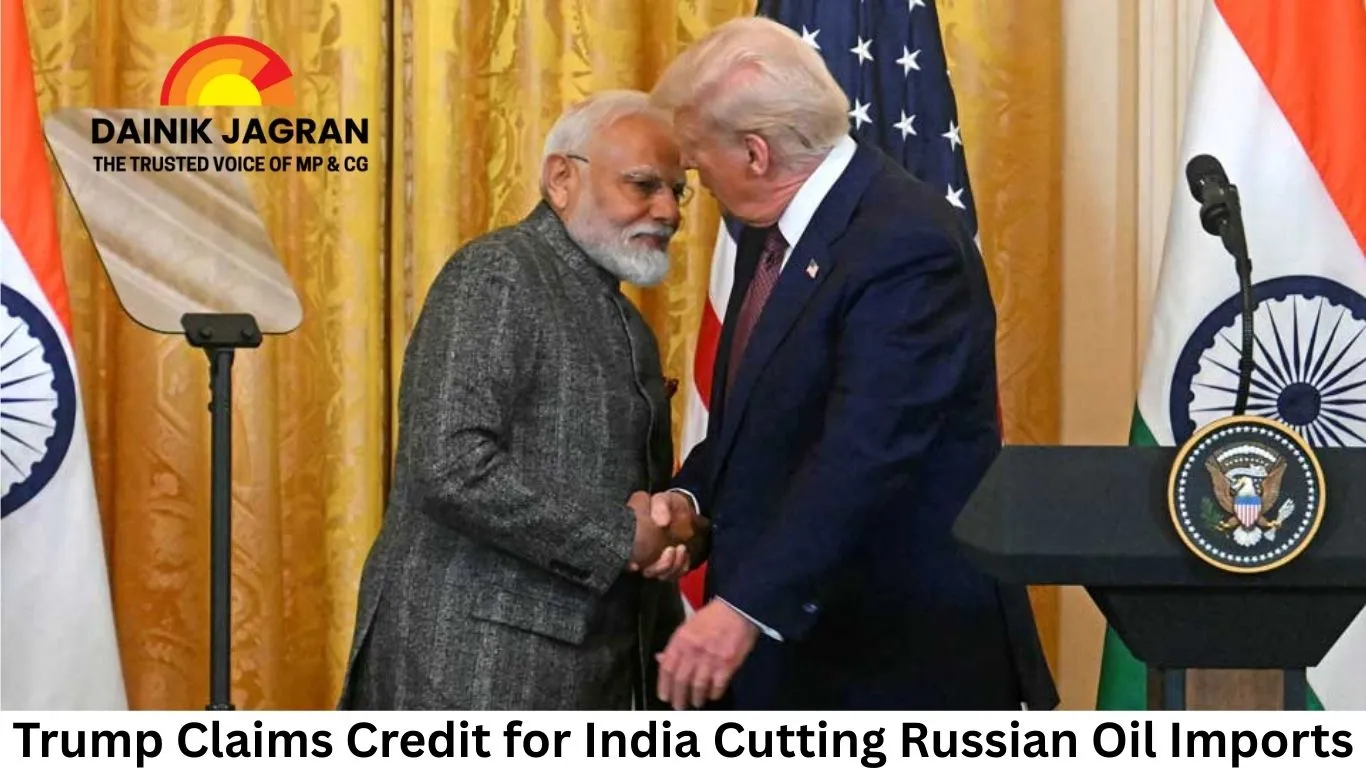
Trump Claims Credit for India Cutting Russian Oil Imports, Signals Possible Tariff Escalation
Digital Desk
Speaking during a late-night interaction with reporters, Trump said Prime Minister Narendra Modi acted after sensing Washington’s displeasure over India’s continued purchases of Russian oil following the Ukraine war. “They wanted to please me. Prime Minister Modi is a very good person. He knew I wasn’t happy, so it was important to make me happy,” Trump said, adding that the US could “raise tariffs” as part of its trade leverage.
The remarks come as India records its first significant reduction in Russian crude imports since 2021. According to data cited by Reuters, India’s imports from Russia fell from about 1.77 million barrels per day in November to nearly 1.2 million barrels per day in December. Market analysts expect the figure to drop further, possibly below one million barrels per day, when January data is released.
India had emerged as Russia’s largest oil buyer after Western sanctions followed Moscow’s invasion of Ukraine. US officials repeatedly argued that large-scale Indian purchases were indirectly supporting Russia’s war effort. In response, the Trump administration imposed a 25 percent tariff on Indian goods, linking it directly to New Delhi’s energy trade with Moscow.
The decline in Russian oil imports has also been influenced by market dynamics. After the Ukraine conflict began, Russia offered steep discounts of $20–25 per barrel when global crude prices were hovering near $130. With international prices now around $63 per barrel, discounts have narrowed sharply to about $1.5–2 per barrel, eroding the commercial advantage for Indian refiners. Higher shipping and insurance costs associated with Russian supplies have further reduced their attractiveness.
As a result, India has increasingly turned back to traditional suppliers such as Saudi Arabia, the United Arab Emirates and the United States, where pricing stability and lower logistical risks now outweigh marginal cost differences.
Trade tensions remain a key pressure point in bilateral ties. The US has imposed a cumulative 50 percent tariff on certain Indian exports—25 percent as a reciprocal tariff and an additional 25 percent linked to Russian oil purchases. Indian exporters have flagged adverse impacts on shipments to the US, one of India’s largest overseas markets.
Negotiations on a broader trade agreement are ongoing. India is seeking a reduction of the total tariff burden to 15 percent and the complete withdrawal of the oil-related penalty. Officials on both sides have indicated that talks are continuing, with expectations of greater clarity in the coming months.
Trump’s comments underline how energy decisions and trade policy remain closely intertwined in US–India relations, with future tariff actions likely to depend on both geopolitical alignments and commercial outcomes.
.jpg)




