

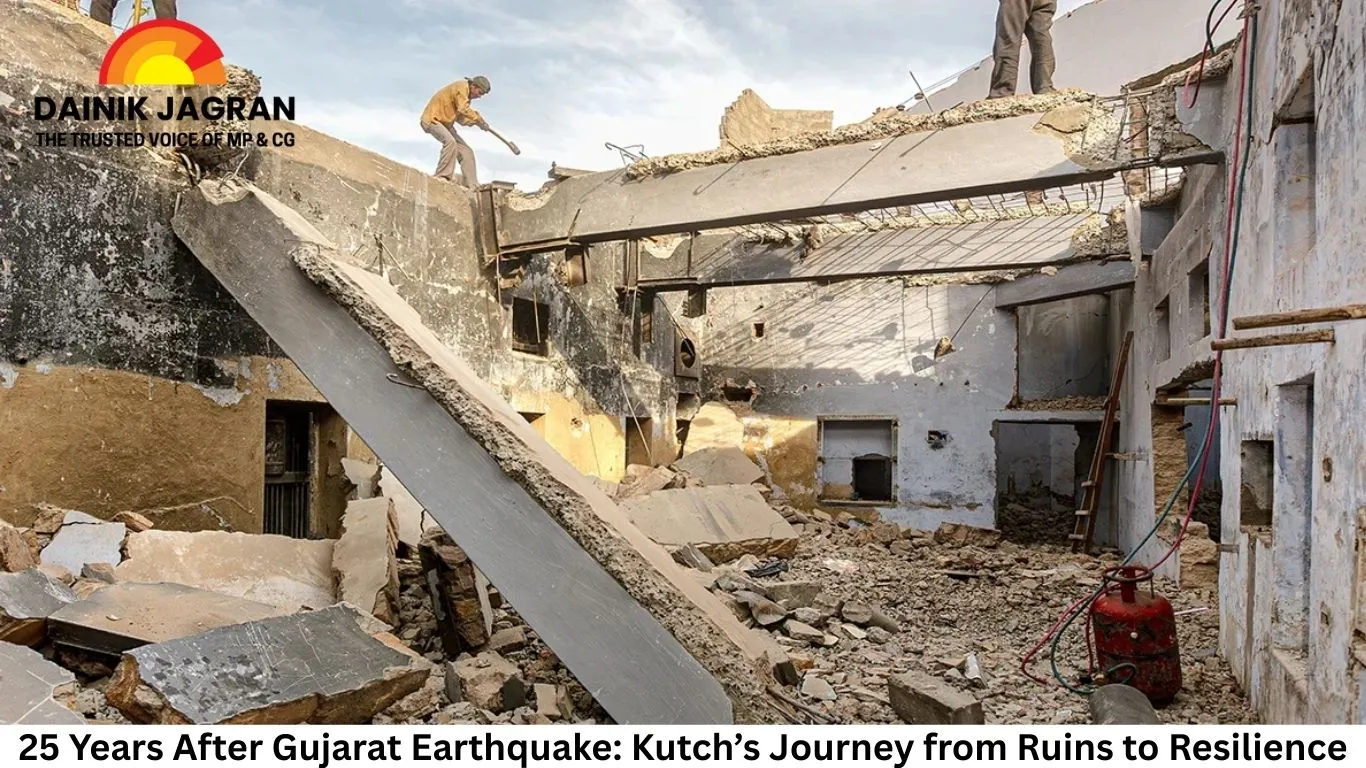
25 Years After Gujarat Earthquake: Kutch’s Journey from Ruins to Resilience
Digital Desk
January 26, 2001, marked one of the deadliest disasters in India’s recent history when a 7.7-magnitude earthquake struck Bhuj in Gujarat’s Kutch district. The tremors were felt up to 700 km away, claiming over 12,000 lives and leaving nearly 6 lakh people homeless. Entire villages were reduced to rubble, and the scale of destruction raised doubts about Kutch’s ability to recover. However, over the next two decades, the determined efforts of individuals and policymakers helped transform the region.
Leadership and Vision Post-Disaster
Eight months after the earthquake, Narendra Modi assumed office as Gujarat’s Chief Minister on October 3, 2001. Focusing on infrastructure, water management, industry, and tourism, he spearheaded Kutch’s revival. Thousands of homes were rebuilt, water scarcity addressed through Narmada canal projects, and industrial incentives were introduced, turning Kutch into one of Asia’s major industrial hubs. The launch of the Rann Utsav in 2005 further cemented Kutch’s identity as a global tourism destination.
Bipin Bhatt: City Planning Pioneer
Bipin Bhatt, then CEO of the Bhuj Urban Development Authority, played a pivotal role in city reconstruction. Bhatt prepared a blueprint for Bhuj’s redevelopment on an apartment model, replacing narrow, congested lanes with wide roads and organized town planning. In recognition of his contributions, a town—Bipin Bhatt Nagar—was named in his honor, a rare tribute to an administrative officer in Kutch’s history.
Suresh Mehta and Industrial Transformation
Former Gujarat Chief Minister and then Industry Minister Suresh Mehta ensured Kutch received a special industrial package, declaring it a tax-holiday zone. This encouraged major companies like Adani, Tata, and Welspun to invest, creating thousands of jobs. Mehta also pushed for railway expansion to Bhuj, improving connectivity to previously isolated areas like Khavda.
Humanitarian Efforts Amid Tragedy
The disaster demanded extraordinary human compassion. Rasik Thakkar, president of the Lohana community, stayed at Bhuj’s crematorium for 18 days, personally performing last rites for over 900 earthquake victims. Late MP Anant Dave, arriving from Delhi, set up a langar and community programs, staying in Bhuj for 15 days to provide relief and uplift morale.
Pushpdan Gadhvi: Infrastructure Development
Pushpdan Gadhvi, former MP, accelerated development initiatives including the modernization of Kutch General Hospital to AIIMS-level standards and the development of Mundra Port. These measures attracted further industrial investment, creating a sustainable foundation for economic revival.
Twenty-five years on, Kutch stands as a symbol of resilience, showcasing how visionary leadership and humanitarian efforts can rebuild lives from devastation.
--------
🚨 Beat the News Rush – Join Now!
Get breaking alerts, hot exclusives, and game-changing stories instantly on your phone. No delays, no fluff – just the edge you need. ⚡
Tap to join:
🟢 WhatsApp Channel: Dainik Jagran MP CG
Crave more?
🅕 Facebook: Dainik Jagran MP CG English
🅧 Twitter (X): Dainik Jagran MP CG
🅘 Instagram: Dainik Jagran MP CG
Share the fire – keep your crew ahead! 🗞️🔥
25 Years After Gujarat Earthquake: Kutch’s Journey from Ruins to Resilience
Digital Desk
Leadership and Vision Post-Disaster
Eight months after the earthquake, Narendra Modi assumed office as Gujarat’s Chief Minister on October 3, 2001. Focusing on infrastructure, water management, industry, and tourism, he spearheaded Kutch’s revival. Thousands of homes were rebuilt, water scarcity addressed through Narmada canal projects, and industrial incentives were introduced, turning Kutch into one of Asia’s major industrial hubs. The launch of the Rann Utsav in 2005 further cemented Kutch’s identity as a global tourism destination.
Bipin Bhatt: City Planning Pioneer
Bipin Bhatt, then CEO of the Bhuj Urban Development Authority, played a pivotal role in city reconstruction. Bhatt prepared a blueprint for Bhuj’s redevelopment on an apartment model, replacing narrow, congested lanes with wide roads and organized town planning. In recognition of his contributions, a town—Bipin Bhatt Nagar—was named in his honor, a rare tribute to an administrative officer in Kutch’s history.
Suresh Mehta and Industrial Transformation
Former Gujarat Chief Minister and then Industry Minister Suresh Mehta ensured Kutch received a special industrial package, declaring it a tax-holiday zone. This encouraged major companies like Adani, Tata, and Welspun to invest, creating thousands of jobs. Mehta also pushed for railway expansion to Bhuj, improving connectivity to previously isolated areas like Khavda.
Humanitarian Efforts Amid Tragedy
The disaster demanded extraordinary human compassion. Rasik Thakkar, president of the Lohana community, stayed at Bhuj’s crematorium for 18 days, personally performing last rites for over 900 earthquake victims. Late MP Anant Dave, arriving from Delhi, set up a langar and community programs, staying in Bhuj for 15 days to provide relief and uplift morale.
Pushpdan Gadhvi: Infrastructure Development
Pushpdan Gadhvi, former MP, accelerated development initiatives including the modernization of Kutch General Hospital to AIIMS-level standards and the development of Mundra Port. These measures attracted further industrial investment, creating a sustainable foundation for economic revival.
Twenty-five years on, Kutch stands as a symbol of resilience, showcasing how visionary leadership and humanitarian efforts can rebuild lives from devastation.


