

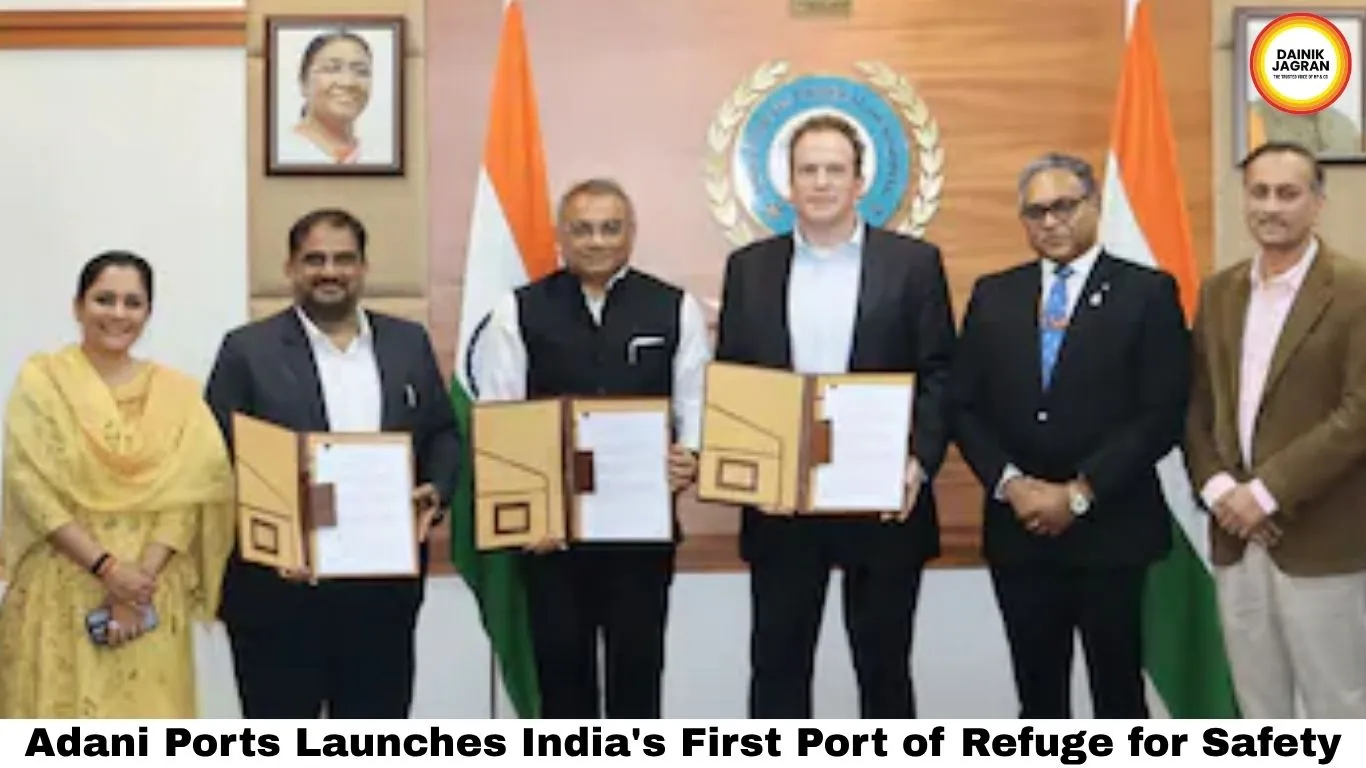
Adani Ports Launches India's First Port of Refuge for Safety
Digital Desk
APSEZ operationalises India's first Port of Refuge at Dighi and Gopalpur ports, backed by a tripartite MoU with SMIT Salvage and MERC for maritime emergency response.
A Long-Overdue First
India has finally joined the ranks of the world's major maritime nations. Adani Ports and Special Economic Zone Ltd (APSEZ) has operationalised India's first Port of Refuge (PoR), addressing a longstanding gap in maritime emergency infrastructure by creating a structured mechanism to handle maritime emergencies and vessels in distress.
The announcement, made on March 27, marks a turning point for a country that controls one of the world's longest coastlines yet had no formalised emergency refuge system in place — until now.
What Is a Port of Refuge?
As defined by the International Maritime Organization, a Port of Refuge is a designated place where ships can seek shelter during emergencies to stabilise conditions, protect lives, and reduce environmental damage. While such systems are standard practice among major maritime nations, India lacked a formal framework — a gap that has now been decisively addressed.
The absence of such a mechanism had long been flagged as a structural vulnerability, given India's strategic position along some of the world's busiest trade corridors.
Two Ports, One System
India's new PoR is not a single port but a two-port system functioning as a unified Port of Refuge, strengthening maritime emergency response across both the eastern and western coasts.
APSEZ has designated two sites under this framework — Dighi Port on the west coast, supporting vessel traffic across the Arabian Sea and routes to the Persian Gulf, and Gopalpur Port on the east coast, serving ships navigating the Bay of Bengal and routes towards the Malacca Strait, one of the world's most critical maritime trade corridors.
The facilities will provide a full suite of emergency services including salvage and wreck removal, firefighting, pollution containment, and emergency coordination through specialised equipment and trained response teams.
Global Partners Brought In
The initiative draws on world-class international expertise. APSEZ has signed a tripartite Memorandum of Understanding with SMIT Salvage — the salvage and emergency response division of Royal Boskalis Westminster N.V. — and the Maritime Emergency Response Centre (MERC), bringing global operational capability into the framework.
The system will support vessels insured under the International Group of Protection and Indemnity (P&I) Clubs, aligning India's new mechanism with established global maritime risk and liability standards.
What Triggered the Urgency
The timing of this development is not incidental. On March 1, India granted refuge to the Iranian Navy ship IRIS Lavan at Kochi port after it reported technical difficulties amid rising Iran-US tensions. The vessel's 183 crew members were accommodated at naval facilities following docking on March 4.
That incident — managed entirely on an ad hoc basis — exposed the absence of any formalised response protocol and underlined how urgently India needed a structured framework rather than case-by-case diplomatic improvisation.
Voices From the Top
APSEZ CEO Ashwani Gupta described the move as both a commercial and moral milestone. "Ports connect economies — but a Port of Refuge protects lives," he said, adding that the initiative sets a new benchmark for coastal safety in India.
Director General of Shipping Shyam Jagannathan noted that a standardised Port of Refuge framework would enable more coordinated and timely action during maritime incidents, ensuring effective protection of life, cargo, and the coastal environment.
Richard Janssen of SMIT Salvage underlined the operational significance, stating that a Port of Refuge is critical in any salvage operation to ensure vessels and cargo are handled swiftly and professionally, with all materials disposed of in compliance with applicable legislation.
India's Maritime Stature Grows
APSEZ, India's largest port operator, handles nearly 27 per cent of the country's total port cargo volumes. With a coastline stretching over 11,000 kilometres and a geographic position bridging the Persian Gulf, the Bay of Bengal, and the Malacca Strait, India's maritime importance has long outpaced its emergency preparedness.
The Port of Refuge framework is expected to change that equation decisively — bringing India's response capabilities closer to international standards and reinforcing the country's stature as a responsible and major node in global shipping.
--------
🚨 Beat the News Rush – Join Now!
Get breaking alerts, hot exclusives, and game-changing stories instantly on your phone. No delays, no fluff – just the edge you need. ⚡
Tap to join:
🟢 WhatsApp Channel: Dainik Jagran MP CG
Crave more?
🅕 Facebook: Dainik Jagran MP CG English
🅧 Twitter (X): Dainik Jagran MP CG
🅘 Instagram: Dainik Jagran MP CG
Share the fire – keep your crew ahead! 🗞️🔥
Adani Ports Launches India's First Port of Refuge for Safety
Digital Desk
A Long-Overdue First
India has finally joined the ranks of the world's major maritime nations. Adani Ports and Special Economic Zone Ltd (APSEZ) has operationalised India's first Port of Refuge (PoR), addressing a longstanding gap in maritime emergency infrastructure by creating a structured mechanism to handle maritime emergencies and vessels in distress.
The announcement, made on March 27, marks a turning point for a country that controls one of the world's longest coastlines yet had no formalised emergency refuge system in place — until now.
What Is a Port of Refuge?
As defined by the International Maritime Organization, a Port of Refuge is a designated place where ships can seek shelter during emergencies to stabilise conditions, protect lives, and reduce environmental damage. While such systems are standard practice among major maritime nations, India lacked a formal framework — a gap that has now been decisively addressed.
The absence of such a mechanism had long been flagged as a structural vulnerability, given India's strategic position along some of the world's busiest trade corridors.
Two Ports, One System
India's new PoR is not a single port but a two-port system functioning as a unified Port of Refuge, strengthening maritime emergency response across both the eastern and western coasts.
APSEZ has designated two sites under this framework — Dighi Port on the west coast, supporting vessel traffic across the Arabian Sea and routes to the Persian Gulf, and Gopalpur Port on the east coast, serving ships navigating the Bay of Bengal and routes towards the Malacca Strait, one of the world's most critical maritime trade corridors.
The facilities will provide a full suite of emergency services including salvage and wreck removal, firefighting, pollution containment, and emergency coordination through specialised equipment and trained response teams.
Global Partners Brought In
The initiative draws on world-class international expertise. APSEZ has signed a tripartite Memorandum of Understanding with SMIT Salvage — the salvage and emergency response division of Royal Boskalis Westminster N.V. — and the Maritime Emergency Response Centre (MERC), bringing global operational capability into the framework.
The system will support vessels insured under the International Group of Protection and Indemnity (P&I) Clubs, aligning India's new mechanism with established global maritime risk and liability standards.
What Triggered the Urgency
The timing of this development is not incidental. On March 1, India granted refuge to the Iranian Navy ship IRIS Lavan at Kochi port after it reported technical difficulties amid rising Iran-US tensions. The vessel's 183 crew members were accommodated at naval facilities following docking on March 4.
That incident — managed entirely on an ad hoc basis — exposed the absence of any formalised response protocol and underlined how urgently India needed a structured framework rather than case-by-case diplomatic improvisation.
Voices From the Top
APSEZ CEO Ashwani Gupta described the move as both a commercial and moral milestone. "Ports connect economies — but a Port of Refuge protects lives," he said, adding that the initiative sets a new benchmark for coastal safety in India.
Director General of Shipping Shyam Jagannathan noted that a standardised Port of Refuge framework would enable more coordinated and timely action during maritime incidents, ensuring effective protection of life, cargo, and the coastal environment.
Richard Janssen of SMIT Salvage underlined the operational significance, stating that a Port of Refuge is critical in any salvage operation to ensure vessels and cargo are handled swiftly and professionally, with all materials disposed of in compliance with applicable legislation.
India's Maritime Stature Grows
APSEZ, India's largest port operator, handles nearly 27 per cent of the country's total port cargo volumes. With a coastline stretching over 11,000 kilometres and a geographic position bridging the Persian Gulf, the Bay of Bengal, and the Malacca Strait, India's maritime importance has long outpaced its emergency preparedness.
The Port of Refuge framework is expected to change that equation decisively — bringing India's response capabilities closer to international standards and reinforcing the country's stature as a responsible and major node in global shipping.


