


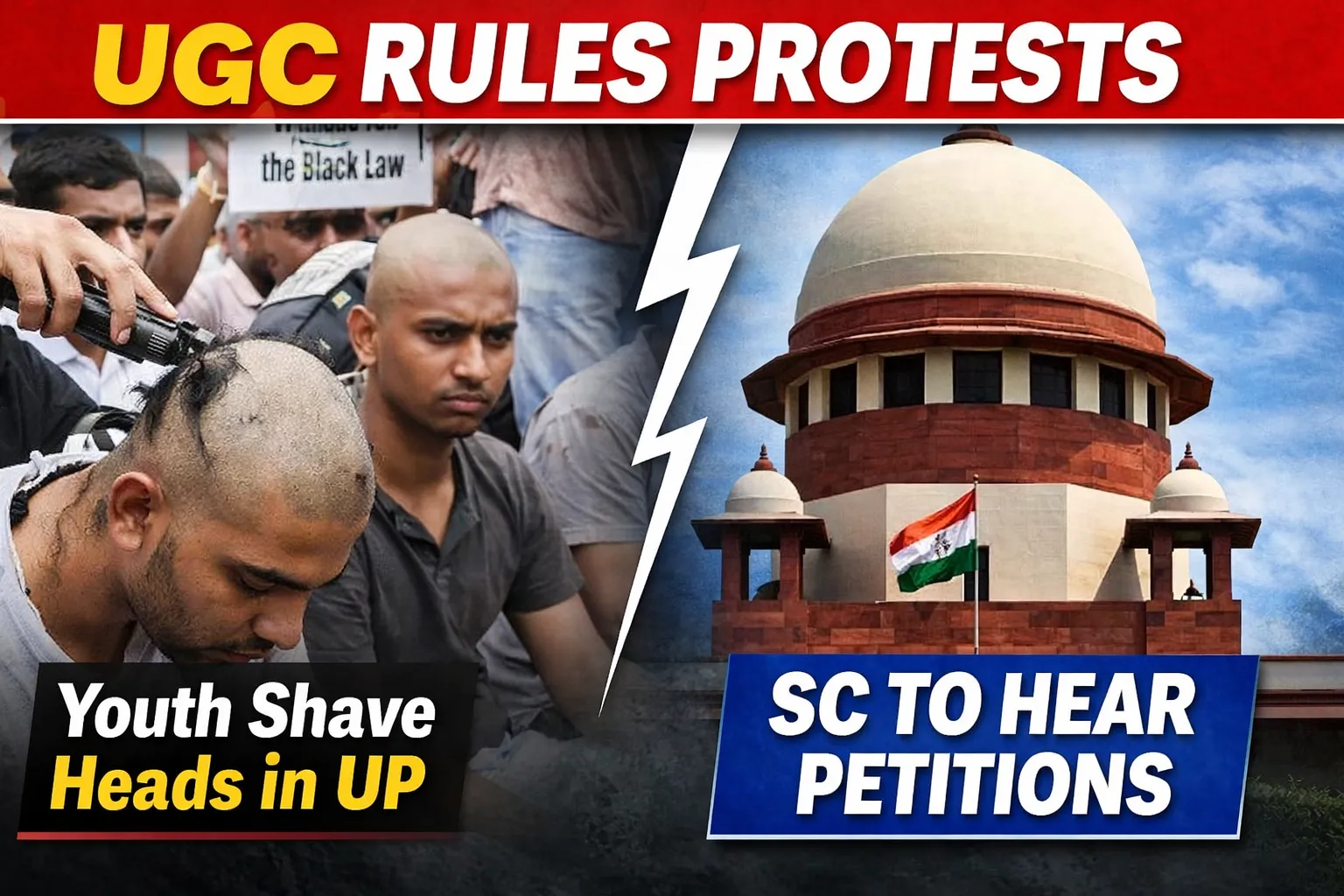
Nationwide Protests Erupt Against UGC’s New Equity Rules; Supreme Court Agrees to Hear Petitions
Digital Desk
A Bench headed by Chief Justice of India Suryakant, along with Justice Joymalya Bagchi, took note of the concerns raised by petitioners questioning the UGC’s Promotion of Equity in Higher Education Institutions Regulations, 2026. The Chief Justice observed that the court was aware of the situation and said the matter would be listed for detailed hearing, asking that perceived shortcomings in the regulations be clearly flagged.
On the ground, protests gathered momentum among students from the General Category and members of upper-caste communities. In Pilibhit, Uttar Pradesh, groups of youths shaved their heads as a symbolic mark of protest, accusing the UGC of framing rules that, they claim, single out General Category students. Demonstrations were also reported in Lucknow and Deoria, where tensions briefly flared between protesters and police during attempts to manage crowds.
In Bihar’s Patna, protesters smeared black ink on posters of Prime Minister Narendra Modi and Union Home Minister Amit Shah, while others burned posters and raised slogans demanding withdrawal of what they described as a “black law.” Protesters held placards alleging that the regulations would disturb campus harmony and create an atmosphere of fear.
The regulations, notified by the UGC on January 13, mandate that universities and colleges establish Equity Committees, helplines and monitoring mechanisms to prevent caste-based discrimination, particularly addressing grievances of Scheduled Castes (SC), Scheduled Tribes (ST) and Other Backward Classes (OBC). The government has maintained that the rules are intended to promote fairness, accountability and inclusion in higher education.
Critics, however, argue that the framework is one-sided. Several student groups from the General Category have expressed apprehension that the rules portray them as “presumptive offenders” and could be misused, potentially leading to reverse discrimination and strained academic environments.
The debate has also reached Parliament. A parliamentary standing committee on Education, Women, Children, Youth and Sports, chaired by senior Congress leader Digvijaya Singh, has recommended making Equity Committees mandatory across all higher education institutions. The panel comprises 30 members drawn from both Houses of Parliament and includes representatives from the ruling party and the opposition.
As protests continue, all eyes are now on the Supreme Court’s forthcoming hearing, which is expected to examine the constitutional validity of the regulations and balance competing concerns of social justice and equal treatment on campuses.
.jpg)




