


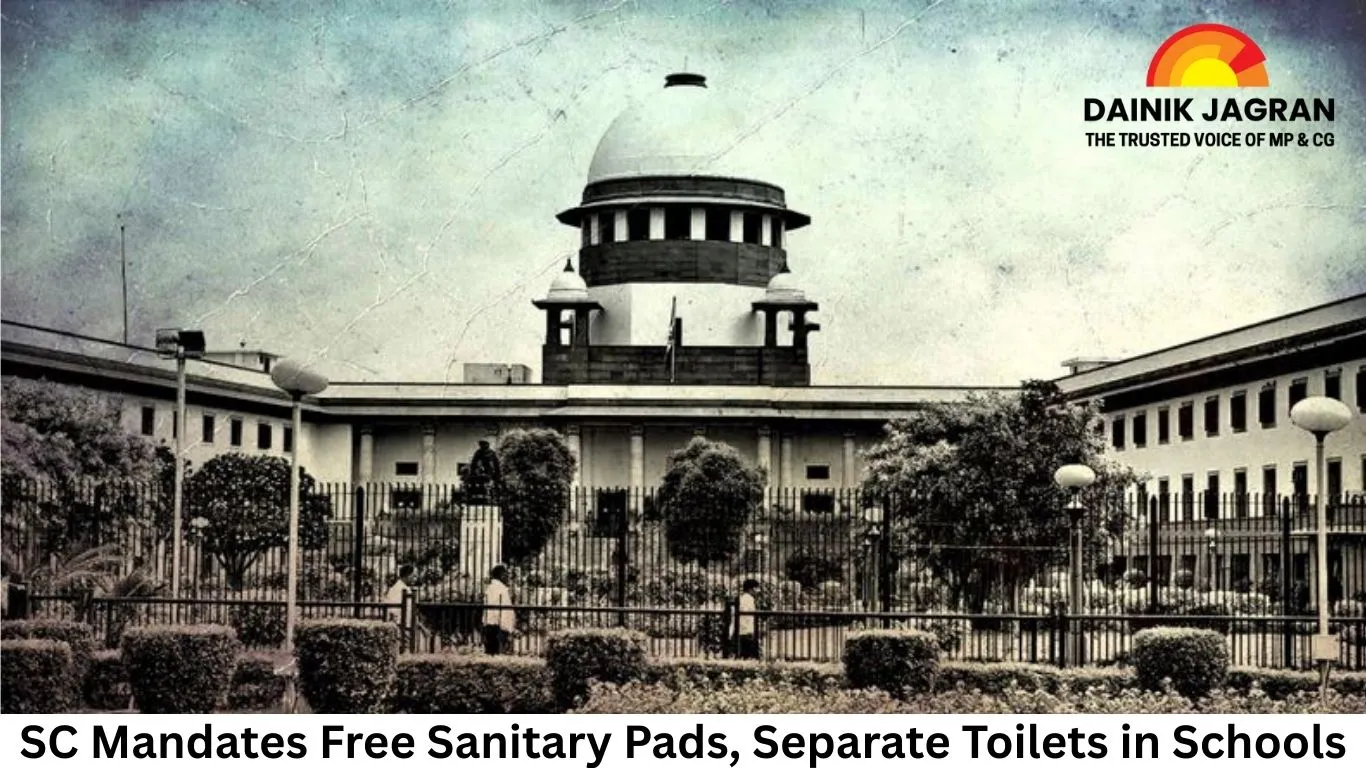
SC Mandates Free Sanitary Pads, Separate Toilets in Schools; Non-Compliant Institutions Face Derecognition
Digital Desk
The order was passed while hearing a public interest litigation (PIL) filed in 2024 by social activist Jaya Thakur, who sought nationwide implementation of the Centre’s Menstrual Hygiene Policy. The bench held that lack of basic menstrual hygiene facilities in schools directly violates constitutional guarantees under Articles 14 and 21.
Emphasising the constitutional dimension of the issue, the court observed that absence of separate toilets for girls amounts to a denial of the Right to Equality under Article 14. It further noted that without access to sanitary pads, girls are unable to participate in education and extracurricular activities on an equal footing with boys. “Dignified access to menstrual hygiene is intrinsic to the Right to Life and personal dignity under Article 21,” the court said.
The apex court also instructed all states and Union Territories to ensure that every school is equipped with disability-friendly toilets, calling inclusive sanitation infrastructure a non-negotiable requirement. Authorities were directed to conduct periodic inspections and submit compliance reports within a stipulated timeframe.
During the hearing, the court made strong observations on societal attitudes toward menstruation, stating that girls’ bodies are often treated as a burden rather than a natural biological reality. It underscored that institutional apathy and social silence around menstruation contribute significantly to absenteeism and dropouts among adolescent girls.
“This order is not confined to legal compliance alone,” the court noted. “It speaks to classrooms where students hesitate to ask for help, to teachers constrained by lack of resources, and to families unaware of the long-term consequences of neglect.”
The judgment places clear responsibility on school managements to make budgetary and administrative provisions for menstrual hygiene products and sanitation facilities. Education departments have been asked to integrate these requirements into recognition and affiliation norms, ensuring uniform enforcement.
Child rights advocates and education experts have welcomed the ruling, calling it a decisive step toward reducing gender-based barriers in schooling. They noted that while policies on menstrual hygiene have existed for years, inconsistent implementation has blunted their impact.
The verdict is expected to have far-reaching implications for school infrastructure standards and monitoring mechanisms nationwide, reinforcing the principle that access to education cannot be separated from dignity, health, and equality.
.jpg)




