


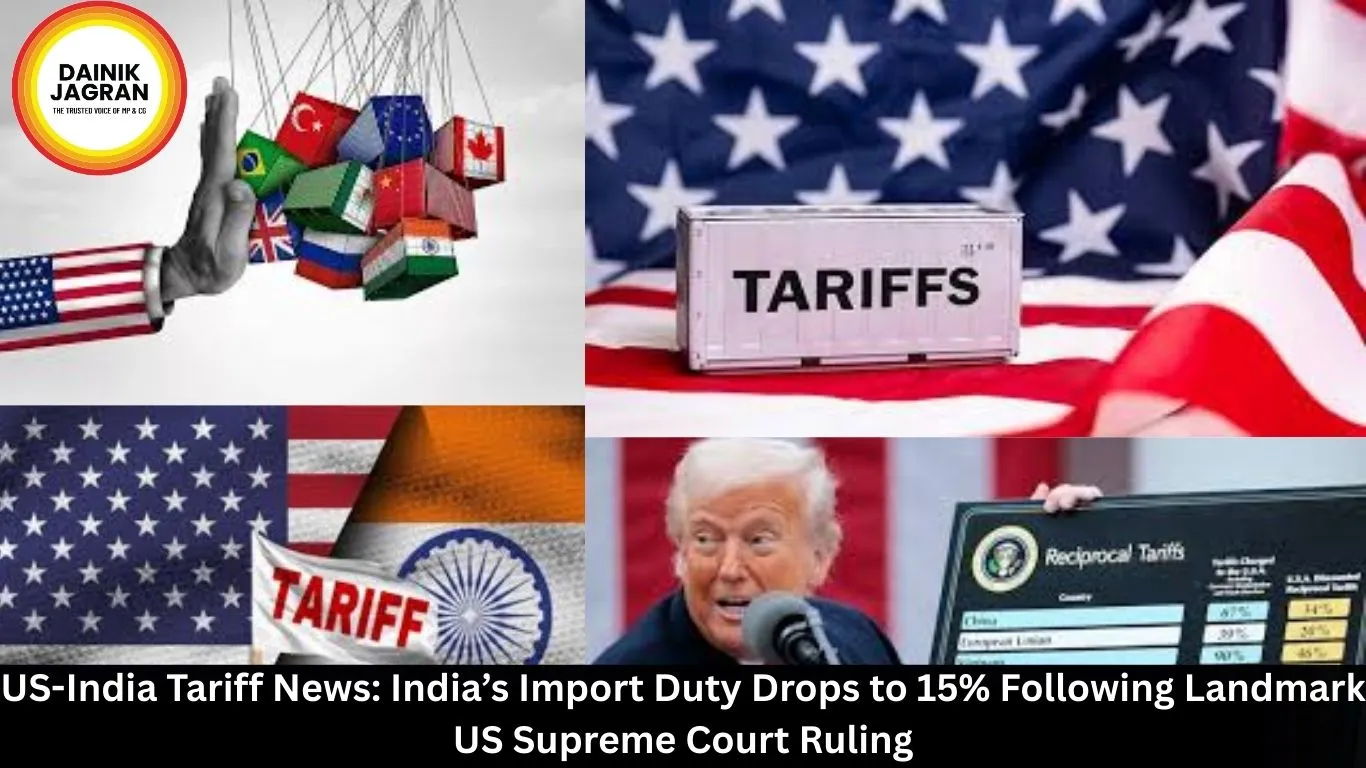
US-India Tariff News: India’s Import Duty Drops to 15% Following Landmark US Supreme Court Ruling
Digital Desk
The landscape of US tariffs on India has undergone a seismic shift this week, providing a rare moment of relief for Indian exporters. After a year of intense trade friction, the effective reciprocal tariff on most Indian goods has plummeted to 15%, down from a staggering high of 50% just months ago. This sudden change follows a high-stakes US Supreme Court ruling that struck down President Donald Trump’s previous tariff regime, forcing a legal reset of Washington’s trade policy.
The Great Tariff Reset: From 50% to 15%
For the last 10 months, Indian businesses have navigated a "rollercoaster" of trade barriers. At its peak in late 2025, India faced a total tariff burden of 50%—a combination of a 10% baseline duty, a 15% reciprocal tariff, and a punitive 25% penalty linked to India's purchase of Russian oil.
However, a 6-3 verdict by the US Supreme Court recently ruled that the President exceeded his authority under the International Emergency Economic Powers Act (IEEPA) to impose such sweeping global levies. In response, the White House pivoted to Section 122 of the Trade Act of 1974, imposing a new "temporary import surcharge." Initially set at 10% on February 20, President Trump raised this surcharge to 15% on February 22, 2026.
For Indian exporters, this 15% surcharge effectively replaces the higher reciprocal rates, making "Made in India" products significantly more competitive in the American market.
India-America Tariff Timeline: A Year of Volatility
To understand the current India-America tariff timeline, one must look at the rapid escalations that defined 2025:
-
April 2, 2025: The US introduces "Reciprocal Tariffs," initially targeting a 26% total rate for Indian goods.
-
August 2025: Tensions peak as a 25% "Russian Oil Penalty" is added, pushing total duties to 50%.
-
February 2, 2026: An interim India-US trade deal is announced, proposing to lower rates to 18% in exchange for India buying more US energy.
-
February 20-22, 2026: The US Supreme Court strikes down the old system. Trump implements a 15% global surcharge under Section 122, which now serves as the current rate for India.
What This Means for Indian Businesses
The move to a 15% surcharge is a double-edged sword. While it is lower than the 18% agreed upon in the interim deal, it is also strictly temporary, lasting only 150 days unless extended by the US Congress.
Expert Insight: "This 15% floor provides immediate breathing room for labour-intensive sectors like textiles, gems, and engineering," says a senior trade analyst. "However, the uncertainty of what happens after the 150-day window means India must fast-track the formal signing of its bilateral trade agreement."
Current Sector Impacts:
-
Exempted Goods: Pharmaceuticals, critical minerals, and certain electronics remain largely exempt from the new surcharge to protect US supply chains.
-
High-Duty Goods: Sector-specific tariffs on steel (50%), aluminum (50%), and select auto parts (25%) remain in place as they are governed by different legal authorities (Section 232).
Conclusion: Is the India-US Trade Deal Still on?
Despite the legal turmoil, President Trump has stated that the India-US trade deal remains "on track," describing the relationship as "fantastic." For India, the current 15% rate is a strategic win, but the clock is ticking. With the US being India’s largest trading partner—boasting a bilateral trade value of $186 billion—the next five months will be critical for negotiators to lock in long-term stability.
.jpg)




