


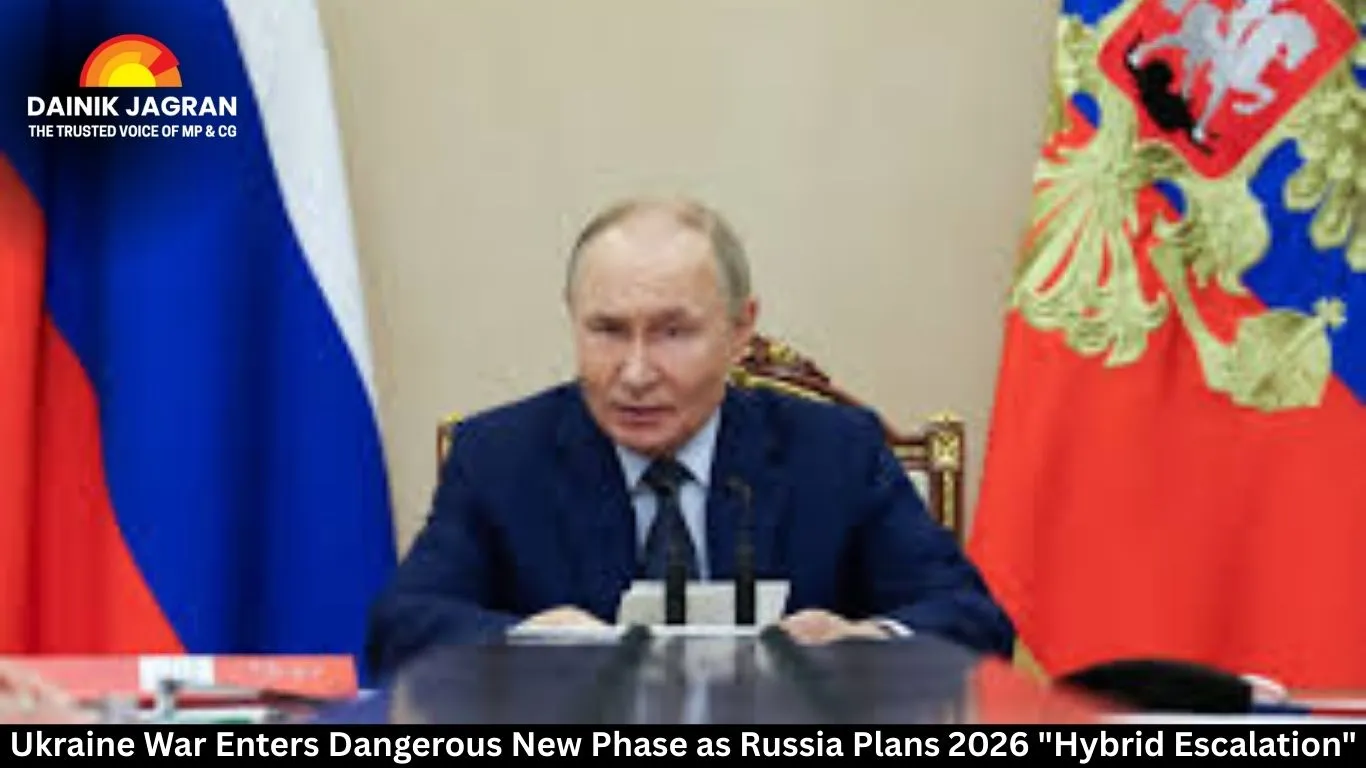
Ukraine War Enters Dangerous New Phase as Russia Plans 2026 "Hybrid Escalation"
Digital Desk
The grim rhythm of the war in Ukraine continues into 2026, but a dangerous new beat is emerging beneath the daily reports of drone strikes and artillery duels. With conventional military progress measured in meters per day and a sanctioned economy sliding toward stagnation, analysts warn that Russia is preparing for a year of "hybrid escalation".
This shift marks a critical turning point, where the conflict's greatest risks may come not from dramatic frontal assaults, but from covert attacks, political subversion, and psychological warfare designed to fracture Western resolve.
The Stalled Offensive and a Shrinking Toolkit
On the ground, the war remains a brutal slog. Russian attacks in Ukraine's Odesa region recently killed one person and damaged critical port facilities. In the southeast, strikes left the Dnipropetrovsk and Zaporizhzhia regions "almost completely without electricity".
For its part, Ukraine continues a long-range strike campaign, reportedly hitting a major Russian ammunition arsenal in Kostroma Oblast and an oil depot in Lipetsk Oblast.
Yet, despite the constant violence, Russia's conventional military progress is minimal. One assessment notes Russia is spending billions to make battlefield advances of 50 meters a day in some areas—a pace slower than the World War I Somme offensive.
After nearly four years of war, Russia has secured little more than 2% of additional Ukrainian territory beyond its initial 2022 gains. With an estimated 1.4 million casualties and Soviet-era equipment reserves depleting, Russia's conventional options are narrowing.
The Economic Vice Tightens
This military stasis coincides with severe and growing economic pressure. The Russian economy, after a period of wartime adjustment, is heading toward stagnation. Growth has plummeted from 3.6% at the end of 2024 to just 0.6% in the third quarter of 2025. The International Monetary Fund forecasts a mere 1% growth for 2026.
The War Drain: Official defense spending has quintupled since 2021. When hidden costs are included, the real burden likely approaches 9% of GDP—a level comparable to unsustainable late-Soviet spending and far exceeding the USSR's cost of the Afghanistan war.
Revenue Shortfalls: Budget revenues are falling short as global oil prices drop. To compensate, the Kremlin is raising taxes on businesses and citizens, increasing the VAT and expanding who must pay it.
Structural Stagnation: The central bank maintains high interest rates to combat inflation, which stifles investment in the non-defense civilian sector. Analysts warn the slowdown is not just cyclical but signals a phase of structural stagnation, with the economy operating at the limits of its "war economy" model.
The Three Pillars of Hybrid Escalation
Fiscally squeezed and militarily constrained, the Kremlin's path forward, according to security analysts, lies in a three-pronged hybrid offensive:
1. Sabotage: Targeting Europe's expanding defense production and supply chains for Ukraine. Attacks like the 2025 arms factory explosion in Cugir, Romania, are likely blueprints for operations designed to delay weapons deliveries and drive up security costs.
2. Subversion: Intensifying information warfare and political interference, particularly during a major election year in Europe and the United States. The goal is to boost pro-Russian populist parties to weaken sanctions and political resolve.
3. Coercion: Increasingly aggressive military demonstrations—like airspace violations and risky naval maneuvers—coupled with calibrated nuclear rhetoric. The message is clear: supporting Ukraine risks direct escalation.
A recently leaked German military document substantiates this threat, assessing that Russia is intensifying covert attacks on German infrastructure as preparation for a potential wider conflict, viewing Germany as a priority target due to its role as a NATO logistics hub.
Europe's Precarious Position and the Search for Security
This looming hybrid campaign finds Europe in a vulnerable state. U.S. foreign policy under the Trump administration has shifted toward "America First," with the new National Security Strategy no longer identifying Russia as a direct threat and questioning NATO's "constant expansion". German Chancellor Friedrich Merz has bluntly stated that the "decades of Pax Americana are largely over".
In this vacuum, Europe is scrambling to provide its own security guarantees for Ukraine. The "Coalition of the Willing," including the US, UK, and France, has discussed a plan involving a multinational force and long-term arms commitments to activate upon a ceasefire. However, Ukrainian President Volodymyr Zelenskyy has expressed frustration, stating he has received no "unequivocal answer" on whether allies would defend Ukraine against a future Russian invasion. British Prime Minister Keir Starmer has said any UK troop deployment would be subject to a parliamentary vote, highlighting the political fragility of these promises.
A Dangerous Crossroads
The convergence of these factors sets the stage for a perilous 2026. Russia, facing economic decline and military exhaustion, may see hybrid escalation as its only affordable tool to undermine Western support for Ukraine before its own window of opportunity closes. Europe, meanwhile, is militarizing without a fully coherent strategy, burdened by economic strain and political division.
.jpg)




