


The meeting, held on January 12 at the BJP headquarters, was led by Sun Heyan, Vice Minister of the International Department of the CPC. The BJP delegation was headed by National General Secretary Arun Singh, with party leaders stating that discussions focused on enhancing inter-party communication. China’s Ambassador to India, Xu Feihong, was also present.
Congress leader Supriya Shrinate shared photographs of the meeting on social media, questioning the timing and intent of the interaction. “What secret agreement has the BJP made with China?” she asked, alleging that the meeting raised serious concerns about national interest. The Congress also circulated a video statement from China’s Ministry of Foreign Affairs in which spokesperson Mao Ning reiterated Beijing’s claim over the Shaksgam Valley, calling it Chinese territory and defending infrastructure construction there.
The controversy intensified as the meeting coincided with China’s assertion that the Shaksgam Valley—part of the erstwhile princely state of Jammu and Kashmir—is under its sovereignty. India has consistently rejected this claim, maintaining that the territory is illegally occupied, having been ceded by Pakistan to China in 1963 following Pakistan’s occupation of the region in 1948.
Responding to China’s remarks, the Congress questioned the Modi government’s foreign policy posture, asking whether New Delhi’s diplomatic stance toward Beijing had weakened. Party leaders pointed to repeated border tensions and China’s continued infrastructure expansion in disputed areas as evidence of unresolved challenges.
The BJP, however, has maintained that inter-party exchanges are routine diplomatic engagements aimed at dialogue and communication, distinct from official government negotiations. Party officials underscored that India’s position on territorial integrity and sovereignty remains unchanged and is articulated through formal diplomatic channels.
The Shaksgam Valley holds strategic importance due to its location along the China-Pakistan Economic Corridor (CPEC), a flagship Belt and Road Initiative project. Through CPEC, China seeks a shorter route for energy imports and access to the Arabian Sea via Gwadar Port—moves India has opposed, citing sovereignty concerns.
With political tempers rising, the episode has once again brought India-China relations into domestic political debate. Observers note that the timing of the meeting and China’s territorial assertion has added to sensitivities ahead of upcoming parliamentary discussions on national security and foreign policy.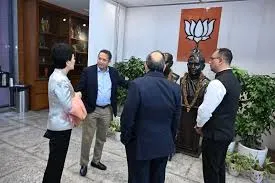
.jpg)
.jpg)

.jpg)
