


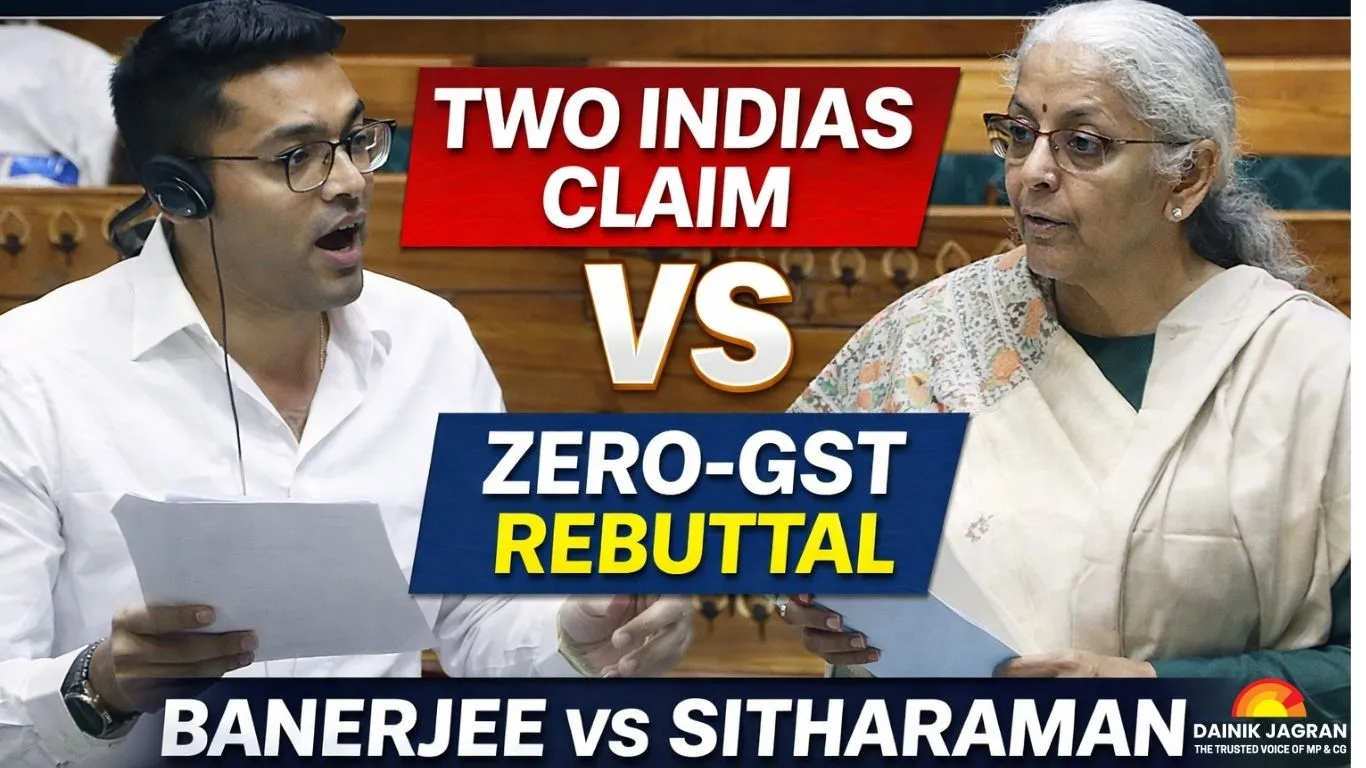
GST Debate in Lok Sabha: Banerjee’s ‘Two Indias’ Claim Meets Sitharaman’s Zero-GST Rebuttal
Digital Desk
The debate, which took place during discussions on the Union Budget, quickly turned contentious when Banerjee argued that the current GST structure has created “Two Indias” — one that is privileged and insulated, and another that struggles under indirect taxes on basic necessities.
Banerjee targeted essential items and services, asserting that even survival needs are taxed under the GST regime. He cited powdered milk, commonly used by economically weaker households, which attracts a 5% GST, contrasting it with fresh milk consumed by the affluent. He also raised concerns over education-related goods, noting that pencils, crayons, graph books, and lab notebooks were earlier taxed at 12%, a burden he said should not be imposed on students.
Turning to healthcare, Banerjee listed several life-saving items such as anaesthetics, medical oxygen, insulin, and diagnostic kits as GST-bearing commodities. He argued that taxing these essentials increases financial strain on the poor. He also claimed that funeral items like incense sticks are taxed, saying: “Whether you acknowledge it or not, Madam Finance Minister, both Indias exist.”
In response, Finance Minister Nirmala Sitharaman rejected Banerjee’s assertions as a “pack of lies,” accusing him of spreading misinformation. She clarified that fresh milk, curd, and unbranded lassi have been under 0% GST since the introduction of the GST in 2017. She further highlighted that the 56th GST Council meeting reduced GST on pencils, sharpeners, and notebooks to 0%, offering relief to students.
On healthcare, Sitharaman said recent “Next Gen GST” reforms have brought individual health and life insurance premiums under a 0% GST bracket. She also pointed out that GST rates on 33 life-saving drugs have been reduced.
Addressing Banerjee’s claim on funeral expenses, the Finance Minister stated that funeral services are exempt from GST. She added that any extra charges could stem from local syndicate practices rather than central taxation, a remark that drew protests from Opposition members.
The exchange highlighted the deepening political divide over tax policy and the government’s stance on protecting essential goods from indirect taxation. As GST reforms continue, the debate is likely to resurface, especially ahead of upcoming state and national elections.
.jpg)




