


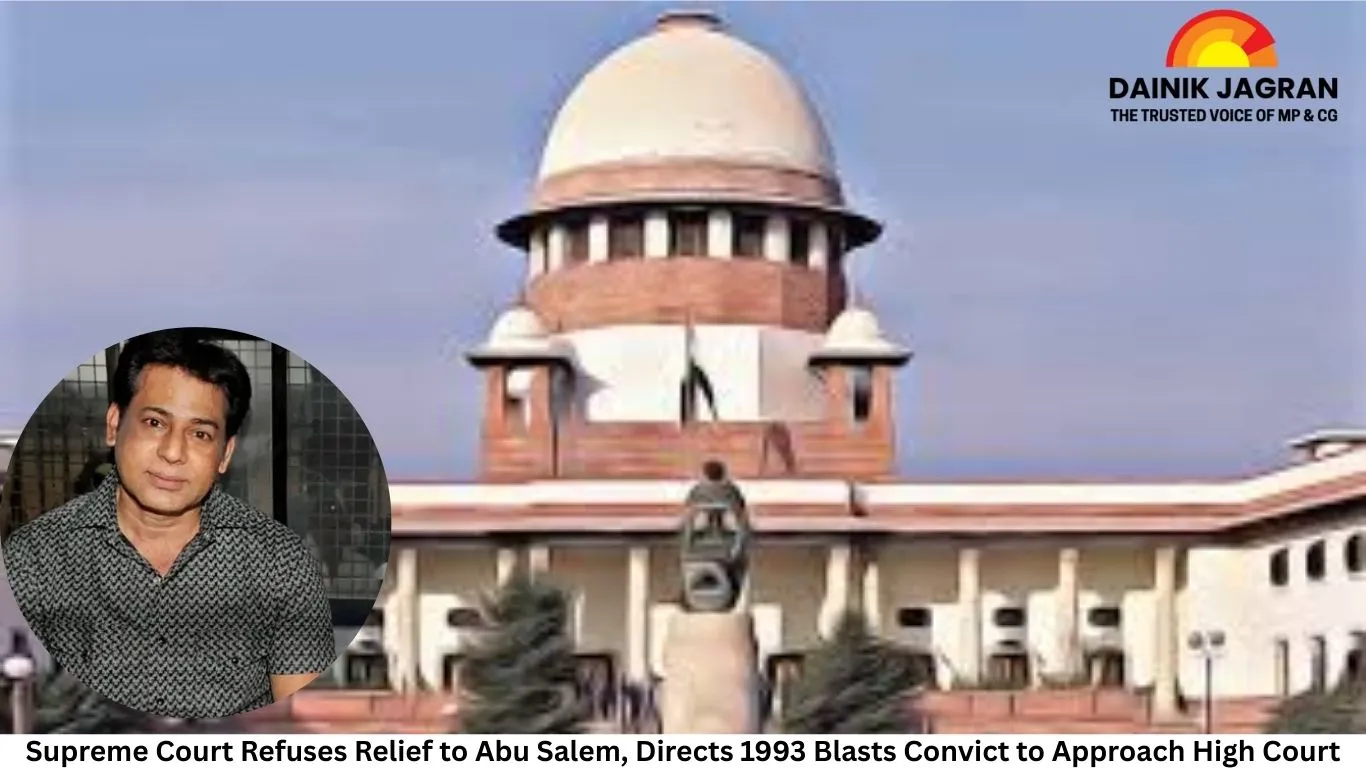
Supreme Court Refuses Relief to Abu Salem, Directs 1993 Blasts Convict to Approach High Court
Digital Desk
A bench comprising Justices Vikram Nath and Sandeep Mehta said the high court had only refused interim relief and that Salem’s proper legal remedy was to continue his arguments there. The court therefore declined to grant any immediate relief or examine the merits of his claim.
Salem’s petition argued that, after accounting for remission for good conduct, he had already completed 25 years of imprisonment and had been held in illegal custody for more than 10 additional months. He sought release on that basis. The bench, however, indicated that such factual and procedural questions should first be decided by the high court.
Salem is serving a life sentence for his role in the coordinated bomb blasts that struck Mumbai on 12 March 1993, killing 257 people and injuring over 1,400. Investigators found that he was involved in procuring, transporting and distributing weapons and explosives used in the attacks. In 2017, a special court convicted him under multiple provisions of the Indian Penal Code and anti-terror laws for conspiracy, murder and related offences.
The case also carries an international legal dimension. Salem was extradited to India from Portugal in 2005 under an agreement in which Indian authorities assured Lisbon that he would neither face the death penalty nor serve a sentence exceeding 25 years. In 2022, the Supreme Court observed that the Union government was bound to honour those assurances, prompting legal debate over how the 25-year term should be calculated.
His latest plea forms part of that continuing dispute. Legal experts note that the core issue now centres on whether remission and pre-trial detention count toward the 25-year cap promised during extradition. The high court is expected to examine these technical aspects in detail.
The Supreme Court’s refusal to intervene at this stage leaves Salem’s immediate fate unchanged and shifts the focus back to the high court proceedings. The outcome there could determine not only his release timeline but also clarify how India interprets extradition assurances in future international criminal cases.
.jpg)




