


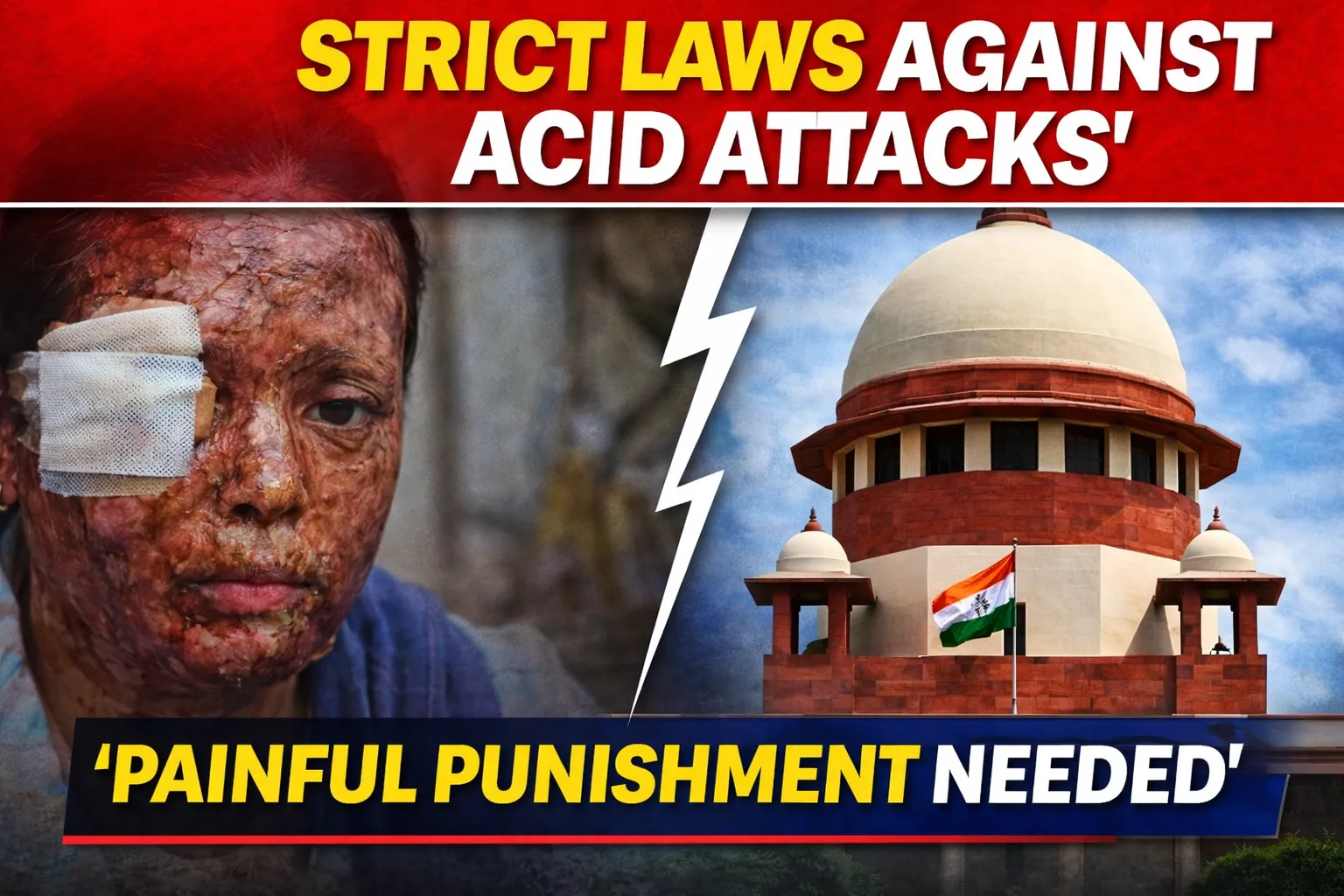
Supreme Court Urges Centre to Frame Stricter Laws Against Acid Attacks, Seeks Nationwide Data
Digital Desk
Hearing a public interest litigation on acid attack cases, a Bench comprising Chief Justice of India Suryakant, Justice R. Mahadevan and Justice Joymalya Bagchi said the reformative theory of punishment may not be applicable in such offences. “Until the punishment is painful for the accused, these crimes will not stop,” the Bench observed, adding that in grave offences such as acid attacks, the burden of proof may need to shift to the accused, similar to provisions in dowry death cases.
The court directed all states and Union Territories to submit comprehensive data on acid attack cases within four weeks. The information sought includes year-wise registration of cases, their current status in courts, and details of rehabilitation measures for victims. The Bench also asked for data on the educational, employment and marital status of victims, treatment costs incurred or expected, and particulars of rehabilitation schemes. Separate details have been sought in cases involving forced acid consumption.
The observations came during the hearing of a petition filed by Shahina Malik, an acid attack survivor from Haryana. Malik told the court that all accused in her case were acquitted after prolonged legal proceedings, and she has since challenged the verdict in the Delhi High Court. Noting her circumstances, the Supreme Court offered her free legal aid and allowed her to engage counsel of her choice.
Malik said she was 26 years old at the time of the attack and is now 42, still awaiting justice. The Bench expressed concern over delays in trials and questioned whether confiscation of the convicts’ property to compensate victims could be explored as a legal option.
The court also took note of the high number of pending cases across the country. Data received from 15 High Courts indicates that Uttar Pradesh has the highest number of pending acid attack cases, followed by Gujarat, Bihar, West Bengal and Maharashtra. In light of these figures, the Supreme Court directed High Courts to prioritise such cases and consider disposing of them within a fixed timeframe.
According to the National Crime Records Bureau’s 2025 report, 844 acid attack cases were pending nationwide as of 2023, with numbers rising steadily since 2021. Studies suggest the actual incidence may be significantly higher due to underreporting.
The matter will be taken up again after states and authorities submit the requested data.
.jpg)




