


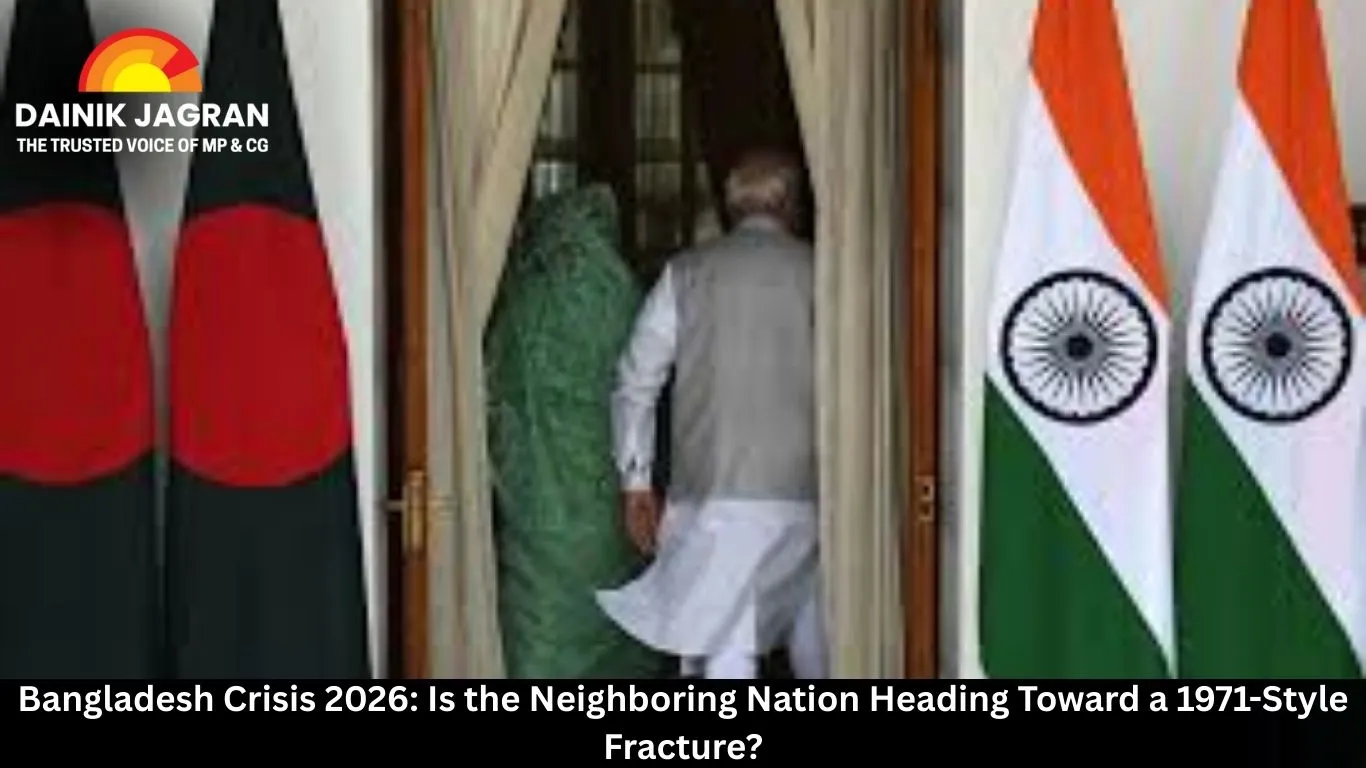
Bangladesh Crisis 2026: Is the Neighboring Nation Heading Toward a 1971-Style Fracture?
Digital Desk
In the world of geopolitics, the unthinkable often becomes inevitable. Ten months before the liberation of Bangladesh in 1971, many global analysts dismissed the possibility of a new nation. Fast forward to the present, and Bangladesh Political Crisis appears to be standing at a similar historical crossroads. Since the ouster of Sheikh Hasina, the nation has seen over 637 deaths—70% of whom were affiliated with the Awami League—proving that the instability is far from over.
The Three-Way Split of the 'Student Revolution'
What started as a unified student movement has now fractured into three distinct and rival factions. This internal rivalry is the biggest threat to the legitimacy of the interim government led by Muhammad Yunus.
-
The Government Insiders: Leaders like Nahid Islam have taken ministerial posts, attempting to legitimize the interim regime.
-
The Electoral Challengers: The newly formed National Citizens Party (NCP) is preparing for the 2025-26 elections, positioning itself against traditional giants like the BNP.
-
The Street Radicals: Groups like the Inqilab Manch are practicing "gunpoint politics," threatening to sever all ties with India.
This internal friction has turned violent. Recent attacks on leaders of these factions suggest a "revenge theory" where student groups are targeting each other to claim the title of the "true heirs of the revolution."
The Shadow Play of Jamaat-e-Islami
While students fight in the streets, Jamaat-e-Islami is playing a much deeper game. Historically opposed to the very creation of Bangladesh in 1971, the party was banned in 2013 for having a constitution that conflicted with Bangladesh’s secular values.
Today, that ban has been lifted by the Supreme Court, and Jamaat is weaponizing anti-India sentiment to radicalize the youth. Their strategy is simple: create distrust in secular democracy, wait for the interim government to fail, and then present "Pure Sharia" as the only stable alternative.
Strategic Challenges for India: The Siliguri Corridor
For India, this chaos is not just a neighbor's problem; it is a direct threat to the Siliguri Corridor (the Chicken’s Neck). If a radicalized Bangladesh government—influenced by Pakistan’s ISI—blocks transit agreements, India’s North East faces an economic and security nightmare.
However, history shows that when India's national interests are cornered, bold shifts occur. There is growing discourse regarding the "reclamation of identity" in regions like Rangpur and Chattogram (Chittagong).
-
Rangpur: Historically linked to the Cooch Behar kingdom, this region is vital for widening the Siliguri Corridor.
-
Chattogram: A region with deep Buddhist and Hindu roots, currently suffering under radical pressure.
Conclusion: A Bold Moment for the Subcontinent
Bangladesh is currently a "Kings Party" of chaos. If the systematic subversion of minorities—including 13 million Hindus and millions of Buddhists and Christians—continues, the demand for international intervention or territorial shifts may become a reality. As India-Bangladesh Relations hit a historic low, the neighbors must realize that using India as a scapegoat only fuels their own internal decline.
.jpg)




