

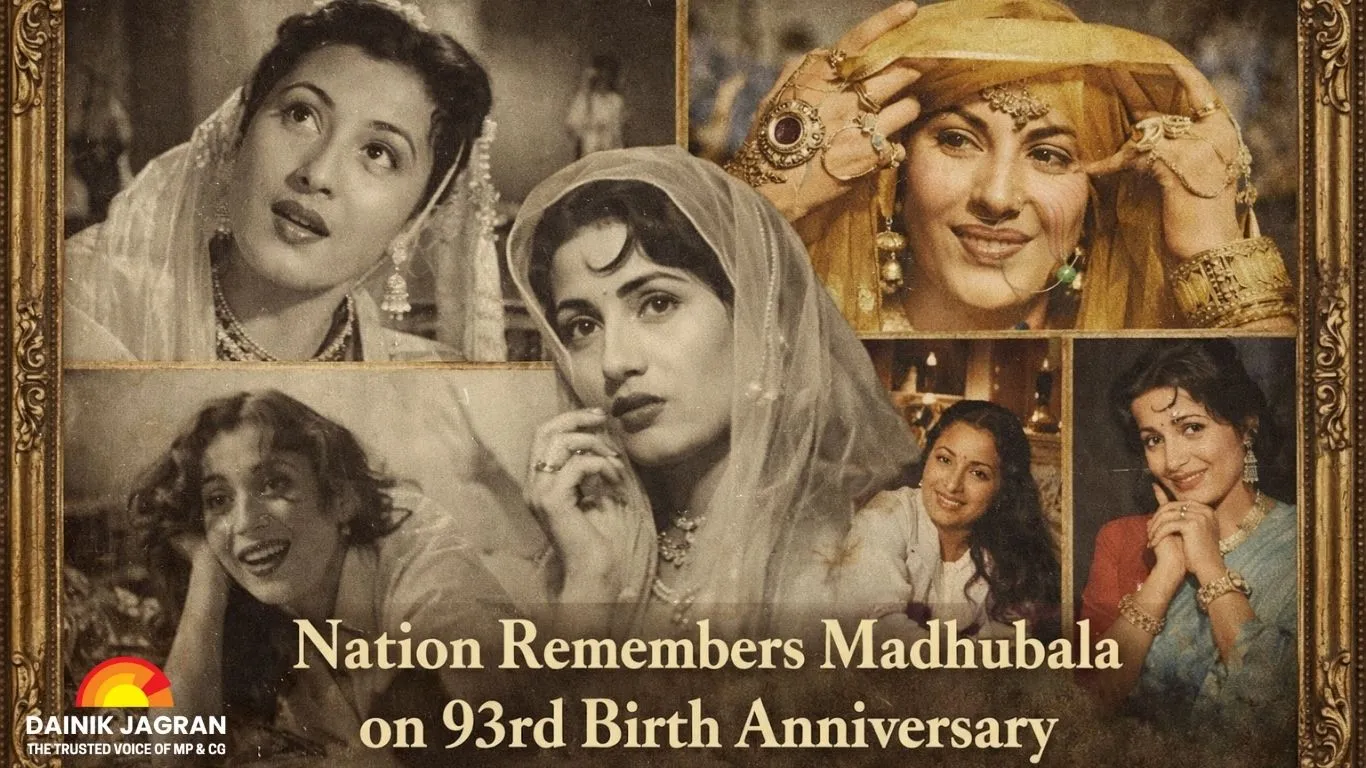
‘Eternal Enchantress of Indian Cinema’: Nation Remembers Madhubala on 93rd Birth Anniversary
Digital Desk
Film lovers, historians, and members of the Indian film fraternity on Friday commemorated the 93rd birth anniversary of legendary actress Madhubala, celebrating her enduring legacy as one of Hindi cinema’s most iconic stars. Tributes poured in across social platforms, film societies announced special screenings, and archival photographs resurfaced, reaffirming her status as a timeless screen presence nearly six decades after her death.
Born Mumtaz Jehan Begum Dehlavi in 1933, Madhubala rose to prominence in the late 1940s and 1950s, a period widely considered the golden age of Hindi cinema. She became synonymous with beauty, charisma, and emotional range, captivating audiences in classics such as Mahal, Mr. & Mrs. '55, Howrah Bridge, Chalti Ka Naam Gaadi, and Barsaat Ki Raat. Her portrayal of Anarkali in Mughal-e-Azam remains one of Indian cinema’s most celebrated performances and earned her a nomination for the Filmfare Award for Best Actress.
Industry veterans note that Madhubala’s appeal transcended genres. She excelled equally in romance, comedy, costume drama, and noir-style thrillers, demonstrating a versatility rare for her era. Film scholars often cite her work in Kala Pani and Tarana as examples of her nuanced acting and expressive screen command.
Despite her professional success, her career was marked by health challenges. Diagnosed with a congenital heart condition, she continued working through illness before withdrawing from films in the early 1960s. She died in 1969 at just 36, a loss widely mourned across the country.
Over the decades, Madhubala has come to symbolize classic Bollywood elegance. Restored prints of her films continue to draw audiences, and her portraits remain fixtures in studios and film institutes. Historians credit her with helping define the visual grammar of Hindi cinema’s romantic heroine, influencing generations of actors.
On her birth anniversary, retrospectives in Mumbai and Delhi highlighted her artistic contribution and the preservation of film heritage. Cultural commentators say her continued popularity reflects not only nostalgia but also the timeless quality of her performances.
As Indian cinema evolves, Madhubala’s legacy endures as a benchmark of grace, talent, and star power — a reminder of an era when screen legends were born, not manufactured.
--------
🚨 Beat the News Rush – Join Now!
Get breaking alerts, hot exclusives, and game-changing stories instantly on your phone. No delays, no fluff – just the edge you need. ⚡
Tap to join:
🟢 WhatsApp Channel: Dainik Jagran MP CG
Crave more?
🅕 Facebook: Dainik Jagran MP CG English
🅧 Twitter (X): Dainik Jagran MP CG
🅘 Instagram: Dainik Jagran MP CG
Share the fire – keep your crew ahead! 🗞️🔥
‘Eternal Enchantress of Indian Cinema’: Nation Remembers Madhubala on 93rd Birth Anniversary
Digital Desk
Born Mumtaz Jehan Begum Dehlavi in 1933, Madhubala rose to prominence in the late 1940s and 1950s, a period widely considered the golden age of Hindi cinema. She became synonymous with beauty, charisma, and emotional range, captivating audiences in classics such as Mahal, Mr. & Mrs. '55, Howrah Bridge, Chalti Ka Naam Gaadi, and Barsaat Ki Raat. Her portrayal of Anarkali in Mughal-e-Azam remains one of Indian cinema’s most celebrated performances and earned her a nomination for the Filmfare Award for Best Actress.
Industry veterans note that Madhubala’s appeal transcended genres. She excelled equally in romance, comedy, costume drama, and noir-style thrillers, demonstrating a versatility rare for her era. Film scholars often cite her work in Kala Pani and Tarana as examples of her nuanced acting and expressive screen command.
Despite her professional success, her career was marked by health challenges. Diagnosed with a congenital heart condition, she continued working through illness before withdrawing from films in the early 1960s. She died in 1969 at just 36, a loss widely mourned across the country.
Over the decades, Madhubala has come to symbolize classic Bollywood elegance. Restored prints of her films continue to draw audiences, and her portraits remain fixtures in studios and film institutes. Historians credit her with helping define the visual grammar of Hindi cinema’s romantic heroine, influencing generations of actors.
On her birth anniversary, retrospectives in Mumbai and Delhi highlighted her artistic contribution and the preservation of film heritage. Cultural commentators say her continued popularity reflects not only nostalgia but also the timeless quality of her performances.
As Indian cinema evolves, Madhubala’s legacy endures as a benchmark of grace, talent, and star power — a reminder of an era when screen legends were born, not manufactured.


