Paid previews alone reportedly grossed over ₹40 crore on Wednesday evening, while Thursday’s opening day breached ₹100 crore. With a four-day extended weekend plus previews, the film is on course for ₹500 crore in its first week domestically and could push toward ₹700 crore worldwide. Yet box-office velocity cannot mask a deeper creative malaise: the sequel’s fundamental failure to honour, expand, or even sustain the narrative excellence of its prequel.

Where the original Dhurandhar was a taut, character-driven revenge saga that balanced visceral action with emotional resonance and razor-sharp pacing, The Revenge’ chooses the path of excess. It treats its prequel not as sacred canon to be elevated, but as raw material to be bloated into a four-hour spectacle. The result is a film whose character arcs atrophy, whose entertainment quotient plummets, and whose structural choices betray a misguided belief that “more” automatically equals “better.” What follows is not merely a catalogue of flaws but an autopsy of a sequel that forgot its own DNA.
The story opens promisingly enough. We meet Hamza Ali Mazari (Ranveer Singh) in a backstory as an aspirant in the Indian Army as Jaskirat Singh Rangi in Punjab. A brutal killing spree against assailants who murdered his father and raped his sister lands him in prison. The early stretches feel deliberate, almost meditative, as we witness his grief. An emotionally charged reunion with his mother and sister re-establishes the personal stakes that powered the first film. He is then hand-picked by the enigmatic handler Sanyal for “Operation Dhurandhar,” a covert mission that catapults him into the lawless streets of Lyari in Karachi. Here, he assumes the identity of Hamza while forging uneasy alliances. The interval arrives on a high: Jaskirat’s brother-in-law arrives from Punjab as a drug courier, reigniting the narrative momentum and delivering the film’s most gripping pre-interval sequence.
Post-interval, however, the architecture collapses. The sacrifice of Indian agent Gaurav Gera (a welcome but brief cameo) clears the deck for SP Aslam Chowdhury (Sanjay Dutt) to exit in equally perfunctory fashion. The spotlight then fixes relentlessly on the ISI mastermind Major Iqbal (Arjun Rampal), whose shadowy machinations dominate the final two hours. Twists arrive, blackmail plots unfold, new characters materialise and vanish, and the revenge motif circles back—twice—first when we believe the mission is complete and Jaskirat returns home, only for him to re-emerge for one final reckoning. The film’s music, particularly the reimagined Nusrat Fateh Ali Khan tracks and the haunting “Aari Aari ,” offers fleeting solace. Yet these sonic highs only accentuate how much the rest of the film drifts.
The cardinal sin is conceptual. By anchoring itself so slavishly to the prequel’s world, The Revenge never dares to evolve its own identity. Instead of deepening the moral ambiguities that made the original protagonist a tragic anti-hero, it transforms Ranveer Singh’s Jaskirat into a cartoonish Rambo figure—rocket launchers, jeep explosions, and mass stabbings executed with mechanical nonchalance. The character arc that once balanced raw vengeance with quiet humanity simply evaporates. Where the first film’s protagonist felt dangerously real, here he becomes a video-game avatar whose superhuman feats strain credulity and erode audience investment. This is not evolution; it is regression.
Ten structural and tonal missteps compound the damage:
1. Runtime as self-sabotage- At 229 minutes, the film is an endurance test. The second half, fixated almost exclusively on eliminating Major Iqbal, adds 30–40 redundant minutes of wheel-spinning. A disciplined editor could have trimmed half an hour without losing a single plot thread, yet the director seems enamoured with his own sprawl.
2. Gruesome excess that numbs- Severed heads, shattered bones, flying limbs, and rivers of blood escalate from shocking to gratuitous. The first film’s violence served character; here it becomes pornography of pain. Viewers are not invested but they are exhausted.l by now.
3. The “Bade Sahib” reveal as anti-climax- Months of marketing teased a seismic guest appearance. When the character finally materialises, the payoff is so predictable and underwhelming that audiences emit a collective sigh of deflation rather than catharsis. The prequel never needed such gimmickry; its surprises emerged organically.
4. Protagonist overreach- Ranveer Singh’s Jaskirat is written as an unstoppable force who kills with the casualness of ordering chai. The prequel grounded its hero in trauma and limits; the sequel removes every brake, turning emotional depth into cartoon bravado.
5. Political insertion that backfires- A lengthy justification of demonetisation via a televised address by the Honourable Prime Minister feels grafted on for contemporary relevance. In a theatre filled with politically aware viewers, it lands as agenda rather than organic storytelling, alienating the very mature audience the film courts.
6. Narrative flatness- Despite multiple twists, the script remains stubbornly linear. The prequel’s serpentine plotting kept viewers guessing; here, the four-hour runtime exposes every gear shift. With minimal dance sequences and fewer genuine surprises, the film cannot sustain momentum.
7. Supporting cast abandonment- Akshaye Khanna’s absence is acutely felt throughout the second half. Sanjay Dutt is reduced to a glorified cameo. Arjun Rampal’s Iqbal, while menacing, lacks the layered charisma that made the first film’s antagonists memorable. The villainous front feels monochromatic and undercooked.
8. Sidelined relationships. Jaskirat’s wife, the Rehman Dakait’s spouse, his brother Uzair Baloch and several characters receive cursory development. Emotional threads that enriched the prequel are either dumped into jail cells or left dangling, robbing the story of its human core.
9. Directorial overindulgence- The filmmaker clearly possesses craft, stunning action choreography, sweeping road sequences, and bombastic set pieces abound. Yet he cannot stop himself. Every explosion is bigger, every fight longer, every confrontation more baroque. The restraint that defined the first film’s tension is replaced by a “more is more” philosophy that suffocates the narrative.
10. Absence of breathing space- The original offered cathartic respites: an item number at a wedding and Hamza’s love life and a marriage sequence brought moments of levity amid carnage. The Revenge provides none. The audience is subjected to an unrelenting barrage of violence and exposition, emerging drained rather than exhilarated. There is no emotional valley to counter the peaks, no song or quiet scene to let the heart rate settle.
Collectively, these choices illustrate a sequel that mistook volume for value. The prequel’s genius lay in its economy, every frame advanced character or stakes. The Revenge mistakes length for depth, gore for gravitas, and star power for substance. Ranveer Singh still delivers a committed, physically ferocious performance, and Arjun Rampal’s icy menace provides occasional sparks, yet neither can compensate for a screenplay that has forgotten why we cared about these people in the first place.
Even the film’s technical achievements, sweeping cinematography across Lyari’s underbelly, thunderous sound design, and a pulsating score, cannot redeem the conceptual drift. The music, especially the Nusrat Fateh Ali Khan reinterpretations, stands as the lone consistent triumph, reminding us what emotional heights the franchise once reached.
Beyond the screen, exhibition woes have compounded audience frustration. Reports of cancelled shows, missing KDMs, incomplete shows at major PVR chains, and Cinepolis Andheri’s chaotic management (soggy popcorn, three-hour waits, ticket prices soaring past ₹1,000) have generated toxic social-media backlash. These are not the film’s sins, yet they underscore a broader industry disconnect: studios and exhibitors alike seem more obsessed with extracting revenue than delivering an experience worthy of a ₹700-crore phenomenon.
In the final analysis, Dhurandhar: The Revenge is not a disaster; it is a disappointment of greater magnitude precisely because its prequel set the bar so high. It possesses isolated sequences of visceral brilliance and enough star wattage to ensure commercial success. But as a piece of storytelling, it represents a textbook case of sequelitis: bigger budget, bigger runtime, bigger body count, smaller soul. The character arcs that once pulsed with lived-in pain have flatlined. The entertainment quotient that made the original a cultural event has been sacrificed at the altar of excess.
Bollywood sequels rarely improve upon their predecessors. Dhurandhar: The Revenge does not even try. It coasts on inherited goodwill while systematically dismantling everything that made the first film remarkable. For an audience that invested emotionally in Jaskirat’s journey, the experience feels less like revenge and more like betrayal. The film will mint money, but its legacy will be a cautionary tale: when you inherit a masterpiece, the greatest sin is to treat it as mere scaffolding for spectacle.
---------------------

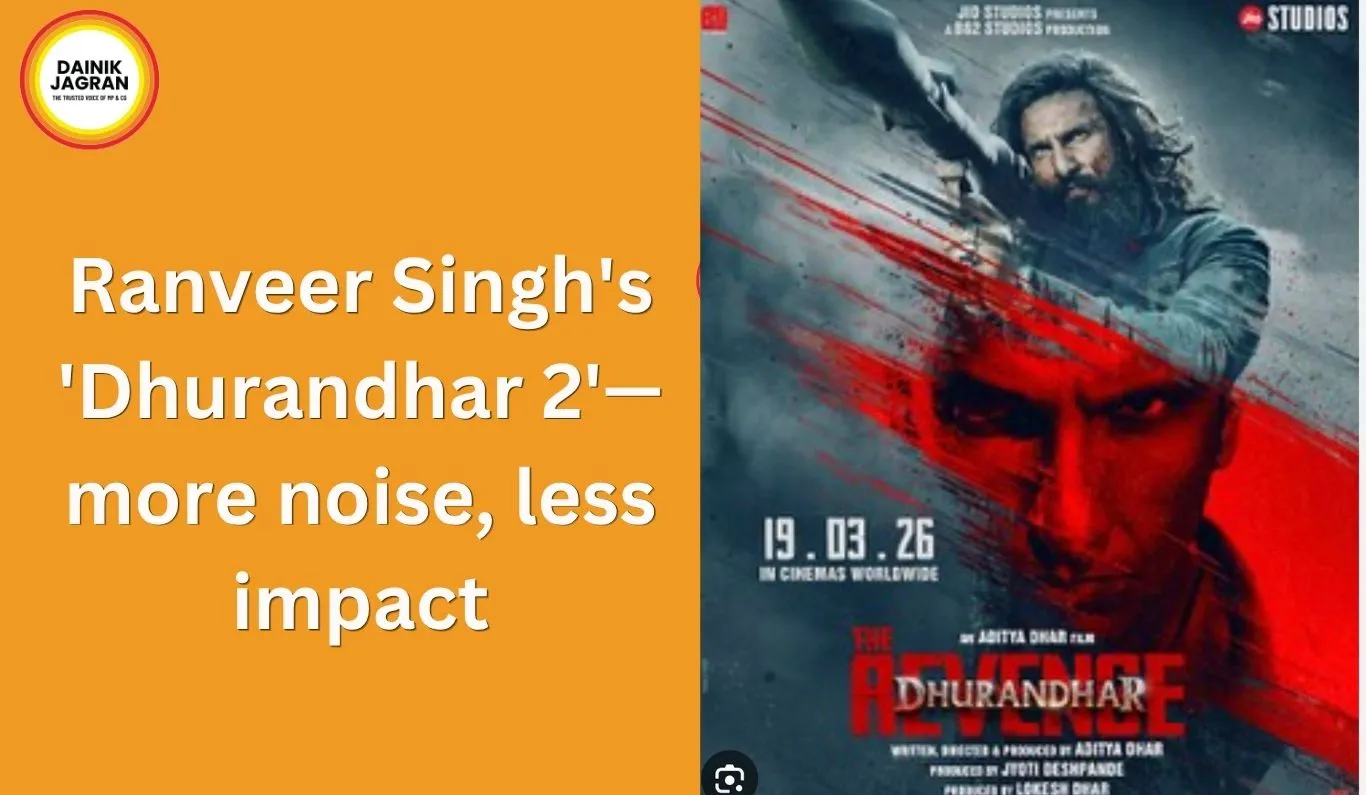
Dhurandhar: The Revenge – A Sequel That Squanders Its Prequel’s Blueprint
Girish Wankhede
Paid previews alone reportedly grossed over ₹40 crore on Wednesday evening, while Thursday’s opening day breached ₹100 crore. With a four-day extended weekend plus previews, the film is on course for ₹500 crore in its first week domestically and could push toward ₹700 crore worldwide. Yet box-office velocity cannot mask a deeper creative malaise: the sequel’s fundamental failure to honour, expand, or even sustain the narrative excellence of its prequel.
Where the original Dhurandhar was a taut, character-driven revenge saga that balanced visceral action with emotional resonance and razor-sharp pacing, The Revenge’ chooses the path of excess. It treats its prequel not as sacred canon to be elevated, but as raw material to be bloated into a four-hour spectacle. The result is a film whose character arcs atrophy, whose entertainment quotient plummets, and whose structural choices betray a misguided belief that “more” automatically equals “better.” What follows is not merely a catalogue of flaws but an autopsy of a sequel that forgot its own DNA.
The story opens promisingly enough. We meet Hamza Ali Mazari (Ranveer Singh) in a backstory as an aspirant in the Indian Army as Jaskirat Singh Rangi in Punjab. A brutal killing spree against assailants who murdered his father and raped his sister lands him in prison. The early stretches feel deliberate, almost meditative, as we witness his grief. An emotionally charged reunion with his mother and sister re-establishes the personal stakes that powered the first film. He is then hand-picked by the enigmatic handler Sanyal for “Operation Dhurandhar,” a covert mission that catapults him into the lawless streets of Lyari in Karachi. Here, he assumes the identity of Hamza while forging uneasy alliances. The interval arrives on a high: Jaskirat’s brother-in-law arrives from Punjab as a drug courier, reigniting the narrative momentum and delivering the film’s most gripping pre-interval sequence.
Post-interval, however, the architecture collapses. The sacrifice of Indian agent Gaurav Gera (a welcome but brief cameo) clears the deck for SP Aslam Chowdhury (Sanjay Dutt) to exit in equally perfunctory fashion. The spotlight then fixes relentlessly on the ISI mastermind Major Iqbal (Arjun Rampal), whose shadowy machinations dominate the final two hours. Twists arrive, blackmail plots unfold, new characters materialise and vanish, and the revenge motif circles back—twice—first when we believe the mission is complete and Jaskirat returns home, only for him to re-emerge for one final reckoning. The film’s music, particularly the reimagined Nusrat Fateh Ali Khan tracks and the haunting “Aari Aari ,” offers fleeting solace. Yet these sonic highs only accentuate how much the rest of the film drifts.
The cardinal sin is conceptual. By anchoring itself so slavishly to the prequel’s world, The Revenge never dares to evolve its own identity. Instead of deepening the moral ambiguities that made the original protagonist a tragic anti-hero, it transforms Ranveer Singh’s Jaskirat into a cartoonish Rambo figure—rocket launchers, jeep explosions, and mass stabbings executed with mechanical nonchalance. The character arc that once balanced raw vengeance with quiet humanity simply evaporates. Where the first film’s protagonist felt dangerously real, here he becomes a video-game avatar whose superhuman feats strain credulity and erode audience investment. This is not evolution; it is regression.
Ten structural and tonal missteps compound the damage:
1. Runtime as self-sabotage- At 229 minutes, the film is an endurance test. The second half, fixated almost exclusively on eliminating Major Iqbal, adds 30–40 redundant minutes of wheel-spinning. A disciplined editor could have trimmed half an hour without losing a single plot thread, yet the director seems enamoured with his own sprawl.
2. Gruesome excess that numbs- Severed heads, shattered bones, flying limbs, and rivers of blood escalate from shocking to gratuitous. The first film’s violence served character; here it becomes pornography of pain. Viewers are not invested but they are exhausted.l by now.
3. The “Bade Sahib” reveal as anti-climax- Months of marketing teased a seismic guest appearance. When the character finally materialises, the payoff is so predictable and underwhelming that audiences emit a collective sigh of deflation rather than catharsis. The prequel never needed such gimmickry; its surprises emerged organically.
4. Protagonist overreach- Ranveer Singh’s Jaskirat is written as an unstoppable force who kills with the casualness of ordering chai. The prequel grounded its hero in trauma and limits; the sequel removes every brake, turning emotional depth into cartoon bravado.
5. Political insertion that backfires- A lengthy justification of demonetisation via a televised address by the Honourable Prime Minister feels grafted on for contemporary relevance. In a theatre filled with politically aware viewers, it lands as agenda rather than organic storytelling, alienating the very mature audience the film courts.
6. Narrative flatness- Despite multiple twists, the script remains stubbornly linear. The prequel’s serpentine plotting kept viewers guessing; here, the four-hour runtime exposes every gear shift. With minimal dance sequences and fewer genuine surprises, the film cannot sustain momentum.
7. Supporting cast abandonment- Akshaye Khanna’s absence is acutely felt throughout the second half. Sanjay Dutt is reduced to a glorified cameo. Arjun Rampal’s Iqbal, while menacing, lacks the layered charisma that made the first film’s antagonists memorable. The villainous front feels monochromatic and undercooked.
8. Sidelined relationships. Jaskirat’s wife, the Rehman Dakait’s spouse, his brother Uzair Baloch and several characters receive cursory development. Emotional threads that enriched the prequel are either dumped into jail cells or left dangling, robbing the story of its human core.
9. Directorial overindulgence- The filmmaker clearly possesses craft, stunning action choreography, sweeping road sequences, and bombastic set pieces abound. Yet he cannot stop himself. Every explosion is bigger, every fight longer, every confrontation more baroque. The restraint that defined the first film’s tension is replaced by a “more is more” philosophy that suffocates the narrative.
10. Absence of breathing space- The original offered cathartic respites: an item number at a wedding and Hamza’s love life and a marriage sequence brought moments of levity amid carnage. The Revenge provides none. The audience is subjected to an unrelenting barrage of violence and exposition, emerging drained rather than exhilarated. There is no emotional valley to counter the peaks, no song or quiet scene to let the heart rate settle.
Collectively, these choices illustrate a sequel that mistook volume for value. The prequel’s genius lay in its economy, every frame advanced character or stakes. The Revenge mistakes length for depth, gore for gravitas, and star power for substance. Ranveer Singh still delivers a committed, physically ferocious performance, and Arjun Rampal’s icy menace provides occasional sparks, yet neither can compensate for a screenplay that has forgotten why we cared about these people in the first place.
Even the film’s technical achievements, sweeping cinematography across Lyari’s underbelly, thunderous sound design, and a pulsating score, cannot redeem the conceptual drift. The music, especially the Nusrat Fateh Ali Khan reinterpretations, stands as the lone consistent triumph, reminding us what emotional heights the franchise once reached.
Beyond the screen, exhibition woes have compounded audience frustration. Reports of cancelled shows, missing KDMs, incomplete shows at major PVR chains, and Cinepolis Andheri’s chaotic management (soggy popcorn, three-hour waits, ticket prices soaring past ₹1,000) have generated toxic social-media backlash. These are not the film’s sins, yet they underscore a broader industry disconnect: studios and exhibitors alike seem more obsessed with extracting revenue than delivering an experience worthy of a ₹700-crore phenomenon.
In the final analysis, Dhurandhar: The Revenge is not a disaster; it is a disappointment of greater magnitude precisely because its prequel set the bar so high. It possesses isolated sequences of visceral brilliance and enough star wattage to ensure commercial success. But as a piece of storytelling, it represents a textbook case of sequelitis: bigger budget, bigger runtime, bigger body count, smaller soul. The character arcs that once pulsed with lived-in pain have flatlined. The entertainment quotient that made the original a cultural event has been sacrificed at the altar of excess.
Bollywood sequels rarely improve upon their predecessors. Dhurandhar: The Revenge does not even try. It coasts on inherited goodwill while systematically dismantling everything that made the first film remarkable. For an audience that invested emotionally in Jaskirat’s journey, the experience feels less like revenge and more like betrayal. The film will mint money, but its legacy will be a cautionary tale: when you inherit a masterpiece, the greatest sin is to treat it as mere scaffolding for spectacle.
---------------------