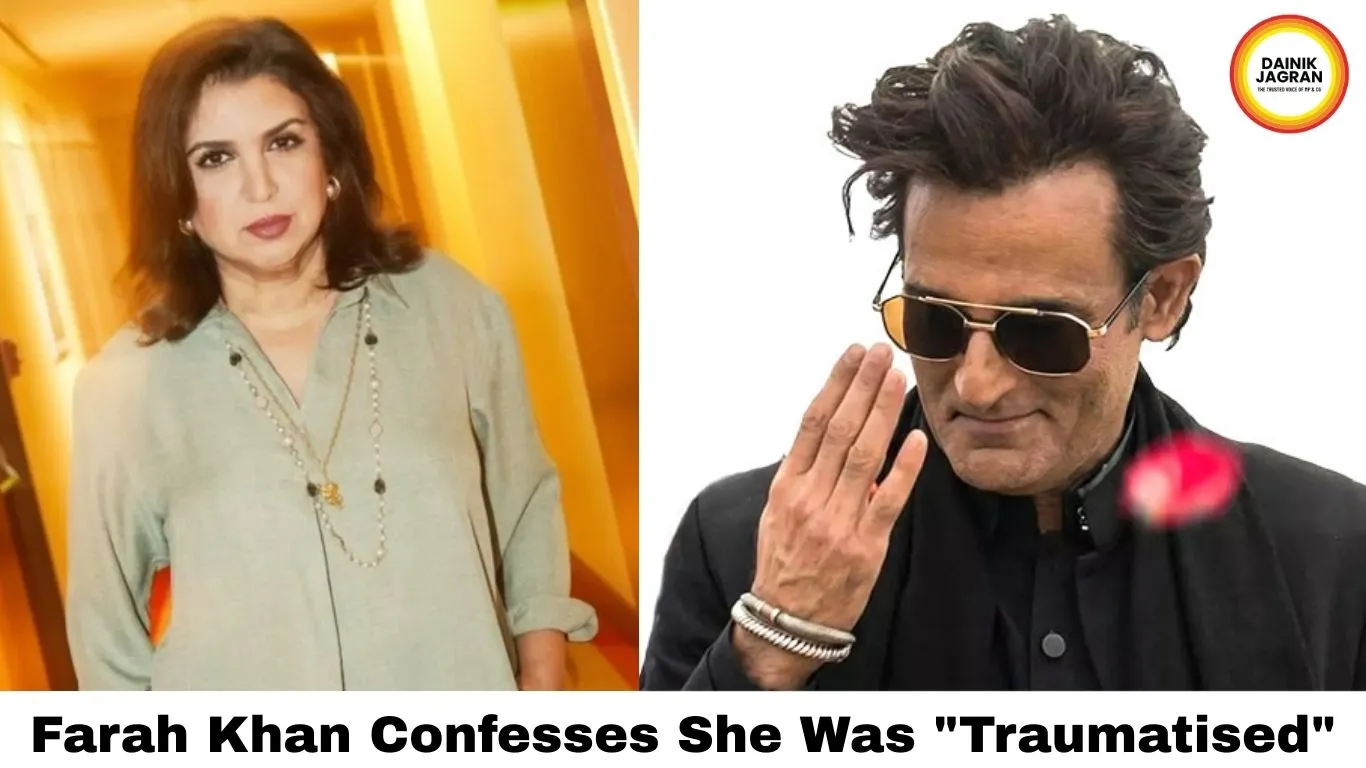
Farah Khan Confesses She Was "Traumatised" Working With Akshaye Khanna in the 90s — The Untold Story of Bollywood's Most Quietly Magnificent Comeback
Digital Desk
The Man Bollywood Gave Up On — Who Refused to Give Up on Himself
There is a particular kind of Bollywood story that the industry tells with enormous relish — the rise, the glittering summit, the catastrophic descent, the wilderness years, and finally, triumphantly, the return. It is a narrative architecture as old as the industry itself, and it has claimed and redeemed some of Hindi cinema's most luminous names.
But Akshaye Khanna's story does not fit neatly into that template. Because Akshaye Khanna never truly descended — he simply disappeared, on his own terms, at his own pace, into a deliberate and sovereign solitude. And when he returned, he did not just reclaim relevance. He redefined it so completely that a new generation of audiences — many of whom had never encountered him in his Border-era glory — are now treating him with the breathless reverence typically reserved for newly discovered icons.
Akshaye Khanna and his aura are getting enormous love from a new generation of audiences, many of whom probably do not know he has been around in Bollywood for nearly three decades. The son of legendary actor Vinod Khanna started his career in 1997 but took several breaks and sabbaticals as his flops and early baldness became burdens.
And now, in the most deliciously candid intervention of the season, filmmaker and choreographer Farah Khan has handed us the most riveting chapter of this story yet — by confessing, with zero diplomatic padding, that she was once so thoroughly traumatised by working with Akshaye Khanna that she actively avoided his films for years.
Farah's Confession: The 90s Akshaye Khan Nobody Talks About
Speaking on Ranveer Allahbadia's podcast, Farah Khan recalled her early experiences working with Akshaye Khanna in the 1990s with disarming candour. "In the '90s, I did a couple of movies with Akshaye, and after that I was traumatised. Because he used to be a different person. Yes, introverted, but not a nice person on set," she said. She added that she would often find excuses to avoid projects that featured him. "Whenever I heard that Akshaye Khanna was in a film, I used to say, 'I don't have the dates'."
The specificity of Farah's recollections is what makes them so utterly compelling. This is not a vague, carefully hedged recollection designed to generate buzz without consequence. This is a woman with thirty years of film industry experience, a legendary eye for talent, and absolutely no incentive to exaggerate — providing a forensically detailed portrait of a young actor in the grip of something that was visibly consuming him.
"I think at that time he himself had said that he was losing his hair. He was constantly irritable. He used to throw things and say, 'What kind of dialogue is this?' He used to be that kind of person," Farah said.
A young man, barely out of his teens, watching his hair disappear in an industry where physicality was not merely an asset but an existential requirement. Reports suggest Akshaye Khanna started facing premature baldness at the age of 19 — a development he himself once described with devastating eloquence as being like a pianist losing his fingers.
That metaphor deserves to be held up and examined in full light. A pianist losing his fingers. Not an inconvenience. Not a setback. An amputation of the very instrument through which he expressed his identity and earned his place in the world. For a young actor in 1990s Bollywood — where heroes were expected to be devastatingly handsome, abundantly hirsute and effortlessly magnetic — the progressive loss of his hair was not merely a cosmetic tragedy. It was an existential crisis wearing the face of a medical condition.
The Rain Songs, the Caps and the Weight of Denial
Farah Khan's observations are not merely gossip — they are a masterclass in the subtle semiotics of on-screen anxiety that filmgoers almost never consciously register but always instinctively absorb.
"Before Dil Chahta Hai, if there was water or rain in a scene, he would always wear a cap — see every rain song of his, such as in Taal. But after Dil Chahta Hai, something changed," Farah observed.
Go back and watch the rain sequences from Akshaye Khanna's pre-2001 filmography with this knowledge in mind, and what you see is not merely an actor in a cap. You see a young man constructing, frame by carefully considered frame, an elaborate architectural defence against the world's gaze. Every cap, every strategic camera angle, every carefully positioned prop was a small act of self-preservation in an industry that had no language of compassion for a leading man's vulnerability.
The cap was not a fashion choice. It was armour.
Dil Chahta Hai: The Film That Changed Everything
Farah noted that Akshaye Khanna underwent a profound and visible transformation around the time of Dil Chahta Hai in 2001. According to her, he appeared far more relaxed and comfortable with himself during that phase. "He had reconciled with his hair. In Dil Chahta Hai, he became very chill," she said.
The word "reconciled" is exquisite in its precision. Not defeated. Not resigned. Reconciled — implying an active, conscious, deeply personal negotiation with a reality he could not alter, arriving finally at a place of acceptance that freed him not just emotionally but artistically.
The winner of two Filmfare Awards — Best Male Debut for Border in 1997 and Best Supporting Actor for Dil Chahta Hai in 2001 — he had earned critical recognition for roles ranging from negative to supporting characters. Twitter But it was the internal transformation that Dil Chahta Hai represented, rather than the award it generated, that proved to be the true hinge point of his career.
A man who had spent his early career fighting his own reflection finally laid down his weapons. And in that surrender — paradoxically, magnificently — he found the authority and ease that would define his finest work for the next two decades.
The Disappearances, the Deliberate Silences
What followed Dil Chahta Hai was a career characterised not by relentless hustle but by a quality of discernment that is almost entirely alien to the commercial logic of mainstream Bollywood.
His filmography shows phases of high output and deliberate breaks as he prioritised quality over quantity. Between 2016 and 2022 he did only eight films but began gaining attention again for his performances, particularly in Mom, Drishyam 2 and Section 375. He again went into a two-year hiatus in 2023 to 2024, preferring only quality projects.
In an industry that equates visibility with relevance and silence with failure, Akshaye Khanna's repeated, unabashed retreats from the spotlight represented either extraordinary confidence or extraordinary indifference — possibly both. While contemporaries hustled through film after film, accumulating credits and brand endorsements with equal urgency, Khanna simply declined to play that game. He sat at home. He watched films. He waited for the right role with the serene patience of a man who had already proved what he needed to prove and had no further interest in performing his own ambition for public consumption.
Farah's Verdict: From "Traumatised" to "Deserves an Oscar"
The arc of Farah Khan's relationship with Akshaye Khanna is, in miniature, the arc of Bollywood's own relationship with him — from bewilderment and avoidance to grudging respect to unqualified, almost disbelieving adoration.
Farah Khan, who gave Akshaye the cult character Aatish Kapoor in Tees Maar Khan, lauded his performance in Dhurandhar in the most extravagant possible terms — declaring that he truly deserves an Oscar. She shared a fan-made post on Instagram cleverly juxtaposing his scenes from Dhurandhar with his memorable moment from Tees Maar Khan.
She proclaimed, with the ebullient certainty of someone who had watched his journey from the closest possible vantage point: "Dhurandhar ke baad, Tees Maar Khan ka hi raj chal raha hai."
From "I used to say I don't have the dates" to "he deserves an Oscar." That is not merely a change of opinion. That is the complete rewriting of a narrative — and it speaks not just to Akshaye Khanna's transformation but to the profound generosity of a woman who is willing to publicly acknowledge that her earlier assessment was entirely and magnificently wrong.
Dhurandhar: The Role That Sealed His Legend
The back-to-back critical and commercial successes of Chhaava and Dhurandhar have effectively positioned Akshaye Khanna as the real Bollywood superstar of 2025, although not in traditional lead roles.
Farah also praised his dancing abilities, referring to the song Koi Kahe Kehta Rahe, calling him a brilliant dancer. National Herald India That combination — the brooding intensity of his antagonist performances, the unexpected grace of his physical presence, the decades of craft quietly accumulated through the wilderness years — has produced something that Bollywood's algorithm-driven, franchise-obsessed, star-power-worshipping ecosystem almost never generates organically: genuine, earned mystique.
Reports suggest Akshaye Khanna wore a hair patch rather than undergoing a hair transplant for his role in Dhurandhar — and he reportedly walked away from Drishyam 3 over a disagreement about wearing a wig, suggesting that even now, three decades on from the anxious young man in the rain-song caps, his relationship with his appearance remains a deeply considered, fiercely personal matter.
The difference is that it is now on his terms entirely. The cap was armour once. Today, the hair patch is a costume — a deliberate creative choice made by a man who has long since ceased to need the world's approval of his reflection.
Conclusion: The Most Interesting Man in Bollywood — And Always Was
Farah Khan's candid revelations about the 1990s Akshaye Khanna are not a scandal. They are, read with proper generosity and context, one of the most quietly moving stories in contemporary Indian cinema — the story of a young man crumbling under the weight of an industry's impossible beauty standards, finding his footing through one transformative film, retreating and returning on his own sovereign terms, and emerging finally as the actor he was always capable of being.
The traumatised young man who threw things on set and wore caps in rain songs is the same man who played Aurangzeb and Rehman Dakait with a terrifying, exhilarating completeness that left audiences stunned. The journey between those two points is not a straight line. It is a long, winding, deeply human road — full of hair-triggered anger and quiet reconciliations and deliberate silences and patient reinventions.
And it is, without question, the most interesting career story Bollywood has produced in a generation.
Farah Khan was once traumatised by Akshaye Khanna. Now she says he deserves an Oscar. In that distance lies the entire, magnificent story.