

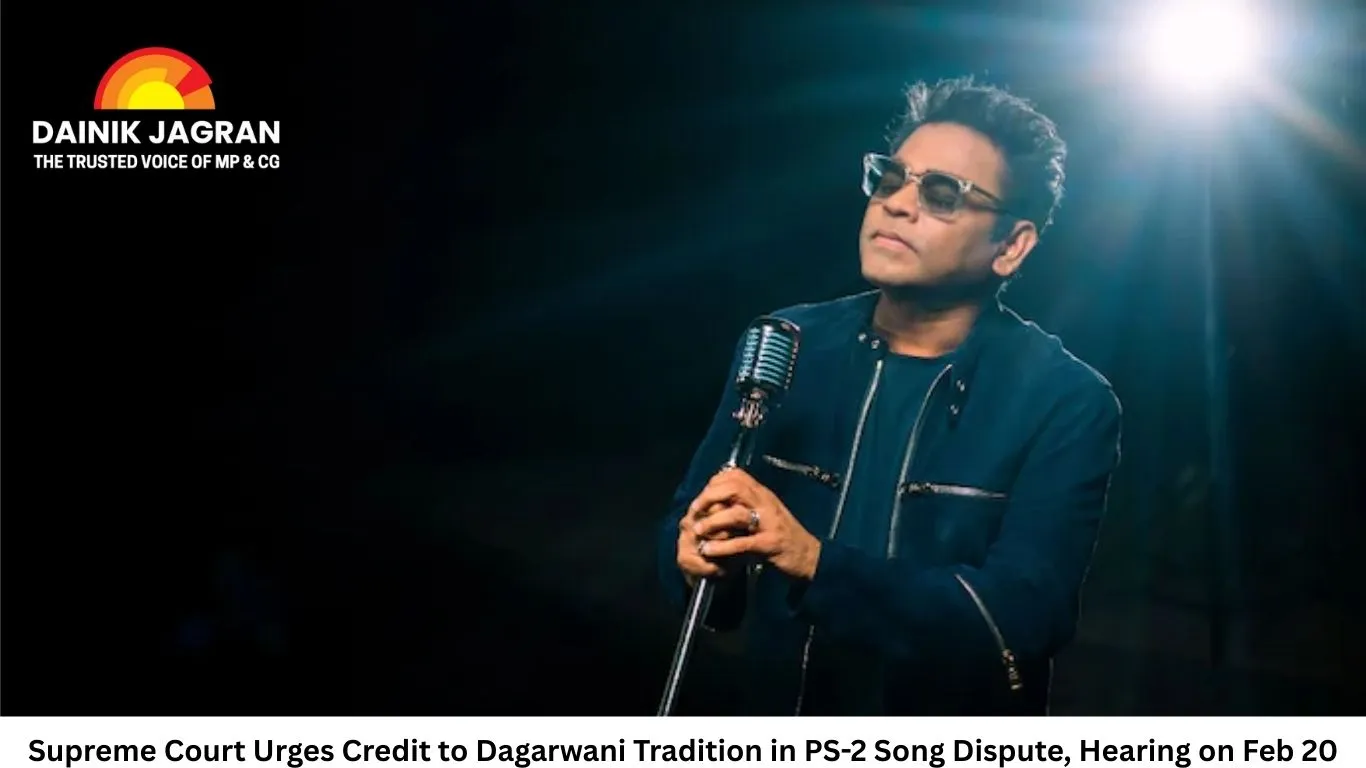
Supreme Court Urges Credit to Dagarwani Tradition in PS-2 Song Dispute, Hearing on Feb 20

Supreme Court Urges Credit to Dagarwani Tradition in PS-2 Song Dispute, Hearing on Feb 20

India’s Supreme Court of India on Friday asked composer A. R. Rahman and the producers of Ponniyin Selvan 2 to ensure that due acknowledgment is given to the Dagarwani classical tradition in the song Veera Raja Veera, while hearing a copyright dispute filed by Dhrupad vocalist Ustad Faiyaz Wasifuddin Dagar. The bench posted the matter for further hearing on February 20.

A bench led by the Chief Justice observed that while the first performers of a composition are not automatically its authors, the court must determine whether the musical piece in question is an original work or derived from an established classical lineage. The judges stressed that India’s gharana traditions have played a foundational role in shaping contemporary music and deserve recognition where their influence is evident.

The petition challenges a September 2025 ruling by the Delhi High Court, which had found no prima facie evidence that the Junior Dagar Brothers created the Shiva Stuti composition that forms the basis of the disputed song. Dagar’s counsel argued before the apex court that the claim is not over ownership of the raga itself but over a specific composition developed by his father and uncle within the family’s musical lineage.

Responding to the bench’s observations, senior advocate Abhishek Singhvi, appearing for Rahman, said that earlier performances of the piece had not drawn objections and that the present claim arose only recently. The court, however, indicated that absence of prior dispute does not preclude legitimate questions about attribution, especially when traditional forms are involved.

The case highlights a broader tension between classical heritage and modern adaptation in the film industry, where compositions rooted in traditional styles are often reinterpreted for contemporary audiences. Legal experts say the outcome could influence how filmmakers credit source traditions when drawing from classical music.

The Dagar lineage is widely regarded as one of the most influential schools of Dhrupad, one of India’s oldest surviving classical vocal traditions. Its practitioners have historically preserved compositions through oral transmission across generations, a practice that can complicate modern copyright claims.

The court did not issue interim restrictions on the song’s use but indicated that acknowledgment of traditional sources may be an appropriate remedy if influence is established. The next hearing is expected to clarify whether attribution alone will resolve the dispute or whether further legal questions regarding authorship will be examined.

--------

🚨 Beat the News Rush – Join Now!

Get breaking alerts, hot exclusives, and game-changing stories instantly on your phone. No delays, no fluff – just the edge you need. ⚡

Tap to join: 

🟢 WhatsApp Channel: Dainik Jagran MP CG

Crave more?

🅕 Facebook: Dainik Jagran MP CG English

🅧 Twitter (X): Dainik Jagran MP CG

🅘 Instagram: Dainik Jagran MP CG

Share the fire – keep your crew ahead! 🗞️🔥

english.dainikjagranmpcg.com
14 Feb 2026 By Nitin Trivedi

Supreme Court Urges Credit to Dagarwani Tradition in PS-2 Song Dispute, Hearing on Feb 20

A bench led by the Chief Justice observed that while the first performers of a composition are not automatically its authors, the court must determine whether the musical piece in question is an original work or derived from an established classical lineage. The judges stressed that India’s gharana traditions have played a foundational role in shaping contemporary music and deserve recognition where their influence is evident.

The petition challenges a September 2025 ruling by the Delhi High Court, which had found no prima facie evidence that the Junior Dagar Brothers created the Shiva Stuti composition that forms the basis of the disputed song. Dagar’s counsel argued before the apex court that the claim is not over ownership of the raga itself but over a specific composition developed by his father and uncle within the family’s musical lineage.

Responding to the bench’s observations, senior advocate Abhishek Singhvi, appearing for Rahman, said that earlier performances of the piece had not drawn objections and that the present claim arose only recently. The court, however, indicated that absence of prior dispute does not preclude legitimate questions about attribution, especially when traditional forms are involved.

The case highlights a broader tension between classical heritage and modern adaptation in the film industry, where compositions rooted in traditional styles are often reinterpreted for contemporary audiences. Legal experts say the outcome could influence how filmmakers credit source traditions when drawing from classical music.

The Dagar lineage is widely regarded as one of the most influential schools of Dhrupad, one of India’s oldest surviving classical vocal traditions. Its practitioners have historically preserved compositions through oral transmission across generations, a practice that can complicate modern copyright claims.

The court did not issue interim restrictions on the song’s use but indicated that acknowledgment of traditional sources may be an appropriate remedy if influence is established. The next hearing is expected to clarify whether attribution alone will resolve the dispute or whether further legal questions regarding authorship will be examined.

https://english.dainikjagranmpcg.com/bollywood/supreme-court-urges-credit-to-dagarwani-tradition-in-ps-2-song/article-14214

Related Posts

Latest News


