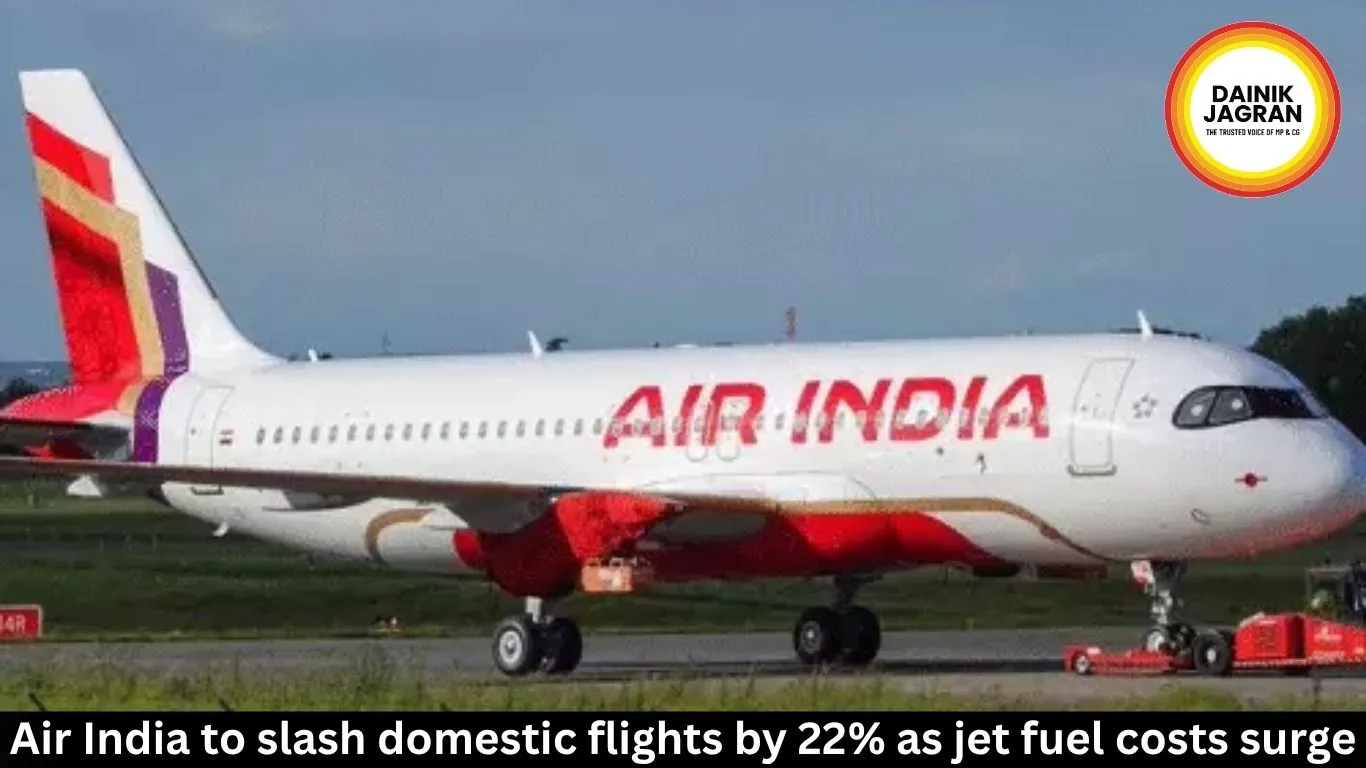
Air India to Cut Domestic Flights by 22% Over Fuel Costs

Digital Desk

Air India to Cut Domestic Flights by 22% Over Fuel Costs

 Air India confirms a temporary 22% reduction in domestic flights from June to August 2026, citing skyrocketing jet fuel prices and West Asia tensions.


Following a major reduction in international services, the carrier announces a temporary capacity rationalisation on domestic routes between June and August 2026.

In a major move reflecting the deepening financial stress on the Indian aviation sector, Air India announced on Wednesday that it will cut its domestic flight operations by up to 22% between June and August 2026. The decision comes on the heels of the airline already scaling back its international network by nearly 27%, as soaring aviation turbine fuel (ATF) prices continue to pressure operational margins.

The Tata Group-owned carrier, which currently operates around 4,400 weekly flights, will see roughly 800 of its 3,600 domestic frequencies affected by this schedule revision.

Escalating operational costs hit network

In an official statement released on Wednesday afternoon, an Air India spokesperson confirmed the development, highlighting that the airline had “temporarily rationalised operations on certain domestic routes” for the upcoming summer-monsoon window.

“In continuation of our previously announced adjustments to select international services between June and August 2026, we have temporarily rationalised operations on certain domestic routes during the same period, with a reduction in frequencies on select routes,” the airline statement noted. “These adjustments are driven by the sustained impact of high fuel prices on overall operations.”

Company sources familiar with the matter indicated that while no specific domestic routes would be completely suspended, frequencies on multiple high-density sectors operating out of major hubs like Delhi and Mumbai are being trimmed down.

Jet fuel price spike changes equations

The primary catalyst behind this aggressive capacity reduction is the steep rise in global crude oil prices, heavily influenced by ongoing geopolitical tensions in West Asia and the closure of key shipping lanes like the Strait of Hormuz. For Indian carriers, jet fuel typically accounts for nearly 40% of total operating expenditures.

According to senior airline officials, Air India's ATF procurement costs have surged from an average of ₹80,000 per kilolitre to well over ₹1 lakh per kilolitre in multiple cities, heavily skewed by varying state-level value-added taxes (VAT). Operating a full domestic schedule under these pricing structures has become commercially unviable, particularly at a time when the carrier is looking to aggressively manage its bottom line after reporting a heavy net loss last fiscal.

Furthermore, the recent suspension of 145 weekly international flights has created a cascading effect, lowering the passenger demand for connecting domestic legs that funnel travellers into metropolitan hubs for overseas departures.

Relieving pressure for affected passengers

With hundreds of weekly flights set to be pulled from the system, passengers booked on the affected flights face imminent disruptions. Addressing these concerns, Air India stated that it has initiated proactive measures to minimise customer inconvenience.

The carrier has committed to offering full refunds, complimentary date modifications, or re-accommodation on alternative flights for those hit by the sudden rationalisation. Ground teams and digital customer service channels are reportedly being scaled up to handle the influx of rebooking requests before the June rollout.

Broader industry faces a tough summer

The capacity cuts at Air India are not an isolated event in the domestic skies. Industry reports indicate that India’s largest carrier, IndiGo, is also contemplating a 5% to 7% reduction in its domestic operations over the same three-month period to counter the fuel price shock.

Aviation analysts warn that this combined reduction in seat capacity by the country's top operators during the peak travel months could inevitably lead to higher ticket pricing across popular domestic circuits, leaving flyers with fewer choices and costlier bookings. Air India maintained that it will continue to closely monitor demand trends and volatile operating conditions, with an intention to restore its normal flight frequencies as soon as the global energy market stabilizes.

 

--------

🚨 Beat the News Rush – Join Now!

Get breaking alerts, hot exclusives, and game-changing stories instantly on your phone. No delays, no fluff – just the edge you need. ⚡

Tap to join: 

🟢 WhatsApp Channel: Dainik Jagran MP CG

Crave more?

🅕 Facebook: Dainik Jagran MP CG English

🅧 Twitter (X): Dainik Jagran MP CG

🅘 Instagram: Dainik Jagran MP CG

Share the fire – keep your crew ahead! 🗞️🔥

english.dainikjagranmpcg.com
27 May 2026 By Abhishek Joshi

Air India to Cut Domestic Flights by 22% Over Fuel Costs

Digital Desk

Following a major reduction in international services, the carrier announces a temporary capacity rationalisation on domestic routes between June and August 2026.

In a major move reflecting the deepening financial stress on the Indian aviation sector, Air India announced on Wednesday that it will cut its domestic flight operations by up to 22% between June and August 2026. The decision comes on the heels of the airline already scaling back its international network by nearly 27%, as soaring aviation turbine fuel (ATF) prices continue to pressure operational margins.

The Tata Group-owned carrier, which currently operates around 4,400 weekly flights, will see roughly 800 of its 3,600 domestic frequencies affected by this schedule revision.

Escalating operational costs hit network

In an official statement released on Wednesday afternoon, an Air India spokesperson confirmed the development, highlighting that the airline had “temporarily rationalised operations on certain domestic routes” for the upcoming summer-monsoon window.

“In continuation of our previously announced adjustments to select international services between June and August 2026, we have temporarily rationalised operations on certain domestic routes during the same period, with a reduction in frequencies on select routes,” the airline statement noted. “These adjustments are driven by the sustained impact of high fuel prices on overall operations.”

Company sources familiar with the matter indicated that while no specific domestic routes would be completely suspended, frequencies on multiple high-density sectors operating out of major hubs like Delhi and Mumbai are being trimmed down.

Jet fuel price spike changes equations

The primary catalyst behind this aggressive capacity reduction is the steep rise in global crude oil prices, heavily influenced by ongoing geopolitical tensions in West Asia and the closure of key shipping lanes like the Strait of Hormuz. For Indian carriers, jet fuel typically accounts for nearly 40% of total operating expenditures.

According to senior airline officials, Air India's ATF procurement costs have surged from an average of ₹80,000 per kilolitre to well over ₹1 lakh per kilolitre in multiple cities, heavily skewed by varying state-level value-added taxes (VAT). Operating a full domestic schedule under these pricing structures has become commercially unviable, particularly at a time when the carrier is looking to aggressively manage its bottom line after reporting a heavy net loss last fiscal.

Furthermore, the recent suspension of 145 weekly international flights has created a cascading effect, lowering the passenger demand for connecting domestic legs that funnel travellers into metropolitan hubs for overseas departures.

Relieving pressure for affected passengers

With hundreds of weekly flights set to be pulled from the system, passengers booked on the affected flights face imminent disruptions. Addressing these concerns, Air India stated that it has initiated proactive measures to minimise customer inconvenience.

The carrier has committed to offering full refunds, complimentary date modifications, or re-accommodation on alternative flights for those hit by the sudden rationalisation. Ground teams and digital customer service channels are reportedly being scaled up to handle the influx of rebooking requests before the June rollout.

Broader industry faces a tough summer

The capacity cuts at Air India are not an isolated event in the domestic skies. Industry reports indicate that India’s largest carrier, IndiGo, is also contemplating a 5% to 7% reduction in its domestic operations over the same three-month period to counter the fuel price shock.

Aviation analysts warn that this combined reduction in seat capacity by the country's top operators during the peak travel months could inevitably lead to higher ticket pricing across popular domestic circuits, leaving flyers with fewer choices and costlier bookings. Air India maintained that it will continue to closely monitor demand trends and volatile operating conditions, with an intention to restore its normal flight frequencies as soon as the global energy market stabilizes.

 

https://english.dainikjagranmpcg.com/business/air-india-to-cut-domestic-flights-by-22-over-fuel/article-19315

Related Posts

Latest News

Dindori Ranks 2nd in India Water Conservation 2026 Dindori Ranks 2nd in India Water Conservation 2026
  Dindori district secures second national spot in water conservation with 6.26 lakh community-built structures. Citizen-led initiative transforms water-scarce Madhya
MP cites drone images; no fresh Chambal mining — SC
Tension in Khandwa After Bovine Remains Found; 4 Arrested
Two Killed in Dewas Road Accident on Shipra Bypass Bridge
MP Weather Turns Dramatic: Lightning Damages Guna Temple as Rain Hits 26 Districts
Live Bomb Found at Jabalpur Construction Site | Army Called
Raipur Businessman Ajay Nihalani Dies of Heart Attack in Lisbon