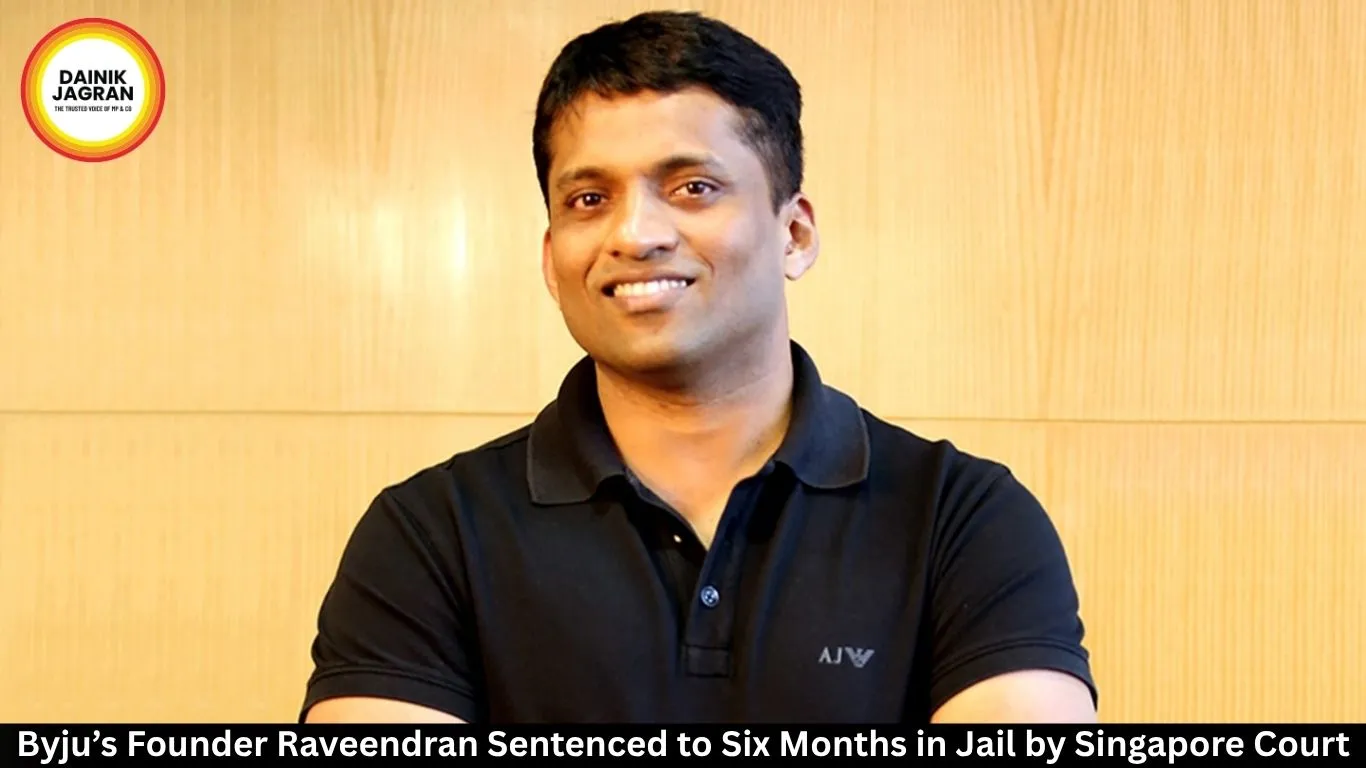
Byju Raveendran Sentenced to 6 Months Jail in Singapore
Digital Desk
A Singapore court has sentenced Byju’s founder Byju Raveendran to six months in jail for contempt of court over missing asset disclosure documents.
In a major escalation of the legal troubles surrounding one of India’s most prominent tech entrepreneurs, a Singapore court has sentenced Byju Raveendran, the founder of embattled edtech firm Byju’s, to six months in prison. The order, issued after the court found Raveendran guilty of contempt, stems from his repeated failure to comply with judicial mandates regarding asset disclosures.
The court found that Raveendran had deliberately disobeyed multiple disclosure orders dating back to April 2024. Alongside the prison term, he has been ordered to immediately surrender to authorities and pay S$90,000 (approximately ₹67 lakh) to cover legal costs.
Non-Compliance Over Assets
The legal proceedings in Singapore center on Raveendran's failure to provide clear information regarding his personal assets and corporate holdings. In addition to the prison sentence, the court has ordered him to furnish documents proving his legal ownership of Beeaar Investco Pte, a Singapore-registered corporate entity that holds shares in a related company.
Sources familiar with the matter said the court took a stern view of the continuous delays, noting that the founder had been given multiple opportunities since April last year to comply with the asset tracing instructions.
Qatar Investment Arm Escalates
The case against the Byju's founder was mounted by a subsidiary of the Qatar Investment Authority (QIA), the Gulf nation’s sovereign wealth fund. QIA had injected capital into the edtech platform during a later-stage funding round—a period when Think & Learn Pvt Ltd, the parent company of Byju’s, was already floundering under severe financial stress, leading to mass layoffs and cost-cutting measures.
During the hearings, Qatar Holdings was represented by prominent law firm Drew & Napier, while Fervent Chambers appeared on behalf of Byju's Investments.
Settlement Talks Progressing
Responding to the development via a series of statements on social media platform X, Byju Raveendran termed the ruling a "procedural contempt of court order" arising from document disclosure disputes rather than any finding of fraud or dishonesty on the merits of the case.
"For months, the lenders (including GLAS Trust and QIA), other stakeholders, and us (the founders) have been in advanced settlement discussions," Raveendran stated. He claimed that a settlement has been agreed in principle, with only minor residual issues remaining between certain parties that do not directly involve him.
"I chose resolution over confrontation," Raveendran added, calling QIA's decision to press for the contempt order an "unnecessary pressure tactic" at a highly sensitive stage of negotiations. He has been directed to appear before the court on June 15, and his legal team is presently contemplating an appeal alongside an application for a stay on the committal order.
Global Legal Battles Mount
The Singapore jail sentence adds to an increasingly complex web of international litigation for the former billionaire. In the United States, Raveendran remains locked in a high-stakes battle with a consortium of overseas lenders represented by GLAS Trust. The creditors are aggressively fighting to locate and recover assets tied to a soured $1.2 billion (approx. ₹11,000 crore) term loan raised in 2021.
A US bankruptcy court had previously held Raveendran in civil contempt for refusing to cooperate with legal efforts to track down nearly half the proceeds of that loan, which vanished from the company's accounts as its financial situation deteriorated.
From Poster Boy to Crisis
Raveendran’s meteoric rise and subsequent legal quagmire have come to symbolize the volatile boom-and-bust cycle of India’s startup ecosystem. From a small learning app, he built Byju’s into a global education technology giant valued at $22 billion at its peak, earning himself a spot among the world's youngest billionaires.
However, aggressive international acquisitions, heavy marketing spending, high-pressure sales tactics, and severe corporate governance failures eventually triggered a liquidity crisis. It remains unclear exactly where Raveendran is currently located or whether he will surrender to Singaporean officials before his scheduled June 15 court appearance.

--------
🚨 Beat the News Rush – Join Now!
Get breaking alerts, hot exclusives, and game-changing stories instantly on your phone. No delays, no fluff – just the edge you need. ⚡
Tap to join:
🟢 WhatsApp Channel: Dainik Jagran MP CG
Crave more?
🅕 Facebook: Dainik Jagran MP CG English
🅧 Twitter (X): Dainik Jagran MP CG
🅘 Instagram: Dainik Jagran MP CG
Share the fire – keep your crew ahead! 🗞️🔥
Byju Raveendran Sentenced to 6 Months Jail in Singapore
Digital Desk
In a major escalation of the legal troubles surrounding one of India’s most prominent tech entrepreneurs, a Singapore court has sentenced Byju Raveendran, the founder of embattled edtech firm Byju’s, to six months in prison. The order, issued after the court found Raveendran guilty of contempt, stems from his repeated failure to comply with judicial mandates regarding asset disclosures.
The court found that Raveendran had deliberately disobeyed multiple disclosure orders dating back to April 2024. Alongside the prison term, he has been ordered to immediately surrender to authorities and pay S$90,000 (approximately ₹67 lakh) to cover legal costs.
Non-Compliance Over Assets
The legal proceedings in Singapore center on Raveendran's failure to provide clear information regarding his personal assets and corporate holdings. In addition to the prison sentence, the court has ordered him to furnish documents proving his legal ownership of Beeaar Investco Pte, a Singapore-registered corporate entity that holds shares in a related company.
Sources familiar with the matter said the court took a stern view of the continuous delays, noting that the founder had been given multiple opportunities since April last year to comply with the asset tracing instructions.
Qatar Investment Arm Escalates
The case against the Byju's founder was mounted by a subsidiary of the Qatar Investment Authority (QIA), the Gulf nation’s sovereign wealth fund. QIA had injected capital into the edtech platform during a later-stage funding round—a period when Think & Learn Pvt Ltd, the parent company of Byju’s, was already floundering under severe financial stress, leading to mass layoffs and cost-cutting measures.
During the hearings, Qatar Holdings was represented by prominent law firm Drew & Napier, while Fervent Chambers appeared on behalf of Byju's Investments.
Settlement Talks Progressing
Responding to the development via a series of statements on social media platform X, Byju Raveendran termed the ruling a "procedural contempt of court order" arising from document disclosure disputes rather than any finding of fraud or dishonesty on the merits of the case.
"For months, the lenders (including GLAS Trust and QIA), other stakeholders, and us (the founders) have been in advanced settlement discussions," Raveendran stated. He claimed that a settlement has been agreed in principle, with only minor residual issues remaining between certain parties that do not directly involve him.
"I chose resolution over confrontation," Raveendran added, calling QIA's decision to press for the contempt order an "unnecessary pressure tactic" at a highly sensitive stage of negotiations. He has been directed to appear before the court on June 15, and his legal team is presently contemplating an appeal alongside an application for a stay on the committal order.
Global Legal Battles Mount
The Singapore jail sentence adds to an increasingly complex web of international litigation for the former billionaire. In the United States, Raveendran remains locked in a high-stakes battle with a consortium of overseas lenders represented by GLAS Trust. The creditors are aggressively fighting to locate and recover assets tied to a soured $1.2 billion (approx. ₹11,000 crore) term loan raised in 2021.
A US bankruptcy court had previously held Raveendran in civil contempt for refusing to cooperate with legal efforts to track down nearly half the proceeds of that loan, which vanished from the company's accounts as its financial situation deteriorated.
From Poster Boy to Crisis
Raveendran’s meteoric rise and subsequent legal quagmire have come to symbolize the volatile boom-and-bust cycle of India’s startup ecosystem. From a small learning app, he built Byju’s into a global education technology giant valued at $22 billion at its peak, earning himself a spot among the world's youngest billionaires.
However, aggressive international acquisitions, heavy marketing spending, high-pressure sales tactics, and severe corporate governance failures eventually triggered a liquidity crisis. It remains unclear exactly where Raveendran is currently located or whether he will surrender to Singaporean officials before his scheduled June 15 court appearance.