

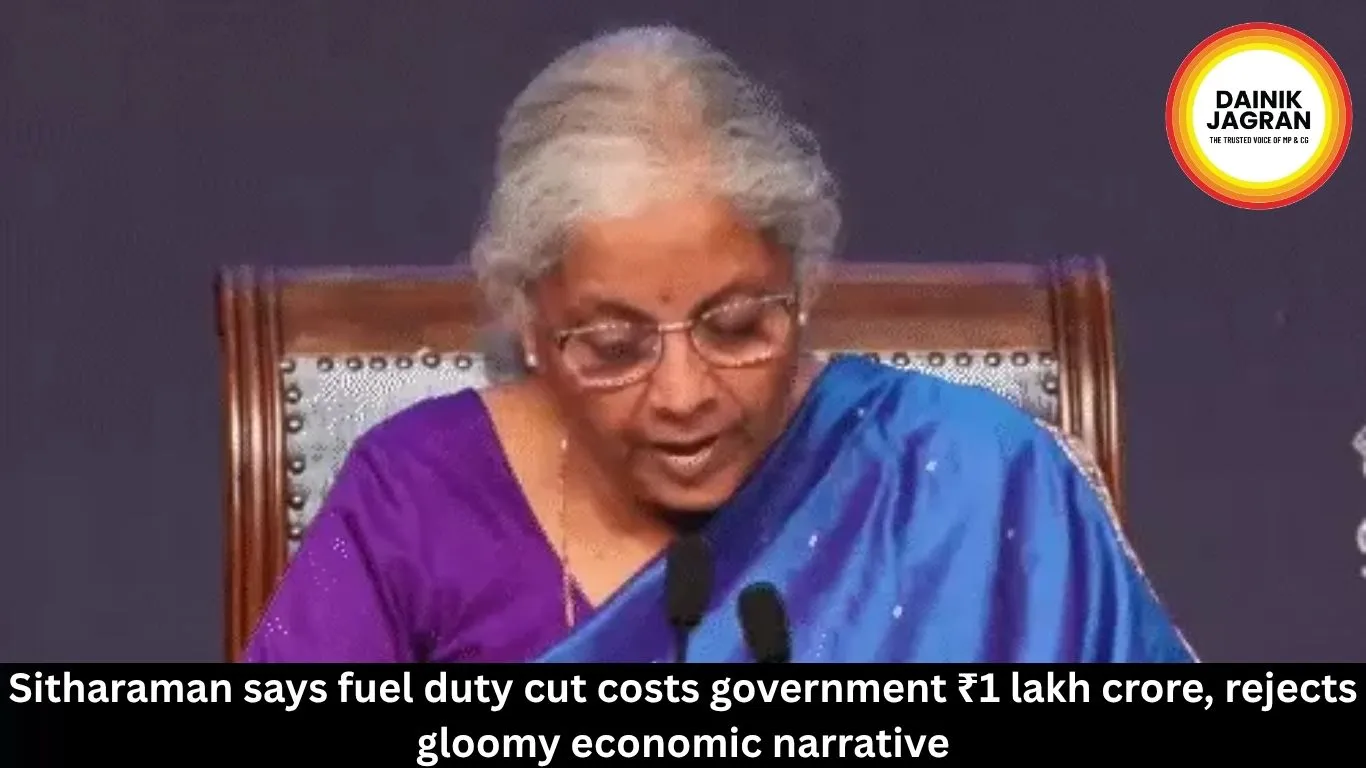
Excise duty cut costs govt ₹1 lakh crore — Sitharaman

Digital Desk

Excise duty cut costs govt ₹1 lakh crore — Sitharaman

Finance Minister Nirmala Sitharaman says the excise duty cut on petrol-diesel cost government about ₹1 lakh crore, defends growth and urges PSUs to clear MSME dues.


Finance minister warns excise reduction hits revenue while defending India’s growth momentum and urging PSUs to clear MSME dues

Finance Minister Nirmala Sitharaman on Monday said the central government faces an estimated revenue loss of about ₹1 lakh crore after it reduced excise duty on petrol and diesel, and criticised what she called an “incorrect pessimistic atmosphere” about India’s economic prospects.

Opening remarks at the 37th foundation day of the Small Industries Development Bank of India (SIDBI) in Mumbai, the minister defended the policy choice to pare fuel levies while insisting that external shocks — not domestic policy failures — are the main source of current pressures on the economy.

Duty cut and revenue impact
According to officials and budget estimates cited by the ministry, the special excise duty on petrol was cut by ₹10 per litre on March 27 — from ₹13 to ₹3 — and the levy on diesel was lowered from ₹10 to zero. That move, Sitharaman said, brought the total central excise burden on petrol down from about ₹21.90 per litre to ₹11.90 and on diesel from ₹17.80 to ₹7.80, triggering an estimated government revenue shortfall of roughly ₹1 lakh crore.

“The relief to consumers was intended and necessary given global energy market volatility,” she said, while also noting the fiscal trade-off involved in the measure.

Fuel prices rise despite relief
The comments came as oil marketing companies increased retail fuel prices on Monday for the fourth time in ten days. Since May 15, petrol and diesel prices have risen by about ₹7.50 per litre amid volatile international crude prices. Initial reports from urban fuel stations in Mumbai and Delhi showed pumps reflecting the latest hikes late on Monday evening.

Sitharaman said the excise cut nevertheless provided direct relief to families and businesses grappling with higher global energy costs brought on by the West Asia crisis. “This was aimed at cushioning households and industry,” she added.

External headwinds, she argued
Delivering a broader assessment of macroeconomic conditions, the finance minister said much of the pressure on India stems from external factors — chiefly commodity cycles and currency movements — rather than domestic policy. She pointed to the need for foreign exchange to import gold, fuel and fertiliser, items whose prices and availability are shaped by global markets.

“India remains one of the fastest-growing major economies,” Sitharaman said, adding that high-frequency indicators continue to show robust industrial demand and momentum. She urged critics not to conflate short-term external shocks with structural weakness.

Pessimism and political debate
Sitharaman’s remarks carried an unmistakable political undertone. She accused some quarters of deliberately creating a pessimistic narrative about India’s growth at a time of external stress. “Casting doubt on achievements in the face of external pressures is wrong,” she said, describing such commentary as misplaced and inappropriate.

Opposition parties and some economists have repeatedly questioned the quality of growth, pointing to consumption slowdowns, inflationary pressures and currency volatility. Analysts say the debate has intensified as policymakers balance inflation control, growth support and fiscal prudence.

PSUs, MSME payments and governance
On the sidelines of the economic argument, the finance minister issued firm instructions to public sector undertakings and large government buyers to adhere to the mandatory 45-day payment rule for micro, small and medium enterprises. Sitharaman warned that delays in clearing dues would not be tolerated and urged timely payments to safeguard MSME cash flows.

The 45-day rule requires large and government companies to settle invoices within 45 days of receiving goods or services; failure to do so can trigger interest liabilities and penalties.

What’s next
Markets and fiscal watchers will now track how the estimated ₹1 lakh crore revenue impact shapes near-term fiscal math, including borrowing plans and expenditure priorities. The government has signalled that the excise cut is a targeted relief step in response to global supply disruptions; how long it remains in place may depend on international oil prices and fiscal considerations.

Local traders and small businesses said they welcomed the relief at pumps but noted that repeated price swings have made planning harder. “Any help in pump prices is welcome, but volatility is what affects us most,” a transport operator in Mumbai said.


--------

🚨 Beat the News Rush – Join Now!

Get breaking alerts, hot exclusives, and game-changing stories instantly on your phone. No delays, no fluff – just the edge you need. ⚡

Tap to join: 

🟢 WhatsApp Channel: Dainik Jagran MP CG

Crave more?

🅕 Facebook: Dainik Jagran MP CG English

🅧 Twitter (X): Dainik Jagran MP CG

🅘 Instagram: Dainik Jagran MP CG

Share the fire – keep your crew ahead! 🗞️🔥

english.dainikjagranmpcg.com
26 May 2026 By Abhishek Joshi

Excise duty cut costs govt ₹1 lakh crore — Sitharaman

Digital Desk

Finance minister warns excise reduction hits revenue while defending India’s growth momentum and urging PSUs to clear MSME dues

Finance Minister Nirmala Sitharaman on Monday said the central government faces an estimated revenue loss of about ₹1 lakh crore after it reduced excise duty on petrol and diesel, and criticised what she called an “incorrect pessimistic atmosphere” about India’s economic prospects.

Opening remarks at the 37th foundation day of the Small Industries Development Bank of India (SIDBI) in Mumbai, the minister defended the policy choice to pare fuel levies while insisting that external shocks — not domestic policy failures — are the main source of current pressures on the economy.

Duty cut and revenue impact
According to officials and budget estimates cited by the ministry, the special excise duty on petrol was cut by ₹10 per litre on March 27 — from ₹13 to ₹3 — and the levy on diesel was lowered from ₹10 to zero. That move, Sitharaman said, brought the total central excise burden on petrol down from about ₹21.90 per litre to ₹11.90 and on diesel from ₹17.80 to ₹7.80, triggering an estimated government revenue shortfall of roughly ₹1 lakh crore.

“The relief to consumers was intended and necessary given global energy market volatility,” she said, while also noting the fiscal trade-off involved in the measure.

Fuel prices rise despite relief
The comments came as oil marketing companies increased retail fuel prices on Monday for the fourth time in ten days. Since May 15, petrol and diesel prices have risen by about ₹7.50 per litre amid volatile international crude prices. Initial reports from urban fuel stations in Mumbai and Delhi showed pumps reflecting the latest hikes late on Monday evening.

Sitharaman said the excise cut nevertheless provided direct relief to families and businesses grappling with higher global energy costs brought on by the West Asia crisis. “This was aimed at cushioning households and industry,” she added.

External headwinds, she argued
Delivering a broader assessment of macroeconomic conditions, the finance minister said much of the pressure on India stems from external factors — chiefly commodity cycles and currency movements — rather than domestic policy. She pointed to the need for foreign exchange to import gold, fuel and fertiliser, items whose prices and availability are shaped by global markets.

“India remains one of the fastest-growing major economies,” Sitharaman said, adding that high-frequency indicators continue to show robust industrial demand and momentum. She urged critics not to conflate short-term external shocks with structural weakness.

Pessimism and political debate
Sitharaman’s remarks carried an unmistakable political undertone. She accused some quarters of deliberately creating a pessimistic narrative about India’s growth at a time of external stress. “Casting doubt on achievements in the face of external pressures is wrong,” she said, describing such commentary as misplaced and inappropriate.

Opposition parties and some economists have repeatedly questioned the quality of growth, pointing to consumption slowdowns, inflationary pressures and currency volatility. Analysts say the debate has intensified as policymakers balance inflation control, growth support and fiscal prudence.

PSUs, MSME payments and governance
On the sidelines of the economic argument, the finance minister issued firm instructions to public sector undertakings and large government buyers to adhere to the mandatory 45-day payment rule for micro, small and medium enterprises. Sitharaman warned that delays in clearing dues would not be tolerated and urged timely payments to safeguard MSME cash flows.

The 45-day rule requires large and government companies to settle invoices within 45 days of receiving goods or services; failure to do so can trigger interest liabilities and penalties.

What’s next
Markets and fiscal watchers will now track how the estimated ₹1 lakh crore revenue impact shapes near-term fiscal math, including borrowing plans and expenditure priorities. The government has signalled that the excise cut is a targeted relief step in response to global supply disruptions; how long it remains in place may depend on international oil prices and fiscal considerations.

Local traders and small businesses said they welcomed the relief at pumps but noted that repeated price swings have made planning harder. “Any help in pump prices is welcome, but volatility is what affects us most,” a transport operator in Mumbai said.


https://english.dainikjagranmpcg.com/business/excise-duty-cut-costs-govt-%E2%82%B91-lakh-crore-%E2%80%94-sitharaman/article-19234

Related Posts

Latest News


