


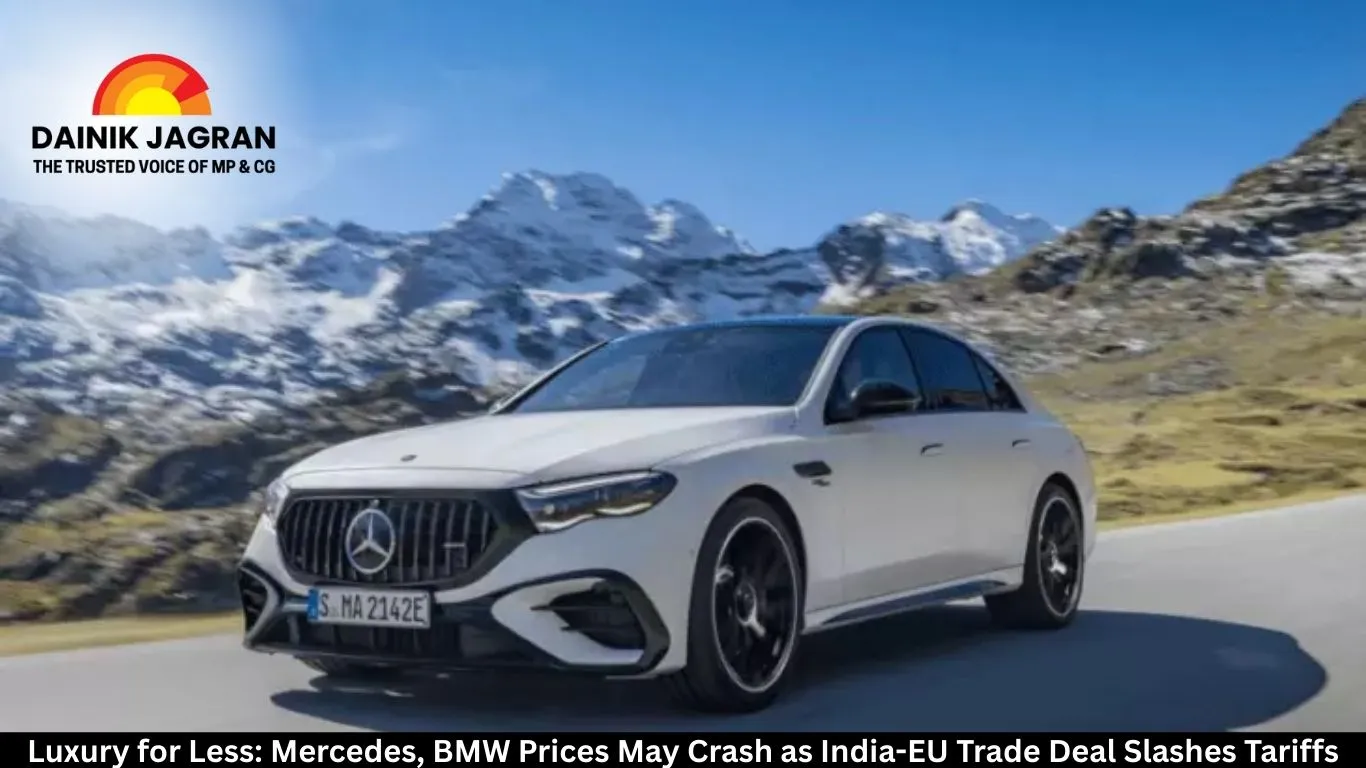
Luxury for Less: Mercedes, BMW Prices May Crash as India-EU Trade Deal Slashes Tariffs
Digital Desk
The dream of owning a German-engineered masterpiece is about to get significantly more affordable for Indian car enthusiasts. In a landmark development at the 16th India-EU Summit in New Delhi today, January 27, 2026, Prime Minister Narendra Modi and European Commission President Ursula von der Leyen officially concluded the long-awaited India-EU FTA (Free Trade Agreement).
Touted as the "mother of all deals," this historic pact is set to revolutionize the Indian automotive landscape by sharply reducing the heavy car import tariffs in India that have long kept luxury brands out of reach for many.
A Massive 110% to 40% Tariff Cut
For decades, India has maintained some of the world’s highest barriers for imported vehicles, with duties ranging from 70% to a staggering 110%. Under the new India-EU FTA, these numbers are slated for a dramatic haircut.
According to official reports, the government has agreed to:
-
Initial Reduction: Cut import duties on European cars priced above €15,000 (approx. ₹16.3 lakh) from 110% down to 40% immediately.
-
Long-term Goal: Gradually phase down these tariffs to a mere 10% by 2030.
-
Annual Quota: The reduced rates will apply to a generous quota of 250,000 petrol and diesel vehicles per year.
Which Brands Will Benefit?
The primary beneficiaries of this deal are the stalwarts of European luxury. A significant Mercedes price drop in India is expected for their high-end CBU (Completely Built Unit) models, alongside similar price corrections for BMW, Audi, and Volkswagen.
While many of these brands already assemble cars locally in India to avoid the highest taxes, the FTA allows them to import niche, high-performance, and ultra-luxury models at much more competitive price points. This move is expected to help European carmakers expand their current 4% share of the 4.4-million-unit Indian market.
Key Takeaway: If you’ve been eyeing a top-tier European import, the "sticker shock" is about to soften considerably as these duty cuts trickle down to showroom prices.
Why Now? The Global Context
The timing of this agreement is no coincidence. As global trade faces uncertainty due to shifting tariff policies in the United States and evolving supply chains, both India and the EU have sought to create a "de-risked corridor."
By linking two economies that represent 25% of the global GDP, the deal provides India with a strategic alternative and secures Europe a first-mover advantage in the world’s fastest-growing major economy.
The Catch: EVs and Local Industry
While petrol and diesel enthusiasts have reason to celebrate, the government is playing a cautious game with the future of mobility. To protect domestic giants like Tata Motors and Mahindra & Mahindra, electric vehicles (EVs) have been excluded from these duty cuts for the first five years. This ensures that the local EV ecosystem, currently seeing billions in investment, has time to mature before facing direct competition from European-made electric imports.
Conclusion: A Win-Win for the Indian Buyer
The finalization of the India-EU FTA marks the end of a 19-year negotiation journey. For the Indian consumer, it means more choice, better technology, and a more competitive BMW India luxury car market. As the deal moves toward implementation early next year, the road to owning a premium European car has never looked smoother.
.jpg)




