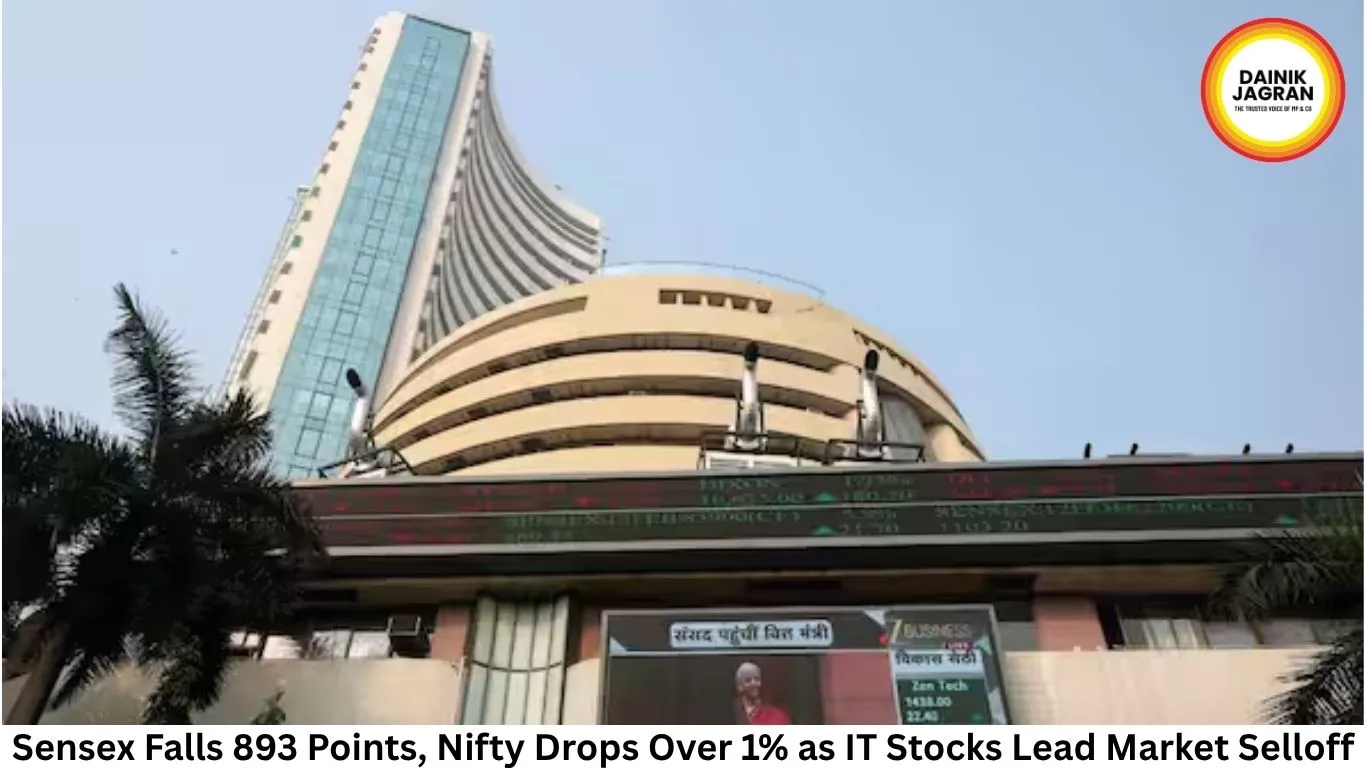
Sensex Falls 893 Points, Nifty Drops Over 1% as IT Stocks Lead Market Selloff

Digital Desk

Sensex Falls 893 Points, Nifty Drops Over 1% as IT Stocks Lead Market Selloff

Global market concerns and heavy selling in technology stocks weighed on Indian equities on Tuesday. Investors remained cautious amid uncertainty surrounding US-Iran peace negotiations, while benchmark indices witnessed broad-based selling pressure across key sectors.

Indian stock markets ended sharply lower on Tuesday, with benchmark indices posting their biggest single-day decline in recent sessions. The BSE Sensex plunged 893.39 points to settle at 76,200.68, while the NSE Nifty closed with losses of more than 1%, reflecting weak investor sentiment across sectors.

The decline came amid growing uncertainty over geopolitical developments in West Asia and concerns about the effectiveness of ongoing diplomatic efforts between the United States and Iran. Market participants adopted a cautious approach, leading to broad-based selling in equities, particularly in information technology and metal stocks.

Among the major laggards on the Sensex were Infosys, TCS, HCL Technologies, Tata Steel, Bharat Electronics and Adani Ports. The sharp fall in IT stocks played a significant role in dragging benchmark indices lower as investors reduced exposure to sectors sensitive to global economic conditions.

Sector-wise, the Nifty IT and Metal indices emerged as the biggest losers during the session. In contrast, the pharmaceutical sector offered some resilience, with the Nifty Pharma index gaining nearly 1% as investors sought defensive opportunities amid market volatility.

IT Stocks Under Pressure

Technology companies faced significant selling pressure due to concerns about global demand and uncertainty in international markets. Analysts noted that any slowdown in major overseas economies could impact earnings prospects for export-oriented IT firms, prompting investors to book profits.

Metal stocks also witnessed weakness as traders monitored developments in global commodity markets and economic growth forecasts. The sector remained sensitive to changing expectations regarding industrial demand and trade activity.

Global market cues further added to investor caution. Most Asian markets ended in negative territory. South Korea's KOSPI index recorded the sharpest decline, falling more than 4%, while Japan's Nikkei and Hong Kong's Hang Seng also closed lower.

Oil Prices and Currency Movement

Despite geopolitical tensions, crude oil prices remained below the $80 per barrel mark. Brent crude continued trading significantly below the highs witnessed during the recent Iran conflict, offering some relief to oil-importing economies such as India.

Meanwhile, the Indian rupee weakened by 11 paise during the session to close at 94.74 against the US dollar. However, the currency has appreciated nearly 3% over the past month, supported by improving capital flows and easing pressure from global energy prices.

According to market data, foreign institutional investors (FIIs) have purchased shares worth approximately ₹3,300 crore over the last seven trading sessions, indicating selective confidence in Indian equities despite near-term volatility. Domestic institutional investors (DIIs) also remained net buyers, helping cushion the overall market decline.

In the primary market, investor attention shifted to the opening of the Waterways Leisure Tourism Limited IPO. The company, which operates Cordelia Cruises in India, launched its public issue with plans to raise ₹585 crore. The IPO will remain open for subscription until June 25, with a price band fixed between ₹769 and ₹808 per share.

Market experts believe investors will continue to monitor geopolitical developments, crude oil prices, foreign investment trends and corporate earnings for further direction. While short-term volatility may persist, analysts maintain that domestic economic fundamentals remain a key support for the broader market outlook.

The sharp Sensex crash and Nifty decline underscore the influence of global developments on investor sentiment, making upcoming international and domestic policy signals crucial for market direction in the coming weeks.


--------

🚨 Beat the News Rush – Join Now!

Get breaking alerts, hot exclusives, and game-changing stories instantly on your phone. No delays, no fluff – just the edge you need. ⚡

Tap to join: 

🟢 WhatsApp Channel: Dainik Jagran MP CG

Crave more?

🅕 Facebook: Dainik Jagran MP CG English

🅧 Twitter (X): Dainik Jagran MP CG

🅘 Instagram: Dainik Jagran MP CG

Share the fire – keep your crew ahead! 🗞️🔥

english.dainikjagranmpcg.com
23 Jun 2026 By Rishita

Sensex Falls 893 Points, Nifty Drops Over 1% as IT Stocks Lead Market Selloff

Digital Desk

Indian stock markets ended sharply lower on Tuesday, with benchmark indices posting their biggest single-day decline in recent sessions. The BSE Sensex plunged 893.39 points to settle at 76,200.68, while the NSE Nifty closed with losses of more than 1%, reflecting weak investor sentiment across sectors.

The decline came amid growing uncertainty over geopolitical developments in West Asia and concerns about the effectiveness of ongoing diplomatic efforts between the United States and Iran. Market participants adopted a cautious approach, leading to broad-based selling in equities, particularly in information technology and metal stocks.

Among the major laggards on the Sensex were Infosys, TCS, HCL Technologies, Tata Steel, Bharat Electronics and Adani Ports. The sharp fall in IT stocks played a significant role in dragging benchmark indices lower as investors reduced exposure to sectors sensitive to global economic conditions.

Sector-wise, the Nifty IT and Metal indices emerged as the biggest losers during the session. In contrast, the pharmaceutical sector offered some resilience, with the Nifty Pharma index gaining nearly 1% as investors sought defensive opportunities amid market volatility.

IT Stocks Under Pressure

Technology companies faced significant selling pressure due to concerns about global demand and uncertainty in international markets. Analysts noted that any slowdown in major overseas economies could impact earnings prospects for export-oriented IT firms, prompting investors to book profits.

Metal stocks also witnessed weakness as traders monitored developments in global commodity markets and economic growth forecasts. The sector remained sensitive to changing expectations regarding industrial demand and trade activity.

Global market cues further added to investor caution. Most Asian markets ended in negative territory. South Korea's KOSPI index recorded the sharpest decline, falling more than 4%, while Japan's Nikkei and Hong Kong's Hang Seng also closed lower.

Oil Prices and Currency Movement

Despite geopolitical tensions, crude oil prices remained below the $80 per barrel mark. Brent crude continued trading significantly below the highs witnessed during the recent Iran conflict, offering some relief to oil-importing economies such as India.

Meanwhile, the Indian rupee weakened by 11 paise during the session to close at 94.74 against the US dollar. However, the currency has appreciated nearly 3% over the past month, supported by improving capital flows and easing pressure from global energy prices.

According to market data, foreign institutional investors (FIIs) have purchased shares worth approximately ₹3,300 crore over the last seven trading sessions, indicating selective confidence in Indian equities despite near-term volatility. Domestic institutional investors (DIIs) also remained net buyers, helping cushion the overall market decline.

In the primary market, investor attention shifted to the opening of the Waterways Leisure Tourism Limited IPO. The company, which operates Cordelia Cruises in India, launched its public issue with plans to raise ₹585 crore. The IPO will remain open for subscription until June 25, with a price band fixed between ₹769 and ₹808 per share.

Market experts believe investors will continue to monitor geopolitical developments, crude oil prices, foreign investment trends and corporate earnings for further direction. While short-term volatility may persist, analysts maintain that domestic economic fundamentals remain a key support for the broader market outlook.

The sharp Sensex crash and Nifty decline underscore the influence of global developments on investor sentiment, making upcoming international and domestic policy signals crucial for market direction in the coming weeks.

https://english.dainikjagranmpcg.com/business/sensex-falls-893-points-nifty-drops-over-1-as-it/article-20518

Latest News