

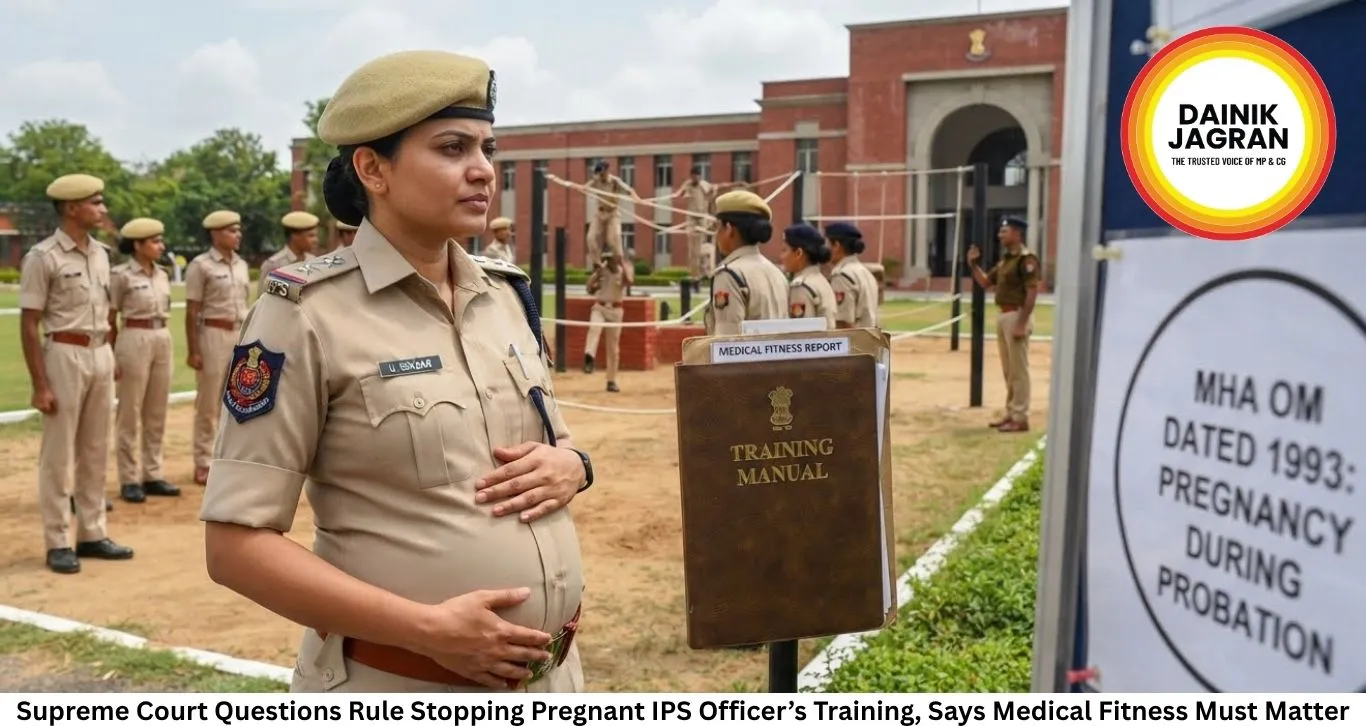
Supreme Court Questions Rule Stopping Pregnant IPS Officer’s Training, Says Medical Fitness Must Matter
Digital desk
The Supreme Court has raised serious questions over a decades-old government rule that prevents pregnant IPS officers from continuing their training, observing that a medically fit woman should not be denied an opportunity solely because of pregnancy.
The remarks came during the hearing of a petition filed by Urvashi Sengar, a 2023-batch Indian Police Service officer allotted to the Madhya Pradesh cadre. Sengar had approached the court after being barred from completing her training due to pregnancy under a Ministry of Home Affairs office memorandum issued in 1993.
While the apex court declined to direct her immediate inclusion in the ongoing training programme, it made it clear that the broader issue raised in the petition deserves consideration. A bench comprising Justice Manoj Misra and Justice S. Chandrasekhar noted that nearly three weeks of the current nine-week training schedule had already been completed, making it impractical for the officer to effectively participate at this stage.
At the same time, the court recorded the Centre’s assurance that Sengar’s seniority would not be adversely affected because of the delay in training. The bench also directed the Central Administrative Tribunal (CAT) to hear and decide the main petition on its merits.
The case has brought renewed attention to the 1993 rule governing IPS probationers. Under the existing provision, a woman officer who becomes pregnant during probation is required to discontinue training and can resume it only one year after childbirth. The period is treated as extraordinary leave.
During an earlier hearing, the Supreme Court had sought an explanation from the Centre on the rationale behind such a blanket restriction. The bench asked why a woman officer who has been declared medically fit should be prevented from undergoing training merely because she is pregnant or has recently become a mother.
The judges observed that policies framed for the welfare of women should not result in the denial of opportunities. They also questioned whether a uniform rule could be applied to all women regardless of individual health conditions and medical assessments.
According to court proceedings, the bench remarked that medical situations vary from person to person. Some women may be fit to resume training within a shorter period, while others could require additional recovery time due to surgery or other complications. Therefore, a one-size-fits-all approach may not adequately address individual circumstances.
The Centre, however, argued that granting exceptions in individual cases could create similar demands from other officers in the future. Government representatives maintained that the existing rule was designed keeping in mind the welfare of both the officer and the child.
Sengar’s counsel countered that exceptions had been granted in the past and argued that modern medical science allows a more nuanced assessment of fitness than was possible when the rule was framed more than three decades ago.
The dispute stems from Sengar’s training journey at the Sardar Vallabhbhai Patel National Police Academy. She began Phase-I training in November 2023. During Phase-II training in April 2025, she became pregnant and informed academy authorities. She was subsequently directed to discontinue training under the 1993 guidelines.
After giving birth in September 2025, Sengar sought permission to complete the remaining portion of her Phase-II training, citing her medical fitness. The academy rejected the request, prompting her to approach the CAT.
In May this year, the tribunal granted interim relief and allowed her to participate in the training subject to medical clearances. However, the police academy challenged the order before the Delhi High Court, which stayed the tribunal’s direction and observed that the policy was intended to safeguard the interests of both mother and child.
The matter eventually reached the Supreme Court, where broader concerns regarding gender equality, workplace rights and service rules came under scrutiny.
The petition also points out that similar restrictions for women IAS officers were modified by the Department of Personnel and Training in 2004, allowing training decisions to be based on medical fitness. The petitioner has argued that continuing to apply the older rule exclusively to IPS officers may be inconsistent with principles of equality.
The final outcome now rests with the Central Administrative Tribunal, whose decision could have significant implications for training policies affecting women officers across the country.
--------
🚨 Beat the News Rush – Join Now!
Get breaking alerts, hot exclusives, and game-changing stories instantly on your phone. No delays, no fluff – just the edge you need. ⚡
Tap to join:
🟢 WhatsApp Channel: Dainik Jagran MP CG
Crave more?
🅕 Facebook: Dainik Jagran MP CG English
🅧 Twitter (X): Dainik Jagran MP CG
🅘 Instagram: Dainik Jagran MP CG
Share the fire – keep your crew ahead! 🗞️🔥
Supreme Court Questions Rule Stopping Pregnant IPS Officer’s Training, Says Medical Fitness Must Matter
Digital desk
The remarks came during the hearing of a petition filed by Urvashi Sengar, a 2023-batch Indian Police Service officer allotted to the Madhya Pradesh cadre. Sengar had approached the court after being barred from completing her training due to pregnancy under a Ministry of Home Affairs office memorandum issued in 1993.
While the apex court declined to direct her immediate inclusion in the ongoing training programme, it made it clear that the broader issue raised in the petition deserves consideration. A bench comprising Justice Manoj Misra and Justice S. Chandrasekhar noted that nearly three weeks of the current nine-week training schedule had already been completed, making it impractical for the officer to effectively participate at this stage.
At the same time, the court recorded the Centre’s assurance that Sengar’s seniority would not be adversely affected because of the delay in training. The bench also directed the Central Administrative Tribunal (CAT) to hear and decide the main petition on its merits.
The case has brought renewed attention to the 1993 rule governing IPS probationers. Under the existing provision, a woman officer who becomes pregnant during probation is required to discontinue training and can resume it only one year after childbirth. The period is treated as extraordinary leave.
During an earlier hearing, the Supreme Court had sought an explanation from the Centre on the rationale behind such a blanket restriction. The bench asked why a woman officer who has been declared medically fit should be prevented from undergoing training merely because she is pregnant or has recently become a mother.
The judges observed that policies framed for the welfare of women should not result in the denial of opportunities. They also questioned whether a uniform rule could be applied to all women regardless of individual health conditions and medical assessments.
According to court proceedings, the bench remarked that medical situations vary from person to person. Some women may be fit to resume training within a shorter period, while others could require additional recovery time due to surgery or other complications. Therefore, a one-size-fits-all approach may not adequately address individual circumstances.
The Centre, however, argued that granting exceptions in individual cases could create similar demands from other officers in the future. Government representatives maintained that the existing rule was designed keeping in mind the welfare of both the officer and the child.
Sengar’s counsel countered that exceptions had been granted in the past and argued that modern medical science allows a more nuanced assessment of fitness than was possible when the rule was framed more than three decades ago.
The dispute stems from Sengar’s training journey at the Sardar Vallabhbhai Patel National Police Academy. She began Phase-I training in November 2023. During Phase-II training in April 2025, she became pregnant and informed academy authorities. She was subsequently directed to discontinue training under the 1993 guidelines.
After giving birth in September 2025, Sengar sought permission to complete the remaining portion of her Phase-II training, citing her medical fitness. The academy rejected the request, prompting her to approach the CAT.
In May this year, the tribunal granted interim relief and allowed her to participate in the training subject to medical clearances. However, the police academy challenged the order before the Delhi High Court, which stayed the tribunal’s direction and observed that the policy was intended to safeguard the interests of both mother and child.
The matter eventually reached the Supreme Court, where broader concerns regarding gender equality, workplace rights and service rules came under scrutiny.
The petition also points out that similar restrictions for women IAS officers were modified by the Department of Personnel and Training in 2004, allowing training decisions to be based on medical fitness. The petitioner has argued that continuing to apply the older rule exclusively to IPS officers may be inconsistent with principles of equality.
The final outcome now rests with the Central Administrative Tribunal, whose decision could have significant implications for training policies affecting women officers across the country.


