

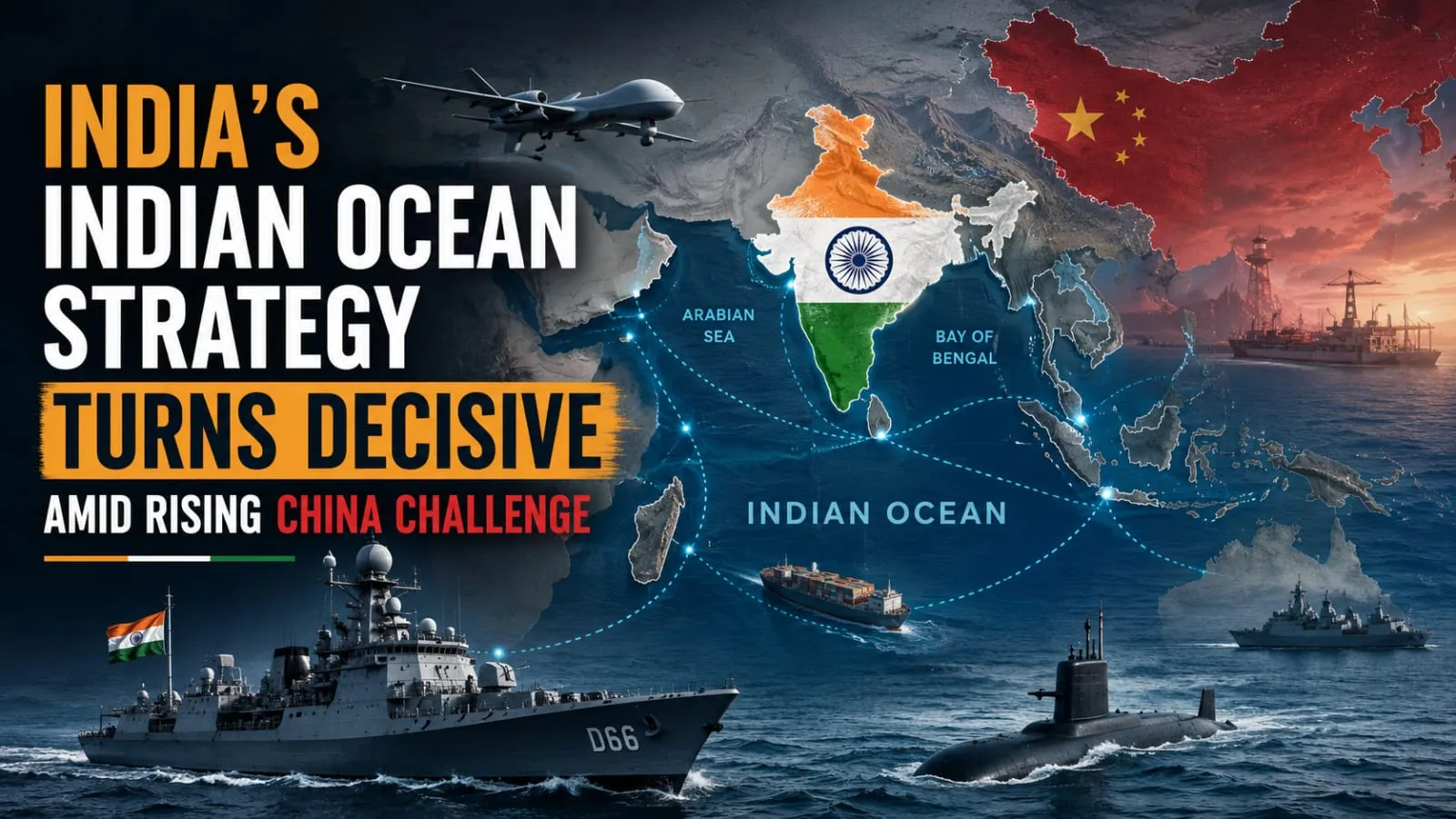
India’s Indian Ocean Strategy Turns Decisive Amid Rising China Challenge
Special Correspondent
India is rapidly transforming its maritime strategy in the Indian Ocean from a traditionally defensive posture into an assertive and far-reaching geopolitical framework aimed at countering China’s expanding influence across the region.
At the center of this strategic shift is India’s growing investment in critical island infrastructure projects, particularly the development of the Agalega Islands in Mauritius and the ambitious Great Nicobar project in the Andaman and Nicobar chain. Together, these initiatives reflect New Delhi’s intention to emerge as a dominant Indo-Pacific maritime power.
The Agalega Islands project, launched under the 2015 India-Mauritius agreement for improving sea and air transportation facilities, has drawn significant global attention. The project includes a 3,000-meter airstrip and a deep-sea jetty built with Indian assistance. While officially described as infrastructure meant for connectivity, maritime surveillance, humanitarian assistance, and regional cooperation, strategic analysts believe the facilities significantly enhance India’s operational reach in the southwestern Indian Ocean.
Located close to vital international sea lanes and near the strategically important Diego Garcia base, Agalega provides India with a critical vantage point for monitoring naval activity and commercial shipping routes.
The development closely aligns with Prime Minister Narendra Modi’s SAGAR doctrine — “Security and Growth for All in the Region” — introduced in 2015 to strengthen India’s role as a net security provider in the Indian Ocean. Under this policy, India has expanded defense and maritime cooperation with island nations including Mauritius, Seychelles, Maldives, and Sri Lanka.
Experts say the projects are part of a broader response to China’s growing presence in the Indian Ocean under Beijing’s Belt and Road Initiative and the so-called “String of Pearls” strategy. Over the past decade, China has financed or secured access to strategic ports and logistics hubs stretching from Gwadar in Pakistan to Hambantota in Sri Lanka and Djibouti in East Africa.
India’s counter-strategy is increasingly visible.
While Agalega strengthens India’s western maritime flank, the proposed Great Nicobar mega-project is expected to serve as the country’s eastern strategic pillar. Situated near the Malacca Strait — one of the world’s busiest maritime chokepoints — Great Nicobar is viewed as a key asset in monitoring critical trade and energy routes.
The project includes plans for a transshipment port, upgraded air infrastructure, military logistics facilities, and power generation systems. Strategic observers note that India’s expanding presence near the Malacca Strait could provide New Delhi with greater leverage in the Indo-Pacific, especially amid rising regional competition with China.
For years, Chinese policymakers have expressed concern over the so-called “Malacca Dilemma,” referring to China’s dependence on narrow sea routes for energy imports and trade. India’s strengthening military and surveillance capabilities in the Andaman and Nicobar region are therefore being closely watched in Beijing.
Analysts believe the combined development of Agalega in the west and Great Nicobar in the east reflects a major evolution in India’s strategic thinking. Traditionally focused on land-based threats from Pakistan and China, New Delhi is now increasingly prioritizing maritime security, trade route protection, and naval influence.
Officials and strategic experts argue that the Indian Ocean will remain central to future global power competition because of its role in international trade, energy transportation, and military movement.
With these expanding projects, India appears determined to ensure that the Indian Ocean does not become dominated by any single external power.
The emerging strategy also highlights India’s broader ambition to establish itself as a leading Indo-Pacific power capable of shaping regional maritime order in the years ahead.
--------
🚨 Beat the News Rush – Join Now!
Get breaking alerts, hot exclusives, and game-changing stories instantly on your phone. No delays, no fluff – just the edge you need. ⚡
Tap to join:
🟢 WhatsApp Channel: Dainik Jagran MP CG
Crave more?
🅕 Facebook: Dainik Jagran MP CG English
🅧 Twitter (X): Dainik Jagran MP CG
🅘 Instagram: Dainik Jagran MP CG
Share the fire – keep your crew ahead! 🗞️🔥
India’s Indian Ocean Strategy Turns Decisive Amid Rising China Challenge
Special Correspondent
India is rapidly transforming its maritime strategy in the Indian Ocean from a traditionally defensive posture into an assertive and far-reaching geopolitical framework aimed at countering China’s expanding influence across the region.
At the center of this strategic shift is India’s growing investment in critical island infrastructure projects, particularly the development of the Agalega Islands in Mauritius and the ambitious Great Nicobar project in the Andaman and Nicobar chain. Together, these initiatives reflect New Delhi’s intention to emerge as a dominant Indo-Pacific maritime power.
The Agalega Islands project, launched under the 2015 India-Mauritius agreement for improving sea and air transportation facilities, has drawn significant global attention. The project includes a 3,000-meter airstrip and a deep-sea jetty built with Indian assistance. While officially described as infrastructure meant for connectivity, maritime surveillance, humanitarian assistance, and regional cooperation, strategic analysts believe the facilities significantly enhance India’s operational reach in the southwestern Indian Ocean.
Located close to vital international sea lanes and near the strategically important Diego Garcia base, Agalega provides India with a critical vantage point for monitoring naval activity and commercial shipping routes.
The development closely aligns with Prime Minister Narendra Modi’s SAGAR doctrine — “Security and Growth for All in the Region” — introduced in 2015 to strengthen India’s role as a net security provider in the Indian Ocean. Under this policy, India has expanded defense and maritime cooperation with island nations including Mauritius, Seychelles, Maldives, and Sri Lanka.
Experts say the projects are part of a broader response to China’s growing presence in the Indian Ocean under Beijing’s Belt and Road Initiative and the so-called “String of Pearls” strategy. Over the past decade, China has financed or secured access to strategic ports and logistics hubs stretching from Gwadar in Pakistan to Hambantota in Sri Lanka and Djibouti in East Africa.
India’s counter-strategy is increasingly visible.
While Agalega strengthens India’s western maritime flank, the proposed Great Nicobar mega-project is expected to serve as the country’s eastern strategic pillar. Situated near the Malacca Strait — one of the world’s busiest maritime chokepoints — Great Nicobar is viewed as a key asset in monitoring critical trade and energy routes.
The project includes plans for a transshipment port, upgraded air infrastructure, military logistics facilities, and power generation systems. Strategic observers note that India’s expanding presence near the Malacca Strait could provide New Delhi with greater leverage in the Indo-Pacific, especially amid rising regional competition with China.
For years, Chinese policymakers have expressed concern over the so-called “Malacca Dilemma,” referring to China’s dependence on narrow sea routes for energy imports and trade. India’s strengthening military and surveillance capabilities in the Andaman and Nicobar region are therefore being closely watched in Beijing.
Analysts believe the combined development of Agalega in the west and Great Nicobar in the east reflects a major evolution in India’s strategic thinking. Traditionally focused on land-based threats from Pakistan and China, New Delhi is now increasingly prioritizing maritime security, trade route protection, and naval influence.
Officials and strategic experts argue that the Indian Ocean will remain central to future global power competition because of its role in international trade, energy transportation, and military movement.
With these expanding projects, India appears determined to ensure that the Indian Ocean does not become dominated by any single external power.
The emerging strategy also highlights India’s broader ambition to establish itself as a leading Indo-Pacific power capable of shaping regional maritime order in the years ahead.


