

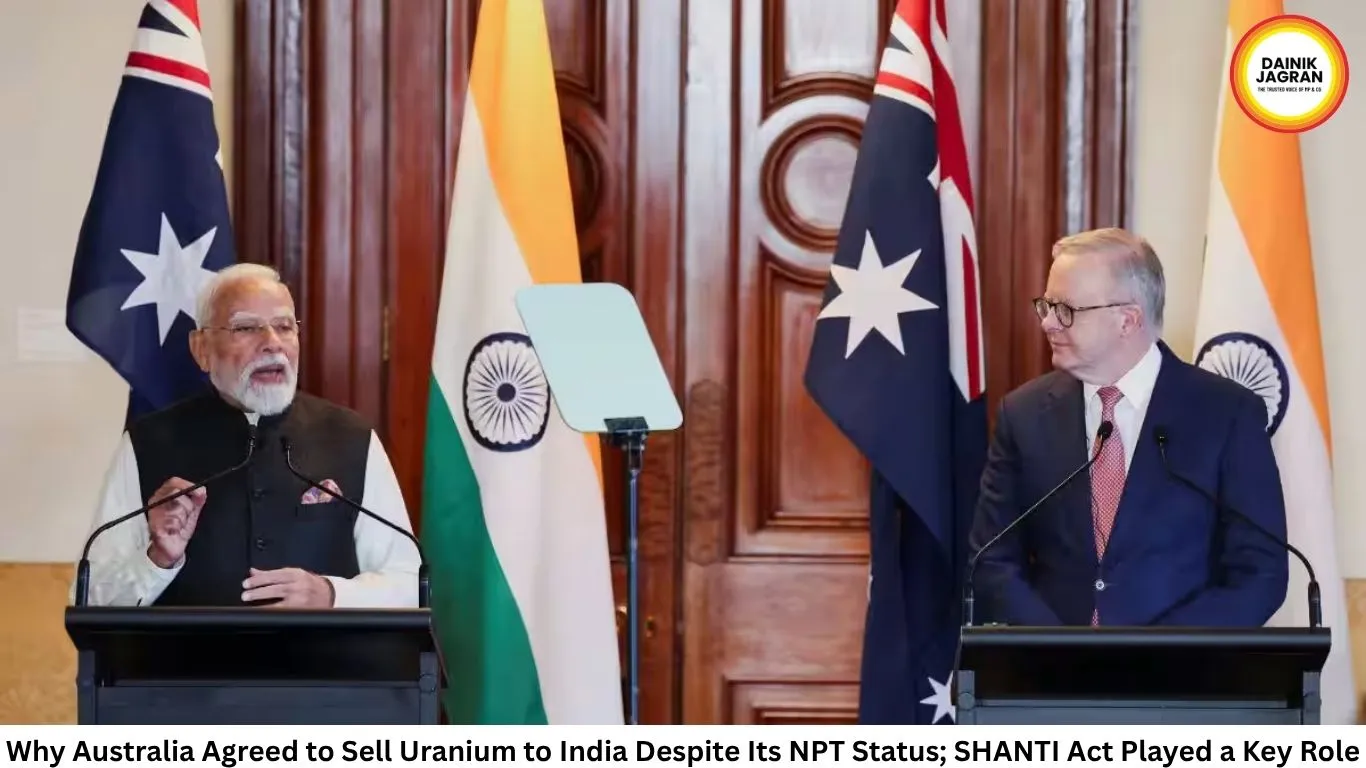
Why Australia Agreed to Sell Uranium to India Despite Its NPT Status; SHANTI Act Played a Key Role
Digital Desk
Australia has agreed to operationalise uranium exports to India during Prime Minister Narendra Modi's visit, with both countries citing India's nuclear reforms under the SHANTI Act and expanding strategic partnership as key factors behind the decision.
Australia has agreed to begin supplying uranium to India after the two countries decided to operationalise their long-pending Civil Nuclear Cooperation Agreement during Prime Minister Narendra Modi's visit to Melbourne. The development is significant because India is not a signatory to the Nuclear Non-Proliferation Treaty (NPT), a factor that had delayed uranium exports for more than a decade. Australian officials now say India's strengthened civil nuclear framework, reforms introduced through the SHANTI Act, and its strong non-proliferation record have addressed many of Canberra's earlier concerns.
The agreement is expected to support India's ambitious clean energy goals while further strengthening strategic ties between New Delhi and Canberra in sectors such as nuclear energy, critical minerals and advanced technologies.
Why the SHANTI Act Changed Australia's Position
Although India and Australia signed a civil nuclear cooperation agreement more than ten years ago, uranium exports never commenced because Australia sought greater clarity on India's civilian nuclear regulatory framework.
The situation changed after Parliament passed the SHANTI (Strategic Harmonisation and Advancement of Nuclear Technology Initiative) Act in December 2025.
The legislation introduced wide-ranging reforms to India's civil nuclear sector by allowing greater participation from private and foreign companies under a regulated licensing framework. It also modernised several provisions governing civilian nuclear energy, creating a clearer legal structure for international cooperation.
According to reports, these reforms reassured Australia that India's civilian nuclear programme would operate under stronger regulatory oversight and internationally accepted safeguards.
India Still Outside the NPT
India remains one of the few nuclear-armed countries that has not joined the Nuclear Non-Proliferation Treaty (NPT).
Australia had previously refused to export uranium to India because of its long-standing policy of supplying nuclear fuel primarily to NPT member states. However, Canberra has gradually revised its approach in recognition of India's record on nuclear non-proliferation, its separation of civilian and strategic nuclear programmes, and its growing strategic partnership with Australia through platforms such as the Quad.
Australian officials have indicated that these factors, together with India's recent nuclear sector reforms, made it possible to move forward with uranium exports.
Boost for India's Clean Energy Plans
India has set an ambitious target of increasing its nuclear power generation capacity from the current 8.8 gigawatts (GW) to 100 GW by 2047 as part of its long-term clean energy strategy.
Australia possesses nearly 28 per cent of the world's known uranium reserves, making it one of the largest potential suppliers of nuclear fuel globally. The agreement is expected to provide India with a reliable long-term source of uranium to support the expansion of its civilian nuclear power programme.
In addition to uranium supplies, both countries have also agreed to strengthen cooperation in the field of critical minerals, which are essential for clean energy technologies, electric vehicles, batteries and advanced manufacturing.
What Prime Minister Modi Said
Speaking alongside Australian Prime Minister Anthony Albanese, Prime Minister Narendra Modi described the agreements as important milestones in bilateral relations.
He said the uranium supply agreement would strengthen India's clean energy ambitions and contribute to its long-term nuclear energy targets. Modi also highlighted cooperation on critical minerals, saying both countries would work towards developing a dedicated critical minerals corridor to enhance strategic security and support the clean energy transition.
The operationalisation of the civil nuclear agreement marks a significant milestone in India-Australia relations. Beyond strengthening energy security, it reflects growing strategic trust between the two Indo-Pacific partners and supports India's efforts to diversify clean energy sources while reducing dependence on fossil fuels. Analysts believe the agreement could also open the door for broader cooperation in advanced technologies, nuclear infrastructure and critical mineral supply chains in the years ahead.
--------
🚨 Beat the News Rush – Join Now!
Get breaking alerts, hot exclusives, and game-changing stories instantly on your phone. No delays, no fluff – just the edge you need. ⚡
Tap to join:
🟢 WhatsApp Channel: Dainik Jagran MP CG
Crave more?
🅕 Facebook: Dainik Jagran MP CG English
🅧 Twitter (X): Dainik Jagran MP CG
🅘 Instagram: Dainik Jagran MP CG
Share the fire – keep your crew ahead! 🗞️🔥
Why Australia Agreed to Sell Uranium to India Despite Its NPT Status; SHANTI Act Played a Key Role
Digital Desk
Australia has agreed to begin supplying uranium to India after the two countries decided to operationalise their long-pending Civil Nuclear Cooperation Agreement during Prime Minister Narendra Modi's visit to Melbourne. The development is significant because India is not a signatory to the Nuclear Non-Proliferation Treaty (NPT), a factor that had delayed uranium exports for more than a decade. Australian officials now say India's strengthened civil nuclear framework, reforms introduced through the SHANTI Act, and its strong non-proliferation record have addressed many of Canberra's earlier concerns.
The agreement is expected to support India's ambitious clean energy goals while further strengthening strategic ties between New Delhi and Canberra in sectors such as nuclear energy, critical minerals and advanced technologies.
Why the SHANTI Act Changed Australia's Position
Although India and Australia signed a civil nuclear cooperation agreement more than ten years ago, uranium exports never commenced because Australia sought greater clarity on India's civilian nuclear regulatory framework.
The situation changed after Parliament passed the SHANTI (Strategic Harmonisation and Advancement of Nuclear Technology Initiative) Act in December 2025.
The legislation introduced wide-ranging reforms to India's civil nuclear sector by allowing greater participation from private and foreign companies under a regulated licensing framework. It also modernised several provisions governing civilian nuclear energy, creating a clearer legal structure for international cooperation.
According to reports, these reforms reassured Australia that India's civilian nuclear programme would operate under stronger regulatory oversight and internationally accepted safeguards.
India Still Outside the NPT
India remains one of the few nuclear-armed countries that has not joined the Nuclear Non-Proliferation Treaty (NPT).
Australia had previously refused to export uranium to India because of its long-standing policy of supplying nuclear fuel primarily to NPT member states. However, Canberra has gradually revised its approach in recognition of India's record on nuclear non-proliferation, its separation of civilian and strategic nuclear programmes, and its growing strategic partnership with Australia through platforms such as the Quad.
Australian officials have indicated that these factors, together with India's recent nuclear sector reforms, made it possible to move forward with uranium exports.
Boost for India's Clean Energy Plans
India has set an ambitious target of increasing its nuclear power generation capacity from the current 8.8 gigawatts (GW) to 100 GW by 2047 as part of its long-term clean energy strategy.
Australia possesses nearly 28 per cent of the world's known uranium reserves, making it one of the largest potential suppliers of nuclear fuel globally. The agreement is expected to provide India with a reliable long-term source of uranium to support the expansion of its civilian nuclear power programme.
In addition to uranium supplies, both countries have also agreed to strengthen cooperation in the field of critical minerals, which are essential for clean energy technologies, electric vehicles, batteries and advanced manufacturing.
What Prime Minister Modi Said
Speaking alongside Australian Prime Minister Anthony Albanese, Prime Minister Narendra Modi described the agreements as important milestones in bilateral relations.
He said the uranium supply agreement would strengthen India's clean energy ambitions and contribute to its long-term nuclear energy targets. Modi also highlighted cooperation on critical minerals, saying both countries would work towards developing a dedicated critical minerals corridor to enhance strategic security and support the clean energy transition.
The operationalisation of the civil nuclear agreement marks a significant milestone in India-Australia relations. Beyond strengthening energy security, it reflects growing strategic trust between the two Indo-Pacific partners and supports India's efforts to diversify clean energy sources while reducing dependence on fossil fuels. Analysts believe the agreement could also open the door for broader cooperation in advanced technologies, nuclear infrastructure and critical mineral supply chains in the years ahead.


