
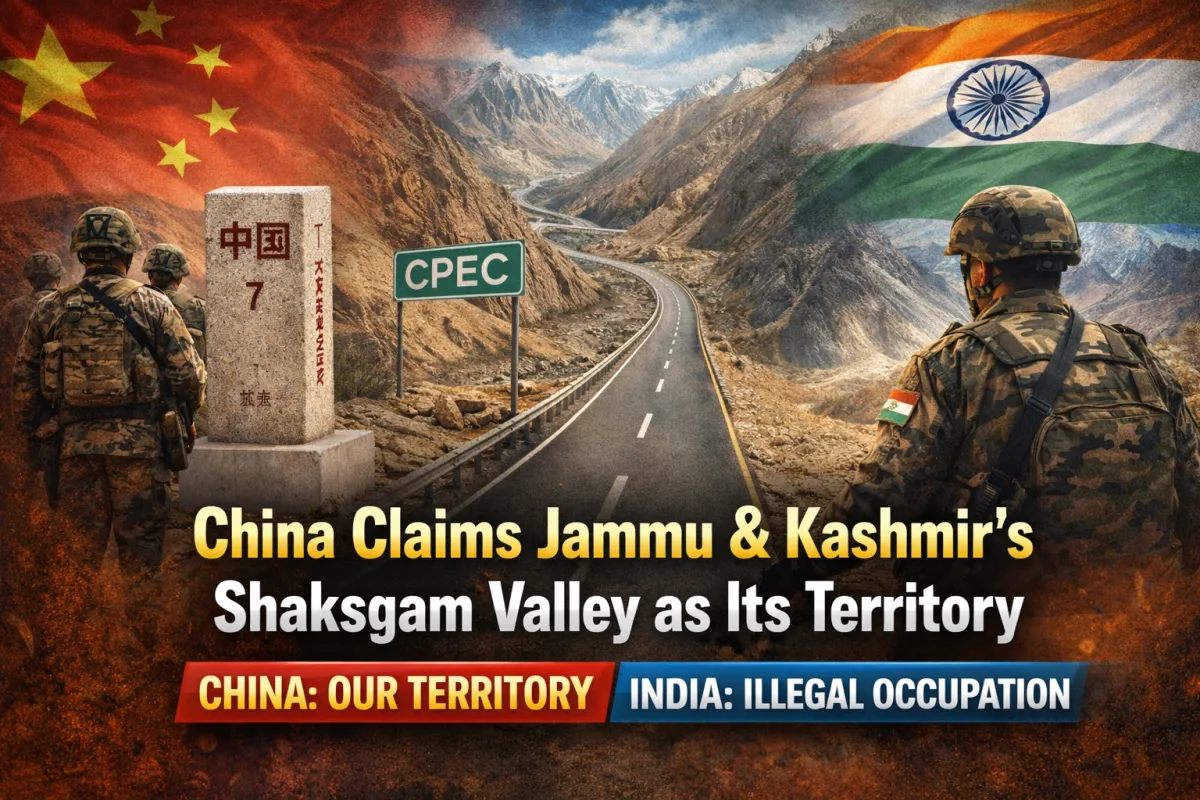

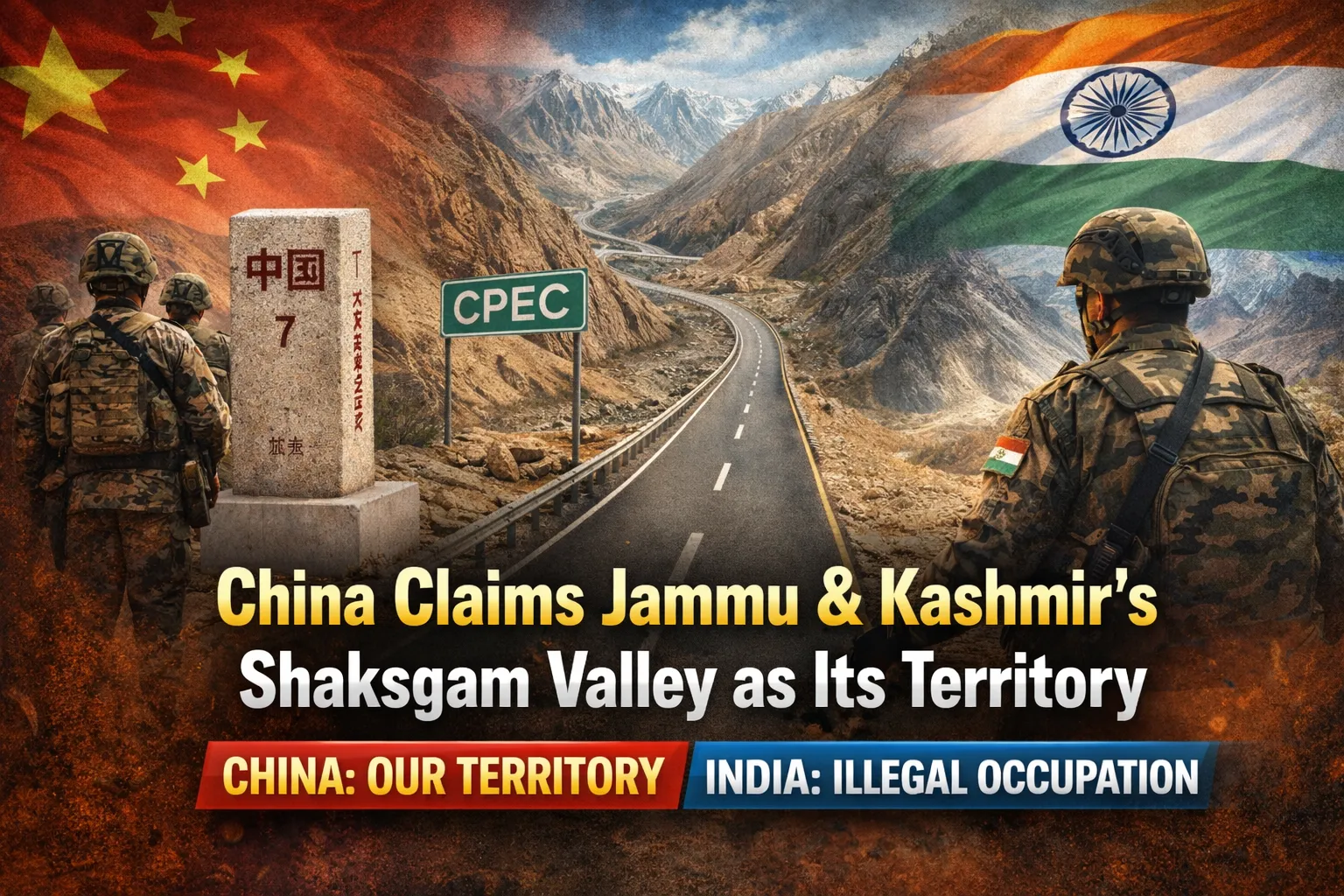
China Claims Shaksgam Valley as Its Territory, India Rejects Move as Illegal Occupation
Digital Desk
China has asserted that the Shaksgam Valley in Jammu and Kashmir is part of its territory, defending the construction of infrastructure under the China–Pakistan Economic Corridor (CPEC) that passes through the region. India has strongly rejected the claim, reiterating that the area is under Pakistan’s illegal occupation and any foreign construction there violates its sovereignty.
The latest statement came on Monday from Chinese Foreign Ministry spokesperson Mao Ning, who told state-run media that the Shaksgam Valley belongs to China and that Beijing has the right to build infrastructure on its own territory. She said such development cannot be questioned by other countries. The remarks follow reports of a road being built from China to Pakistan through the disputed region under CPEC.
India responded firmly, with the Ministry of External Affairs reiterating its long-standing position that the Shaksgam Valley is Indian territory. On January 9, MEA spokesperson Randhir Jaiswal said India does not recognise the 1963 China–Pakistan border agreement, under which Pakistan ceded the area to China. “Jammu and Kashmir and Ladakh are integral parts of India,” he said, adding that New Delhi has conveyed this position to both Beijing and Islamabad on several occasions.
China has sought to separate the issue from the broader Kashmir dispute. Mao Ning said the China–Pakistan border agreement of the 1960s was a legitimate arrangement between two sovereign nations and had no bearing on China’s stated position on Kashmir. She reiterated that Beijing views Kashmir as a historical issue that should be resolved peacefully through dialogue between India and Pakistan, while claiming respect for United Nations resolutions and international norms.
The Shaksgam Valley, located in the trans-Karakoram tract, was occupied by Pakistan in 1948 and transferred to China in 1963 through a boundary agreement that India has consistently termed illegal. The region has gained renewed strategic significance due to CPEC, a flagship project of China’s Belt and Road Initiative launched in 2013.
CPEC, valued at around $60 billion, aims to connect China’s Xinjiang region to Pakistan’s Gwadar Port on the Arabian Sea through a network of roads, railways, energy projects and ports. India has opposed the project, arguing that it passes through Pakistan-occupied Kashmir and undermines its territorial claims.
Strategic analysts note that beyond economic benefits, CPEC provides China with a shorter route for energy imports and potential naval access to the Indian Ocean via Gwadar. The renewed assertion over Shaksgam Valley is expected to further strain already fragile India–China relations, with New Delhi likely to raise the issue through diplomatic channels in the coming days.
--------
🚨 Beat the News Rush – Join Now!
Get breaking alerts, hot exclusives, and game-changing stories instantly on your phone. No delays, no fluff – just the edge you need. ⚡
Tap to join:
🟢 WhatsApp Channel: Dainik Jagran MP CG
Crave more?
🅕 Facebook: Dainik Jagran MP CG English
🅧 Twitter (X): Dainik Jagran MP CG
🅘 Instagram: Dainik Jagran MP CG
Share the fire – keep your crew ahead! 🗞️🔥
China Claims Shaksgam Valley as Its Territory, India Rejects Move as Illegal Occupation
Digital Desk
The latest statement came on Monday from Chinese Foreign Ministry spokesperson Mao Ning, who told state-run media that the Shaksgam Valley belongs to China and that Beijing has the right to build infrastructure on its own territory. She said such development cannot be questioned by other countries. The remarks follow reports of a road being built from China to Pakistan through the disputed region under CPEC.
India responded firmly, with the Ministry of External Affairs reiterating its long-standing position that the Shaksgam Valley is Indian territory. On January 9, MEA spokesperson Randhir Jaiswal said India does not recognise the 1963 China–Pakistan border agreement, under which Pakistan ceded the area to China. “Jammu and Kashmir and Ladakh are integral parts of India,” he said, adding that New Delhi has conveyed this position to both Beijing and Islamabad on several occasions.
China has sought to separate the issue from the broader Kashmir dispute. Mao Ning said the China–Pakistan border agreement of the 1960s was a legitimate arrangement between two sovereign nations and had no bearing on China’s stated position on Kashmir. She reiterated that Beijing views Kashmir as a historical issue that should be resolved peacefully through dialogue between India and Pakistan, while claiming respect for United Nations resolutions and international norms.
The Shaksgam Valley, located in the trans-Karakoram tract, was occupied by Pakistan in 1948 and transferred to China in 1963 through a boundary agreement that India has consistently termed illegal. The region has gained renewed strategic significance due to CPEC, a flagship project of China’s Belt and Road Initiative launched in 2013.
CPEC, valued at around $60 billion, aims to connect China’s Xinjiang region to Pakistan’s Gwadar Port on the Arabian Sea through a network of roads, railways, energy projects and ports. India has opposed the project, arguing that it passes through Pakistan-occupied Kashmir and undermines its territorial claims.
Strategic analysts note that beyond economic benefits, CPEC provides China with a shorter route for energy imports and potential naval access to the Indian Ocean via Gwadar. The renewed assertion over Shaksgam Valley is expected to further strain already fragile India–China relations, with New Delhi likely to raise the issue through diplomatic channels in the coming days.


