

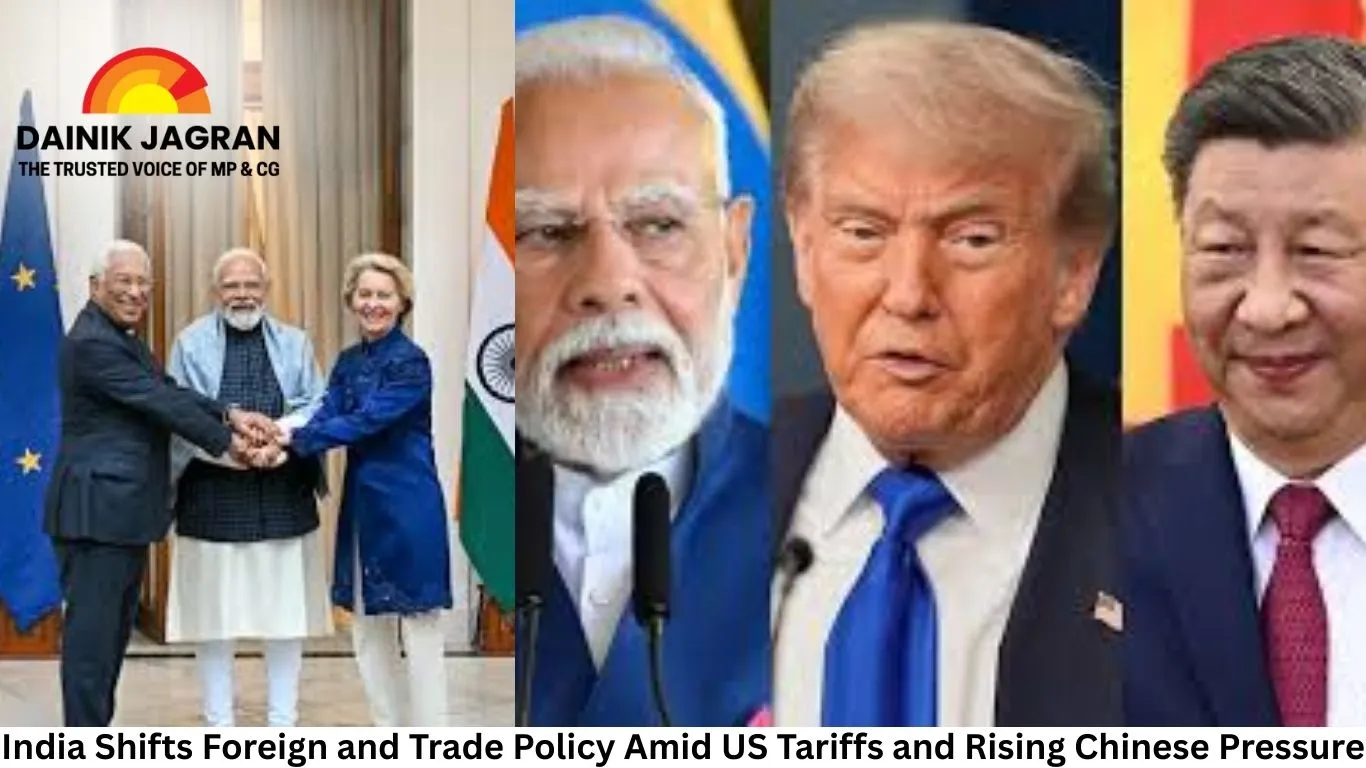
India Shifts Foreign and Trade Policy Amid US Tariffs and Rising Chinese Pressure

Digital Desk

India Shifts Foreign and Trade Policy Amid US Tariffs and Rising Chinese Pressure

India is recalibrating its foreign and trade strategy as it navigates the dual pressures of shifting US policies and China’s growing regional assertiveness. In recent months, New Delhi has strengthened ties with Europe, Canada, and other mid-sized powers to diversify trade and reduce dependence on a single global partner.

The move comes after US-imposed tariffs in 2025 disrupted India-US trade relations. Last year, the Trump administration levied a 50% duty on most Indian exports, partly in response to India’s Russian oil imports, leading to a sharp decline in exports and a 7% weakening of the rupee. The US has since eased tariffs, reducing reciprocal duties from 25% to 18% and lifting the 25% tax on Russian oil imports, partially restoring bilateral trade ties.

India’s recent agreements signal a broad foreign policy shift. In late January, Prime Minister Narendra Modi and European Commission President Ursula von der Leyen concluded a landmark trade deal, ending an 18-year negotiation. The agreement, described as the ‘Mother of All Deals,’ opens access to a market of approximately 2 billion people. Earlier, the UK-India Free Trade Agreement and deals with Oman and New Zealand further strengthened India’s global economic outreach.

Visits from German, Japanese, UAE, and Saudi leaders have led to new bilateral agreements, while Brazilian President Lula da Silva is expected to visit India in February, followed by Canadian Prime Minister Mark Carney in March for further trade discussions. Analysts say such partnerships help India counterbalance China’s dominance in global supply chains and mitigate regional security risks, particularly along the Himalayan border.

Despite its growing global stature as a population and economic powerhouse, India faces structural constraints in critical supply chains compared to China or Taiwan. Experts note that New Delhi’s strategy combines domestic reforms with strategic alliances to attract talent, technology, and investment. Economist Rajat Kathuria highlights that expanding electronics exports and diversifying markets will be crucial for India to offset losses from past US tariffs.

India’s evolving strategy reflects a pragmatic approach, balancing its traditional alignment with the US while actively pursuing new partnerships to safeguard trade, security, and technological interests. Observers suggest that the coming months will be pivotal in cementing India’s role as a major middle power capable of influencing the global economic order.

--------

🚨 Beat the News Rush – Join Now!

Get breaking alerts, hot exclusives, and game-changing stories instantly on your phone. No delays, no fluff – just the edge you need. ⚡

Tap to join: 

🟢 WhatsApp Channel: Dainik Jagran MP CG

Crave more?

🅕 Facebook: Dainik Jagran MP CG English

🅧 Twitter (X): Dainik Jagran MP CG

🅘 Instagram: Dainik Jagran MP CG

Share the fire – keep your crew ahead! 🗞️🔥

english.dainikjagranmpcg.com
03 Feb 2026 By Nitin Trivedi

India Shifts Foreign and Trade Policy Amid US Tariffs and Rising Chinese Pressure

Digital Desk

The move comes after US-imposed tariffs in 2025 disrupted India-US trade relations. Last year, the Trump administration levied a 50% duty on most Indian exports, partly in response to India’s Russian oil imports, leading to a sharp decline in exports and a 7% weakening of the rupee. The US has since eased tariffs, reducing reciprocal duties from 25% to 18% and lifting the 25% tax on Russian oil imports, partially restoring bilateral trade ties.

India’s recent agreements signal a broad foreign policy shift. In late January, Prime Minister Narendra Modi and European Commission President Ursula von der Leyen concluded a landmark trade deal, ending an 18-year negotiation. The agreement, described as the ‘Mother of All Deals,’ opens access to a market of approximately 2 billion people. Earlier, the UK-India Free Trade Agreement and deals with Oman and New Zealand further strengthened India’s global economic outreach.

Visits from German, Japanese, UAE, and Saudi leaders have led to new bilateral agreements, while Brazilian President Lula da Silva is expected to visit India in February, followed by Canadian Prime Minister Mark Carney in March for further trade discussions. Analysts say such partnerships help India counterbalance China’s dominance in global supply chains and mitigate regional security risks, particularly along the Himalayan border.

Despite its growing global stature as a population and economic powerhouse, India faces structural constraints in critical supply chains compared to China or Taiwan. Experts note that New Delhi’s strategy combines domestic reforms with strategic alliances to attract talent, technology, and investment. Economist Rajat Kathuria highlights that expanding electronics exports and diversifying markets will be crucial for India to offset losses from past US tariffs.

India’s evolving strategy reflects a pragmatic approach, balancing its traditional alignment with the US while actively pursuing new partnerships to safeguard trade, security, and technological interests. Observers suggest that the coming months will be pivotal in cementing India’s role as a major middle power capable of influencing the global economic order.

https://english.dainikjagranmpcg.com/international/india-shifts-foreign-and-trade-policy-amid-us-tariffs-and/article-13640

Related Posts

Trending News


