

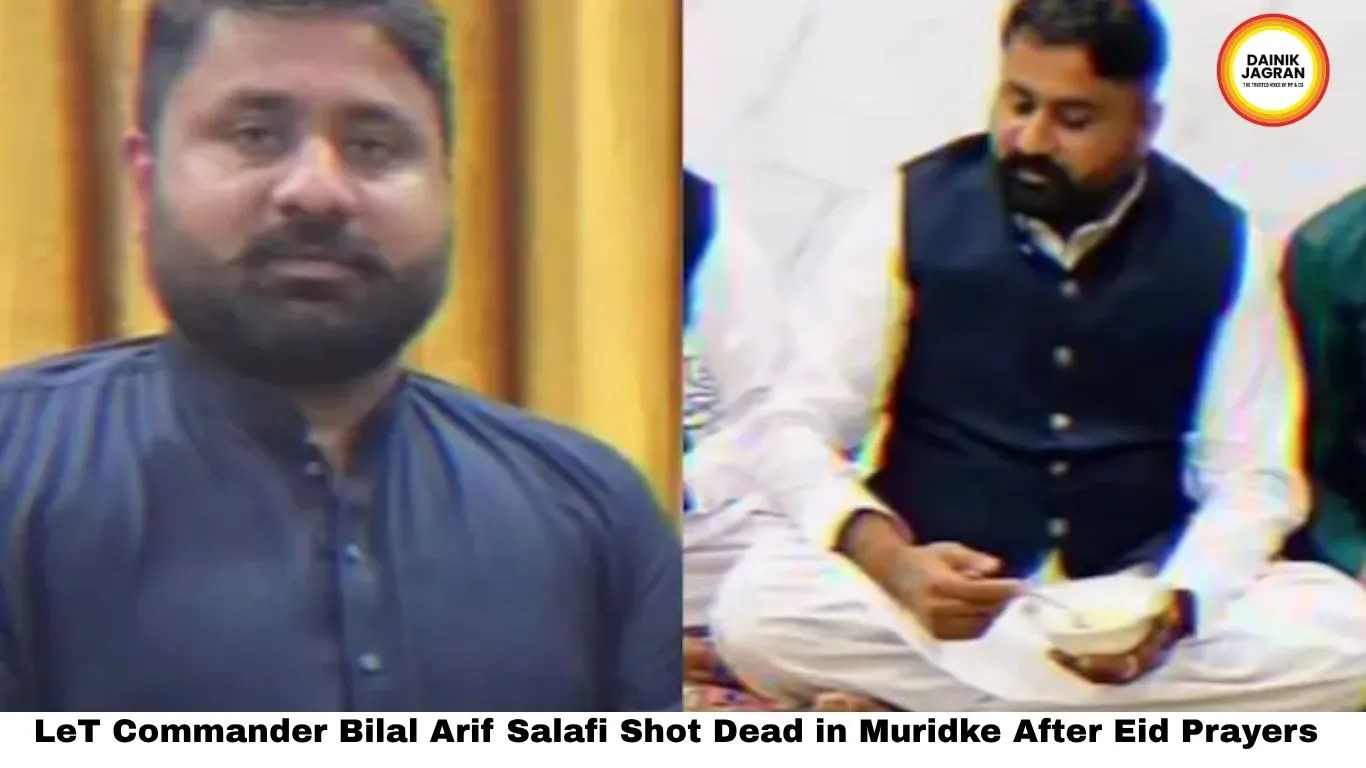
LeT Commander Bilal Arif Salafi Shot Dead in Muridke After Eid Prayers

Digital Desk

LeT Commander Bilal Arif Salafi Shot Dead in Muridke After Eid Prayers


Lashkar-e-Taiba commander Bilal Arif Salafi was shot and stabbed to death inside Markaz Taiba, Muridke, shortly after Eid prayers. Attackers escaped; motive under investigation.

Shot and Stabbed at Eid Prayers: Lashkar-e-Taiba Commander Bilal Arif Salafi Killed Inside Muridke Headquarters

A man and a woman carried out a precision assassination of LeT's chief recruiter inside the heavily guarded Markaz Taiba complex in Muridke — moments after Eid-ul-Fitr prayers — in what analysts believe may be either an internal factional purge or a covert foreign intelligence operation.


A Killing That Should Not Have Been Possible

The Markaz Taiba complex in Muridke, Punjab, is not an ordinary building. It is the fortified headquarters of Lashkar-e-Taiba — one of the world's most designated terrorist organisations, responsible for the 2008 Mumbai attacks and decades of cross-border violence against India. Security within its compound is stringent. Senior commanders live, operate, and move with protection. Outsiders do not simply walk in.

On the morning of March 21, 2026 — Eid-ul-Fitr — someone did.

Bilal Arif Salafi, a senior LeT commander who had served the organisation since 2005, was shot and stabbed to death inside Markaz Taiba moments after concluding Eid prayers. He was targeted in front of other senior operatives, in full public view, inside the most closely guarded compound of one of Pakistan's most powerful terror groups. The attackers then vanished.


How the Assassination Unfolded

The attack was swift, coordinated, and clearly pre-planned. According to accounts pieced together from eyewitness reports and verified footage, Salafi had just completed Eid prayers alongside other senior LeT operatives — including Maulana Abu Zar, the group's Muridke-based training chief, and Maulana Abdul Rehman Abid.

As Salafi stepped out of the prayer area, an unidentified man opened fire on him at close range. Almost simultaneously, a woman accompanying the attacker repeatedly stabbed Salafi with a dagger, ensuring the injuries were fatal. Salafi collapsed in the compound, in a pool of blood. Witnesses describe scenes of panic and chaos. Maulana Abu Zar, standing nearby, was physically restrained by others present — it is unclear whether he was being protected or suspected.

Salafi was rushed to a hospital, reportedly by LeT cadres who arrived at the scene. He died on the way. The attackers escaped the compound before security could respond. No group has claimed responsibility.


Who Was Bilal Arif Salafi?

Bilal Arif Salafi was no ordinary LeT operative. He had been associated with the organisation since 2005 — making him a two-decade veteran of one of the world's most active and well-funded terror networks. Based in Taiba Colony in Muridke, where he lived alongside other senior commanders, he served as the primary recruiter at Lashkar's headquarters — identifying, targeting, and radicalising young Pakistani men to join the "Kashmir Jihad."

His role was not merely logistical. He was responsible for ideological indoctrination — the process of transforming ordinary young men into committed militants willing to cross into Indian territory and carry out attacks. He was also reportedly central to fundraising operations, with the money he helped raise used directly to procure weapons and sustain the group's activities.

His elimination removes a key node in LeT's recruitment and radicalisation pipeline — a function that cannot be easily replaced.


The Same Compound India Struck in Operation Sindoor

The significance of the location cannot be overstated. The Markaz Taiba complex in Muridke is the same LeT headquarters that was targeted by Indian armed forces during Operation Sindoor in May 2025 — a precision strike operation India launched in retaliation for a cross-border terror attack. That India struck Markaz Taiba once before, and that a senior LeT commander has now been killed inside the same compound by unknown assailants, has intensified speculation about the origins of this assassination.

Indian strategic analysts and security observers are carefully watching developments without official comment. The operational precision of the attack — a coordinated two-person team, male and female, entering a high-security compound, executing a senior target, and escaping cleanly — fits the profile of a planned covert intelligence operation rather than a spontaneous act of personal violence.


Three Theories — All Plausible

Pakistani authorities have not confirmed who carried out the killing or why. Three broad theories are circulating in intelligence and diplomatic circles.

The first is internal factional conflict. LeT has experienced internal power struggles before, and a commander of Salafi's seniority and access to resources would have accumulated both allies and enemies over two decades. A falling out over money, ideology, or operational control could have motivated a rival faction within the organisation to eliminate him.

The second theory involves external intelligence agency involvement. The presence of a woman in the assassination team — used to stab while the man shot — is considered an unusual operational signature for internal militant disputes. Such coordination is more consistent with a trained intelligence operation. Multiple analysts have pointed to this as a potential indicator of foreign agency involvement, though no definitive attribution has been made.

The third possibility — which cannot be ruled out given the current global environment — is that the assassination is connected to the broader security realignment unfolding across the region as the US-Israel-Iran war reshapes alliances, priorities, and covert operations across the Middle East and South Asia simultaneously.


Pakistan's Security Establishment Under Scrutiny

The killing has exposed a damaging security failure at the heart of Pakistan's most sensitive terror infrastructure. The fact that two individuals were able to enter Markaz Taiba, assassinate a senior commander in front of witnesses, and exit without being caught raises fundamental questions about the integrity of the compound's security arrangements — and about whether the attack had inside assistance.

Pakistani authorities have cordoned off the area and launched a forensic investigation. No arrests have been made. No official statement has explained how the attackers entered or how they escaped. The silence from Pakistan's security establishment is being read, in several quarters, as a sign of either embarrassment, confusion — or both.


India's Strategic Interest

For India, the death of Bilal Arif Salafi at Lashkar's own headquarters carries unmistakable strategic significance. Whether by Indian action, allied intelligence, or internal enemy — a man who spent twenty years recruiting and radicalising youth to kill Indians is dead. The location of his death, inside the same compound India has already struck once, adds a layer of symbolism that New Delhi has chosen not to comment on publicly — but will certainly not have missed.


What Comes Next

Pakistani authorities are under pressure to identify and apprehend those responsible — both to restore confidence in their security apparatus and to establish whether this was an internally or externally driven operation. LeT's leadership will be assessing the vulnerabilities exposed by this attack. Further targeted eliminations of senior operatives cannot be ruled out if the underlying cause is a sustained covert campaign.

For the region, the killing of a senior terror commander inside Pakistan's most protected radical compound — on Eid morning, in front of fellow operatives — signals that the rules of engagement in South Asia's shadow war have entered a new, more audacious phase.

english.dainikjagranmpcg.com
22 Mar 2026 By Jiya.S

LeT Commander Bilal Arif Salafi Shot Dead in Muridke After Eid Prayers

Digital Desk

Shot and Stabbed at Eid Prayers: Lashkar-e-Taiba Commander Bilal Arif Salafi Killed Inside Muridke Headquarters

A man and a woman carried out a precision assassination of LeT's chief recruiter inside the heavily guarded Markaz Taiba complex in Muridke — moments after Eid-ul-Fitr prayers — in what analysts believe may be either an internal factional purge or a covert foreign intelligence operation.


A Killing That Should Not Have Been Possible

The Markaz Taiba complex in Muridke, Punjab, is not an ordinary building. It is the fortified headquarters of Lashkar-e-Taiba — one of the world's most designated terrorist organisations, responsible for the 2008 Mumbai attacks and decades of cross-border violence against India. Security within its compound is stringent. Senior commanders live, operate, and move with protection. Outsiders do not simply walk in.

On the morning of March 21, 2026 — Eid-ul-Fitr — someone did.

Bilal Arif Salafi, a senior LeT commander who had served the organisation since 2005, was shot and stabbed to death inside Markaz Taiba moments after concluding Eid prayers. He was targeted in front of other senior operatives, in full public view, inside the most closely guarded compound of one of Pakistan's most powerful terror groups. The attackers then vanished.


How the Assassination Unfolded

The attack was swift, coordinated, and clearly pre-planned. According to accounts pieced together from eyewitness reports and verified footage, Salafi had just completed Eid prayers alongside other senior LeT operatives — including Maulana Abu Zar, the group's Muridke-based training chief, and Maulana Abdul Rehman Abid.

As Salafi stepped out of the prayer area, an unidentified man opened fire on him at close range. Almost simultaneously, a woman accompanying the attacker repeatedly stabbed Salafi with a dagger, ensuring the injuries were fatal. Salafi collapsed in the compound, in a pool of blood. Witnesses describe scenes of panic and chaos. Maulana Abu Zar, standing nearby, was physically restrained by others present — it is unclear whether he was being protected or suspected.

Salafi was rushed to a hospital, reportedly by LeT cadres who arrived at the scene. He died on the way. The attackers escaped the compound before security could respond. No group has claimed responsibility.


Who Was Bilal Arif Salafi?

Bilal Arif Salafi was no ordinary LeT operative. He had been associated with the organisation since 2005 — making him a two-decade veteran of one of the world's most active and well-funded terror networks. Based in Taiba Colony in Muridke, where he lived alongside other senior commanders, he served as the primary recruiter at Lashkar's headquarters — identifying, targeting, and radicalising young Pakistani men to join the "Kashmir Jihad."

His role was not merely logistical. He was responsible for ideological indoctrination — the process of transforming ordinary young men into committed militants willing to cross into Indian territory and carry out attacks. He was also reportedly central to fundraising operations, with the money he helped raise used directly to procure weapons and sustain the group's activities.

His elimination removes a key node in LeT's recruitment and radicalisation pipeline — a function that cannot be easily replaced.


The Same Compound India Struck in Operation Sindoor

The significance of the location cannot be overstated. The Markaz Taiba complex in Muridke is the same LeT headquarters that was targeted by Indian armed forces during Operation Sindoor in May 2025 — a precision strike operation India launched in retaliation for a cross-border terror attack. That India struck Markaz Taiba once before, and that a senior LeT commander has now been killed inside the same compound by unknown assailants, has intensified speculation about the origins of this assassination.

Indian strategic analysts and security observers are carefully watching developments without official comment. The operational precision of the attack — a coordinated two-person team, male and female, entering a high-security compound, executing a senior target, and escaping cleanly — fits the profile of a planned covert intelligence operation rather than a spontaneous act of personal violence.


Three Theories — All Plausible

Pakistani authorities have not confirmed who carried out the killing or why. Three broad theories are circulating in intelligence and diplomatic circles.

The first is internal factional conflict. LeT has experienced internal power struggles before, and a commander of Salafi's seniority and access to resources would have accumulated both allies and enemies over two decades. A falling out over money, ideology, or operational control could have motivated a rival faction within the organisation to eliminate him.

The second theory involves external intelligence agency involvement. The presence of a woman in the assassination team — used to stab while the man shot — is considered an unusual operational signature for internal militant disputes. Such coordination is more consistent with a trained intelligence operation. Multiple analysts have pointed to this as a potential indicator of foreign agency involvement, though no definitive attribution has been made.

The third possibility — which cannot be ruled out given the current global environment — is that the assassination is connected to the broader security realignment unfolding across the region as the US-Israel-Iran war reshapes alliances, priorities, and covert operations across the Middle East and South Asia simultaneously.


Pakistan's Security Establishment Under Scrutiny

The killing has exposed a damaging security failure at the heart of Pakistan's most sensitive terror infrastructure. The fact that two individuals were able to enter Markaz Taiba, assassinate a senior commander in front of witnesses, and exit without being caught raises fundamental questions about the integrity of the compound's security arrangements — and about whether the attack had inside assistance.

Pakistani authorities have cordoned off the area and launched a forensic investigation. No arrests have been made. No official statement has explained how the attackers entered or how they escaped. The silence from Pakistan's security establishment is being read, in several quarters, as a sign of either embarrassment, confusion — or both.


India's Strategic Interest

For India, the death of Bilal Arif Salafi at Lashkar's own headquarters carries unmistakable strategic significance. Whether by Indian action, allied intelligence, or internal enemy — a man who spent twenty years recruiting and radicalising youth to kill Indians is dead. The location of his death, inside the same compound India has already struck once, adds a layer of symbolism that New Delhi has chosen not to comment on publicly — but will certainly not have missed.


What Comes Next

Pakistani authorities are under pressure to identify and apprehend those responsible — both to restore confidence in their security apparatus and to establish whether this was an internally or externally driven operation. LeT's leadership will be assessing the vulnerabilities exposed by this attack. Further targeted eliminations of senior operatives cannot be ruled out if the underlying cause is a sustained covert campaign.

For the region, the killing of a senior terror commander inside Pakistan's most protected radical compound — on Eid morning, in front of fellow operatives — signals that the rules of engagement in South Asia's shadow war have entered a new, more audacious phase.

https://english.dainikjagranmpcg.com/international/let-commander-bilal-arif-salafi-shot-dead-in-muridke-after/article-15791

Related Posts

Advertisement

Latest News


