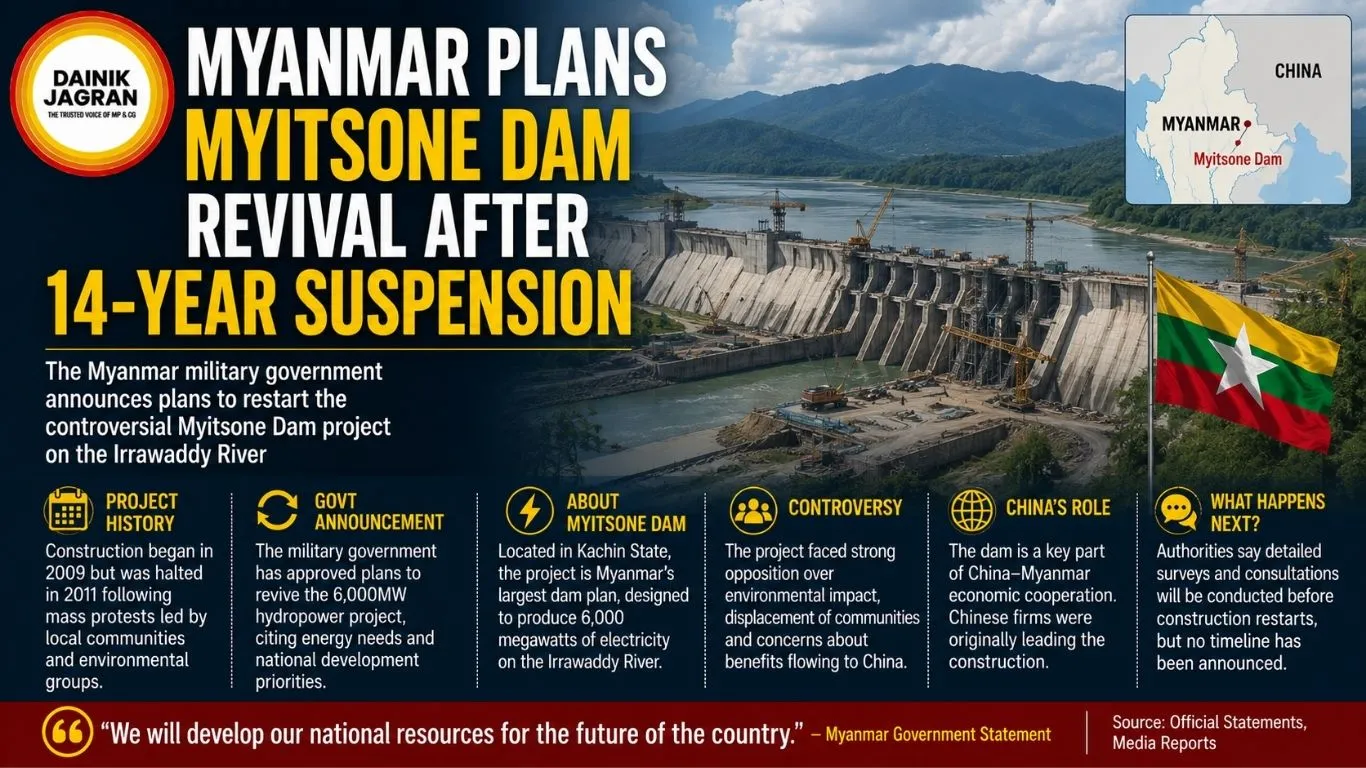
Myanmar Plans Myitsone Dam Revival After 14-Year Suspension

Digital Desk

Myanmar Plans Myitsone Dam Revival After 14-Year Suspension

Myanmar plans to revive the Myitsone Dam after 14 years, but the China-backed project faces cost, earthquake, environmental and displacement concerns.

Myanmar is preparing to revive the China-backed Myitsone hydropower project after 14 years, despite concerns over costs, earthquakes, displacement and environmental damage.

Myanmar is preparing to restart the $3.6 billion China-backed Myitsone hydropower project in Kachin State, 14 years after authorities suspended construction following widespread public opposition.

The proposed dam could generate up to 6 gigawatts (GW) of electricity and take about eight years to complete, according to officials and people familiar with the plans cited by Reuters.

The project would sit at the confluence of the Mali and Nmai rivers, the headwaters of the Irrawaddy. Its reservoir would cover an area roughly comparable to Singapore, according to the project’s reported plans.

Government Signals Project Revival

The proposed restart follows Myanmar military chief and President Min Aung Hlaing’s recent visit to China, which has backed the project since its inception.

Kachin State lawmaker Htet Paing Htoo told Reuters that the project would begin soon and that an official announcement was expected.

Government spokeswoman Khaing Khaing Soe also confirmed that the project had been discussed during Min Aung Hlaing’s Beijing visit. She said authorities were examining both its potential benefits and its possible negative effects.

Electricity Shortage Drives Push

Myanmar faces a severe electricity shortage, making additional generation capacity a major priority for the military administration.

The country’s electricity demand stands at around 10 GW, meaning a fully operational Myitsone project could theoretically produce more than half of current national demand.

Years of conflict following the 2021 military takeover have damaged power infrastructure and disrupted electricity supplies in several parts of the country.

The government therefore views hydropower as one potential way to increase domestic electricity generation.

Project Cost Could Surge

The original agreement between Myanmar and China dates to 2009, when the project was estimated to cost about $3.6 billion.

Restarting construction after more than a decade could substantially increase the final bill. Inflation, construction delays, financing costs and changes in engineering requirements could all raise expenses.

The International Renewable Energy Agency estimates average hydropower construction costs in Asian countries outside China and India at about $1,914 per kilowatt. Applying that figure to a 6-GW facility would produce a theoretical construction cost of roughly $11.5 billion.

That figure is not a confirmed estimate for Myitsone but illustrates how sharply the project’s cost could differ from its original budget.

China’s Electricity Share Questioned

The original agreement created another source of controversy.

Under the earlier arrangement, around 90 per cent of the electricity generated by Myitsone was to be exported to China’s southern power grid. That provision generated widespread criticism in Myanmar, where households and businesses have experienced frequent power shortages.

It remains unclear whether a revived project would retain the original electricity-sharing arrangement or give Myanmar a larger domestic supply.

The answer could influence public acceptance of the project.

Earthquake Risks Raise Alarm

Safety concerns have intensified following Myanmar’s devastating March earthquake.

The proposed dam would stand about 152 metres high and around 37 kilometres upstream from Myitkyina, the Kachin State capital.

The region lies in an earthquake-prone area, raising questions about the safety of a large dam and reservoir. Critics fear a major seismic event could damage the structure and threaten downstream communities.

Kachin authorities have said Chinese engineers would use advanced technology to address geological risks. Officials have sought to reassure residents that the project can withstand potential earthquakes.

Opposition Remains Strong

The Myitsone project has faced opposition since its early stages.

Authorities suspended construction in 2011 after protests over environmental damage, displacement and concerns about the impact on the Irrawaddy river system.

The proposed reservoir could flood large areas around the meeting point of the Mali and Nmai rivers. Environmental groups and local communities fear the project could damage habitats, disrupt fisheries and affect livelihoods dependent on the river.

In May, 49 civil society organisations called for the project to be permanently cancelled, arguing that local communities would bear the costs while receiving limited benefits.

Local Support Campaign Expands

Myanmar authorities have also begun efforts to build support for the revival.

Government-backed committees have reportedly held at least 26 meetings across Kachin State to explain the project and address concerns.

Supporters say the consultations can give residents more information about the project’s potential economic benefits.

Opponents, however, remain concerned about whether communities will have a meaningful say in decisions over land, relocation and environmental safeguards.

The future of the Myitsone Dam will therefore depend not only on financing and Chinese support but also on how Myanmar addresses earthquake risks, electricity-sharing arrangements, environmental concerns and opposition from affected communities.

english.dainikjagranmpcg.com
16 Aug 2026 By Sandeep.P

Myanmar Plans Myitsone Dam Revival After 14-Year Suspension

Digital Desk

Myanmar is preparing to revive the China-backed Myitsone hydropower project after 14 years, despite concerns over costs, earthquakes, displacement and environmental damage.

Myanmar is preparing to restart the $3.6 billion China-backed Myitsone hydropower project in Kachin State, 14 years after authorities suspended construction following widespread public opposition.

The proposed dam could generate up to 6 gigawatts (GW) of electricity and take about eight years to complete, according to officials and people familiar with the plans cited by Reuters.

The project would sit at the confluence of the Mali and Nmai rivers, the headwaters of the Irrawaddy. Its reservoir would cover an area roughly comparable to Singapore, according to the project’s reported plans.

Government Signals Project Revival

The proposed restart follows Myanmar military chief and President Min Aung Hlaing’s recent visit to China, which has backed the project since its inception.

Kachin State lawmaker Htet Paing Htoo told Reuters that the project would begin soon and that an official announcement was expected.

Government spokeswoman Khaing Khaing Soe also confirmed that the project had been discussed during Min Aung Hlaing’s Beijing visit. She said authorities were examining both its potential benefits and its possible negative effects.

Electricity Shortage Drives Push

Myanmar faces a severe electricity shortage, making additional generation capacity a major priority for the military administration.

The country’s electricity demand stands at around 10 GW, meaning a fully operational Myitsone project could theoretically produce more than half of current national demand.

Years of conflict following the 2021 military takeover have damaged power infrastructure and disrupted electricity supplies in several parts of the country.

The government therefore views hydropower as one potential way to increase domestic electricity generation.

Project Cost Could Surge

The original agreement between Myanmar and China dates to 2009, when the project was estimated to cost about $3.6 billion.

Restarting construction after more than a decade could substantially increase the final bill. Inflation, construction delays, financing costs and changes in engineering requirements could all raise expenses.

The International Renewable Energy Agency estimates average hydropower construction costs in Asian countries outside China and India at about $1,914 per kilowatt. Applying that figure to a 6-GW facility would produce a theoretical construction cost of roughly $11.5 billion.

That figure is not a confirmed estimate for Myitsone but illustrates how sharply the project’s cost could differ from its original budget.

China’s Electricity Share Questioned

The original agreement created another source of controversy.

Under the earlier arrangement, around 90 per cent of the electricity generated by Myitsone was to be exported to China’s southern power grid. That provision generated widespread criticism in Myanmar, where households and businesses have experienced frequent power shortages.

It remains unclear whether a revived project would retain the original electricity-sharing arrangement or give Myanmar a larger domestic supply.

The answer could influence public acceptance of the project.

Earthquake Risks Raise Alarm

Safety concerns have intensified following Myanmar’s devastating March earthquake.

The proposed dam would stand about 152 metres high and around 37 kilometres upstream from Myitkyina, the Kachin State capital.

The region lies in an earthquake-prone area, raising questions about the safety of a large dam and reservoir. Critics fear a major seismic event could damage the structure and threaten downstream communities.

Kachin authorities have said Chinese engineers would use advanced technology to address geological risks. Officials have sought to reassure residents that the project can withstand potential earthquakes.

Opposition Remains Strong

The Myitsone project has faced opposition since its early stages.

Authorities suspended construction in 2011 after protests over environmental damage, displacement and concerns about the impact on the Irrawaddy river system.

The proposed reservoir could flood large areas around the meeting point of the Mali and Nmai rivers. Environmental groups and local communities fear the project could damage habitats, disrupt fisheries and affect livelihoods dependent on the river.

In May, 49 civil society organisations called for the project to be permanently cancelled, arguing that local communities would bear the costs while receiving limited benefits.

Local Support Campaign Expands

Myanmar authorities have also begun efforts to build support for the revival.

Government-backed committees have reportedly held at least 26 meetings across Kachin State to explain the project and address concerns.

Supporters say the consultations can give residents more information about the project’s potential economic benefits.

Opponents, however, remain concerned about whether communities will have a meaningful say in decisions over land, relocation and environmental safeguards.

The future of the Myitsone Dam will therefore depend not only on financing and Chinese support but also on how Myanmar addresses earthquake risks, electricity-sharing arrangements, environmental concerns and opposition from affected communities.

https://english.dainikjagranmpcg.com/international/myanmar-moves-to-revive-36-billion-china-backed-myitsone-dam-after/article-26354

Recommended For You

--------

🚨 Beat the News Rush – Join Now!

Get breaking alerts, hot exclusives, and game-changing stories instantly on your phone. No delays, no fluff – just the edge you need. ⚡

Tap to join: 

🟢 WhatsApp Channel: Dainik Jagran MP CG

Crave more?

🅕 Facebook: Dainik Jagran MP CG English

🅧 Twitter (X): Dainik Jagran MP CG

🅘 Instagram: Dainik Jagran MP CG

Share the fire – keep your crew ahead! 🗞️🔥

Trending News