

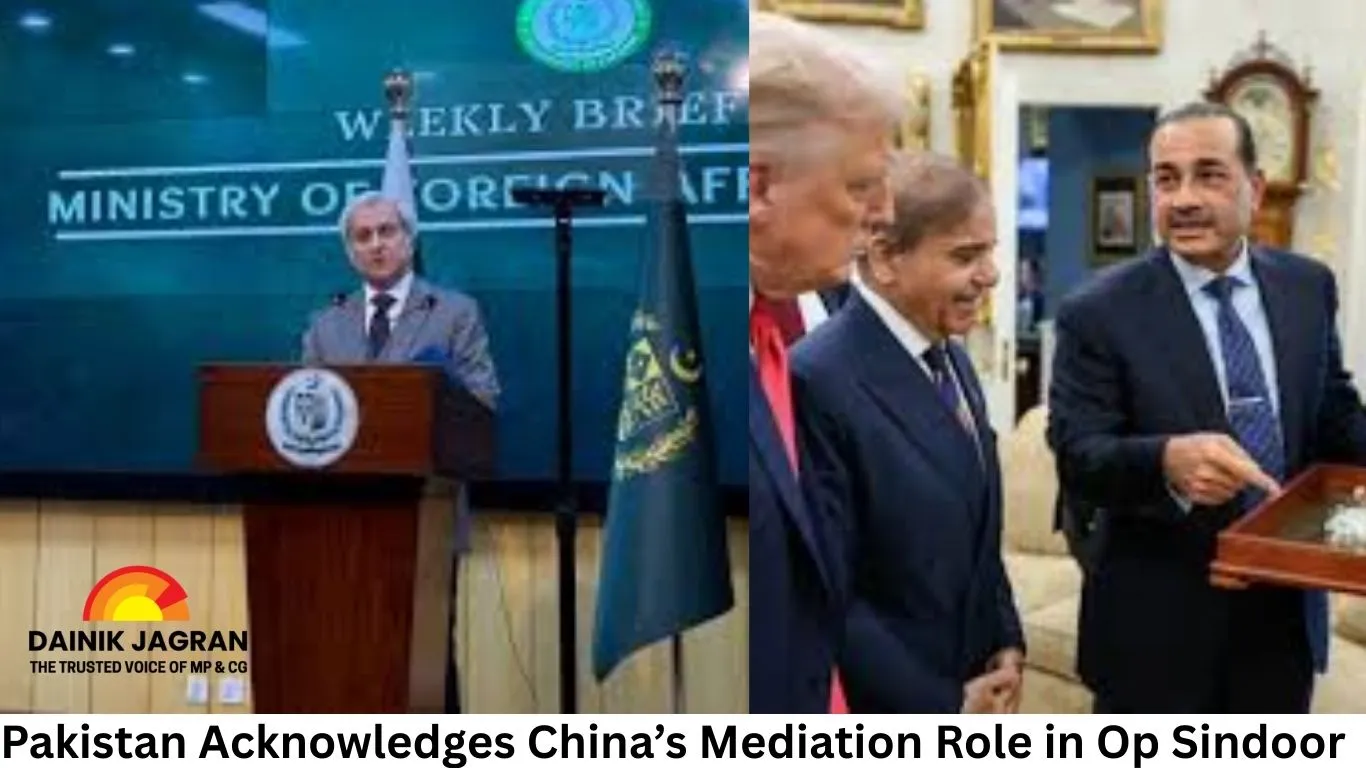
Pakistan Acknowledges China’s Mediation Role in Op Sindoor, Shifting from Earlier US-Centric Narrative
Digital Desk
Pakistan has formally acknowledged China’s role in mediating during the India-Pakistan military confrontation of May 2025, known as Operation Sindoor, marking a notable shift from its earlier stance that credited the ceasefire primarily to US President Donald Trump.
The acknowledgment came on Thursday when Pakistani Foreign Ministry spokesperson Tahir Andrabi told reporters in Islamabad that Chinese leaders remained in “constant touch” with Pakistani authorities during the escalation. Andrabi said Beijing also engaged with Indian leadership, describing China’s efforts as aimed at “peace, prosperity and security” in the region. He added that Pakistan fully supports the statement made earlier by Chinese Foreign Minister Wang Yi, making it the first official confirmation from Islamabad of China’s mediation claim.
The statement follows remarks by Wang Yi in Beijing, where he said China had played a role in easing tensions between India and Pakistan during the crisis. Wang reiterated China’s position that it contributes to conflict resolution through dialogue and diplomacy, including in South Asia.
Until now, Pakistan had publicly attributed the de-escalation almost entirely to US intervention. Islamabad had repeatedly said President Trump personally engaged with both New Delhi and Islamabad to prevent the confrontation from spiralling into a wider conflict. Pakistan had even nominated Trump for the Nobel Peace Prize, citing his role in averting war between the two nuclear-armed neighbours.
India, however, has consistently rejected claims of third-party mediation. New Delhi has maintained that the situation was resolved through direct military channels. According to the Indian government, after sustaining losses, Pakistani officials initiated contact between the two countries’ Directors General of Military Operations. Following those talks, both sides agreed to halt military operations across land, air and sea from May 10, 2025.
Operation Sindoor was triggered by a terrorist attack in Pahalgam, Jammu and Kashmir, on April 22, 2025, which killed 26 tourists. India responded with strikes on 11 terrorist and military targets inside Pakistan, sharply escalating tensions and drawing international concern over the risk of a broader conflict.
Pakistan’s recognition of China’s role comes amid deepening strategic and military ties between the two countries. A recent Pentagon assessment noted that China has supplied Pakistan with J-10C fighter jets, jointly produces JF-17 aircraft, and has provided drones and naval equipment. Joint counter-terrorism exercises and expanded cooperation near India’s borders have further underlined the closeness of the relationship.
Analysts say Islamabad’s evolving narrative reflects its growing reliance on Beijing, while also complicating claims of China’s neutrality in any future mediation between India and Pakistan.
--------
🚨 Beat the News Rush – Join Now!
Get breaking alerts, hot exclusives, and game-changing stories instantly on your phone. No delays, no fluff – just the edge you need. ⚡
Tap to join:
🟢 WhatsApp Channel: Dainik Jagran MP CG
Crave more?
🅕 Facebook: Dainik Jagran MP CG English
🅧 Twitter (X): Dainik Jagran MP CG
🅘 Instagram: Dainik Jagran MP CG
Share the fire – keep your crew ahead! 🗞️🔥
Pakistan Acknowledges China’s Mediation Role in Op Sindoor, Shifting from Earlier US-Centric Narrative
Digital Desk
The acknowledgment came on Thursday when Pakistani Foreign Ministry spokesperson Tahir Andrabi told reporters in Islamabad that Chinese leaders remained in “constant touch” with Pakistani authorities during the escalation. Andrabi said Beijing also engaged with Indian leadership, describing China’s efforts as aimed at “peace, prosperity and security” in the region. He added that Pakistan fully supports the statement made earlier by Chinese Foreign Minister Wang Yi, making it the first official confirmation from Islamabad of China’s mediation claim.
The statement follows remarks by Wang Yi in Beijing, where he said China had played a role in easing tensions between India and Pakistan during the crisis. Wang reiterated China’s position that it contributes to conflict resolution through dialogue and diplomacy, including in South Asia.
Until now, Pakistan had publicly attributed the de-escalation almost entirely to US intervention. Islamabad had repeatedly said President Trump personally engaged with both New Delhi and Islamabad to prevent the confrontation from spiralling into a wider conflict. Pakistan had even nominated Trump for the Nobel Peace Prize, citing his role in averting war between the two nuclear-armed neighbours.
India, however, has consistently rejected claims of third-party mediation. New Delhi has maintained that the situation was resolved through direct military channels. According to the Indian government, after sustaining losses, Pakistani officials initiated contact between the two countries’ Directors General of Military Operations. Following those talks, both sides agreed to halt military operations across land, air and sea from May 10, 2025.
Operation Sindoor was triggered by a terrorist attack in Pahalgam, Jammu and Kashmir, on April 22, 2025, which killed 26 tourists. India responded with strikes on 11 terrorist and military targets inside Pakistan, sharply escalating tensions and drawing international concern over the risk of a broader conflict.
Pakistan’s recognition of China’s role comes amid deepening strategic and military ties between the two countries. A recent Pentagon assessment noted that China has supplied Pakistan with J-10C fighter jets, jointly produces JF-17 aircraft, and has provided drones and naval equipment. Joint counter-terrorism exercises and expanded cooperation near India’s borders have further underlined the closeness of the relationship.
Analysts say Islamabad’s evolving narrative reflects its growing reliance on Beijing, while also complicating claims of China’s neutrality in any future mediation between India and Pakistan.


