
.jpg)

.jpg)
Pakistan's Iran-Saudi Arabia Dilemma: Walking a Tightrope Over an Abyss — The Defence Pact, Nuclear Ambiguity, Shia Protests and a Two-Front War Pakistan Cannot Afford
Digital Desk
"Walking on a Very Thin Line With a Deep Abyss on Both Sides"
That is how Pakistani journalist and anchor Asma Shirazi described her country's position in the Iran-Saudi Arabia-US-Israel war that has consumed the Middle East since February 28, 2026. It is perhaps the most precise summary possible of an impossible strategic situation — one that Pakistan signed itself into with a single pact in September 2025, without quite imagining it would be tested this fast, this hard, or in these circumstances.
In one corner: Iran — a 900-kilometre shared border, millions of Pakistani Shia citizens who venerate the Khamenei they just watched be assassinated, a Balochistan province already a tinderbox, and a neighbour that can stoke separatism, sectarian violence and proxy activity with considerable experience and incentive.
In the other corner: Saudi Arabia — four million Pakistani workers whose remittances keep a structurally fragile economy from collapsing, decades of petrodollar lifelines, a nuclear defence pact signed just six months ago that explicitly states any aggression against either country is aggression against both, and a relationship described by one analyst as placing Pakistan "under the nuclear umbrella."
Pakistan cannot stand with both. It cannot afford to abandon either. And time is running out to avoid being forced to choose.
The Pact That Changed Everything
When Pakistan signed a mutual defence pact with Saudi Arabia in September 2025, it likely did not expect a US-Israel war against Iran to test it so soon. Now Islamabad's credibility could be on the line.
The crisis represents the first serious geopolitical test of the pact, signed during Prime Minister Shehbaz Sharif's state visit to Riyadh. Although the agreement was presented as a framework for defence cooperation, its core clause carries potentially far-reaching implications: aggression against one is treated as aggression against both.
The ambiguity was deliberate. Both Riyadh and Islamabad wanted a pact strong enough to deter Iranian aggression, but flexible enough to avoid locking Pakistan into a military commitment it could not honour. As Joshua White of the Brookings Institution observed: "You can't have deterrence without some constructive ambiguity." The pact was engineered precisely so that both parties retained room to manoeuvre.
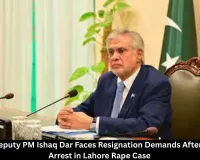
Then Pakistani Foreign Minister Ishaq Dar spent that ambiguity in a single press conference.
The Dar Press Conference: When Words Became a Tripwire
On March 3, Dar publicly told reporters that Islamabad might have to join the Iran war because of the Saudi mutual defence pact — warning Tehran's Foreign Minister Abbas Araghchi directly not to attack Saudi Arabia and invoking the agreement explicitly: "I made them understand that we have a defence agreement."
Pakistani Defence Minister Khawaja Mohammad Asif went even further, appearing to confirm that Pakistan's nuclear capabilities "will be made available to Saudi Arabia according to this agreement" — before walking the statement back entirely to Reuters the following day. That contradiction is not a diplomatic mishap. It is a window into the impossible position Islamabad now occupies.
Dar's public invocation of the defence pact was intended to raise the cost of Iranian aggression against Saudi Arabia. Instead, it has raised the cost of Pakistani inaction to a level Islamabad may be unable to pay. He sounded less like a man laying down a tripwire than one hoping no one would test it — and in doing so may have ensured someone will.
The Iran Problem: A Border Pakistan Cannot Afford to Inflame
Pakistan shares a 900-kilometre long and porous border with Iran in its southwest. The two countries maintain significant trade ties and have recently stepped up diplomatic engagement — Iranian President Masoud Pezeshkian visited Islamabad as recently as August 2025.
The domestic dimension is equally urgent. Members of Pakistan's large Shia community took to the streets to protest against Khamenei's killing — among them Nida Afzal, a political activist from Lahore who described Iran as "one of the very few countries that does not believe in American hegemony."
Security analyst Amir Rana of the Pak Institute of Peace Studies warned: "Iran has significant influence over Shia organisations in Pakistan. And then you have Balochistan, which is already a highly volatile area. If there is any confrontation, the fallout for Pakistan would be severe.
Analysts warn that fighters hardened in Syria's civil war could, if Iran's conflict with Pakistan's Gulf partners deepens, shift from a defensive to an offensive posture on Pakistani soil — adding a militant dimension to the already combustible sectarian and separatist pressures in Balochistan.
The Saudi Problem: An Economy That Cannot Survive Without Riyadh
The financial dimension of Pakistan's dilemma is as binding as the military one.
More than four million Pakistanis work in the Gulf and remit billions of dollars annually — providing a vital cushion for Pakistan's depleted foreign exchange reserves. Beyond these transfers, Saudi Arabia has frequently stabilised Pakistan's recurring economic crises with central bank deposits, deferred oil payments, and ambitious investment pledges.
In 1998, when then-Prime Minister Nawaz Sharif needed cover to conduct a nuclear bomb test in the face of certain Western sanctions, it was Saudi Arabia that provided 50,000 barrels of oil a day, free of charge, to cushion the blow. Pakistani troops guarded Saudi Arabia's northern border during the Iran-Iraq war in the 1980s. A former Pakistani army chief commands a Saudi-led counterterrorism force in Riyadh today.
This is not an alliance of convenience. It is decades of deep structural interdependence — military, financial and strategic. Abandoning it would not just damage a relationship. It would destabilise Pakistan's economy at its most vulnerable point.
The Quiet Diplomacy That May Be Working — For Now
Amid the public contradictions, Pakistan has been playing a quieter and arguably more effective role as a backchannel between the two sides.
On March 6, Saudi Arabia confirmed it had intercepted three ballistic missiles targeting Prince Sultan Air Base. Hours later, Field Marshal Asim Munir was in Riyadh meeting Saudi Defence Minister Prince Khalid bin Salman, where they discussed Iranian attacks and "measures needed to halt them within the framework" of their mutual defence pact.
Ayesha Siddiqa, a London-based Pakistani defence analyst, argued that Saudi Arabia appeared "reluctant to become directly involved in the conflict despite Iranian strikes on its territory" — and therefore has been asking Islamabad to convey the message to Tehran not to attack Saudi soil, as the kingdom is not involved in the conflict.
On March 5, Iran's ambassador to Saudi Arabia welcomed the kingdom's pledge not to allow its airspace or territory to be used during the ongoing war — a pledge that Pakistani back-channel diplomacy reportedly helped to secure and formalise.
Dar himself pointed to this: "You can compare that the least attacks from Iran are against Saudi Arabia and Oman," he said, suggesting that Pakistan's diplomatic engagement has already shaped Iranian targeting decisions.
The Two-Front Problem: Afghanistan Makes Everything Worse
Pakistan's strategic position is not just a bilateral Iran-Saudi dilemma. It is a multi-front crisis.
Pakistan's government, already mobilised due to the 2026 Afghanistan-Pakistan war, has been deeply concerned about cross-border clashes in Balochistan, spillover effects, sectarian tensions, or proxy and terrorist activity from its western borders with Iran becoming unstable — which would risk a two-front war it cannot afford and that could negatively affect its eastern border with India.
Pakistan's military is already busy dealing with terrorism related to Afghanistan. Managing military attention across multiple fronts simultaneously — Afghanistan, a potential Iranian border flare-up, domestic Shia unrest and the permanent India border commitment — creates a resource and strategic challenge of extraordinary complexity.
What Pakistan Will Actually Do
The honest answer is: as little as it can for as long as possible.
Most analysts view limited support to Saudi Arabia — intelligence-sharing, naval patrols in the Arabian Sea, or technical air defence cooperation — as far more realistic than a full military deployment. Some suggest a full deployment is possible only in the most extreme circumstances. Dainikjagranmpcg
Professor Ilhan Niaz of Quaid-e-Azam University said that if Saudi Arabia feels sufficiently threatened to formally request Pakistani military assistance, "Pakistan will come to Saudi Arabia's aid" — adding that "to do otherwise would undermine Pakistan's credibility." But the complicating factor, he acknowledged, is that Pakistan cannot afford to treat Iran simply as an adversary.
As journalist Asma Shirazi concluded: "It is like a bridge that Pakistan must cross. Pakistan is walking on a very thin line with a deep abyss on both sides."
What This Means for India
Pakistan's dilemma has direct implications for India. A Pakistan dragged into an active military commitment in the Gulf diverts military attention and resources westward. A Pakistan with an inflamed Balochistan and Shia unrest creates instability on India's northwestern flank. A Pakistan caught between two major Muslim powers while simultaneously managing an Afghanistan war is a Pakistan less capable of maintaining the controlled confrontation that defines the India-Pakistan relationship.
None of these scenarios are straightforwardly good or bad for India's strategic position — they are simply the landscape of a region in which every crisis connects to every other.
Bottom Line
Pakistan signed a defence pact with Saudi Arabia in September 2025 assuming it would serve as a deterrent that would never need to be activated. Six months later, Iran is firing missiles at Aramco refineries, Field Marshal Munir is in Riyadh, and Islamabad's Foreign Minister is invoking the pact in public press conferences.
The tightrope is real. The abyss on both sides is real. And Pakistan's room to keep walking without falling is narrowing with every Iranian missile that crosses a Gulf border.

.jpg)




