

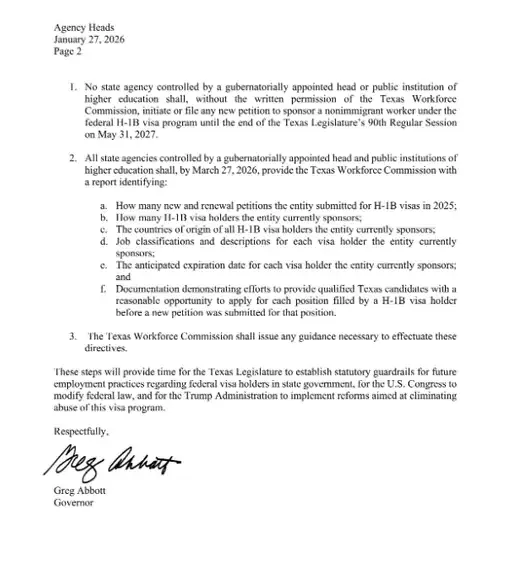
Under the order, no state agency led by a governor-appointed official, nor any public higher education institution in Texas, can submit new H-1B visa petitions without written approval from the Texas Workforce Commission. Abbott said the move is aimed at ensuring that taxpayer-funded jobs benefit Texans first, especially at a time when the programme is under federal review.
“The Texas economy should work for Texans,” the governor said, arguing that state institutions must set an example by exhausting local hiring options before turning to foreign workers. He alleged that in some cases, employers had failed to make genuine efforts to recruit qualified American workers and had instead used the H-1B route to hire foreign employees at lower wages.
The H-1B visa programme allows US employers to hire foreign professionals for specialised roles that typically require at least a bachelor’s degree. In Texas, it has been widely used by public universities, academic medical centres and school districts to recruit professors, researchers, doctors and teachers in fields where local talent is limited. Each year, the programme caps visas at 65,000, with an additional 20,000 reserved for applicants holding advanced degrees.
Alongside the freeze, Abbott announced an inquiry into how Texas public institutions use H-1B visas and ordered all affected agencies and universities to submit a detailed report by March 27, 2026. The report must include data on petitions filed in 2025, current visa holders, their countries of origin, job roles, visa expiry dates and evidence of efforts to recruit qualified Texas candidates.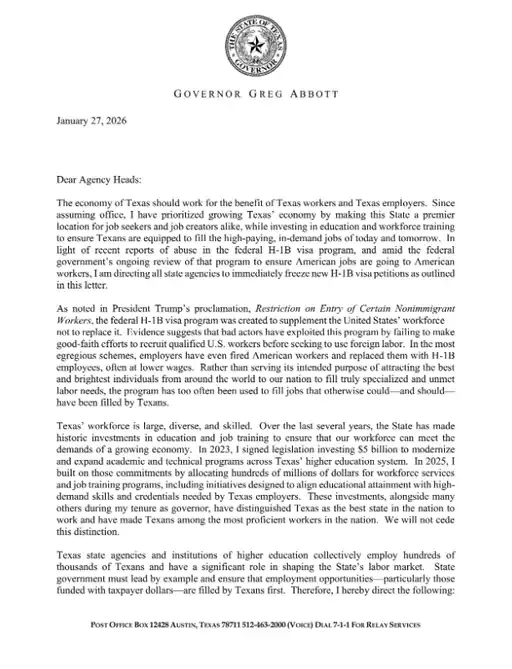
The governor also unveiled a separate ban on China-linked technology companies from Texas state systems, citing concerns over data security and potential exploitation of government networks.
The decision comes amid broader shifts in US immigration policy. In the 2024 financial year, Indian nationals accounted for about 71% of all H-1B approvals, with more than 2.83 lakh petitions. However, recent data for FY 2025 show approvals for traditional Indian IT services firms falling to a decade low, down 37% from the previous year, according to figures released by US Citizenship and Immigration Services and the National Foundation for American Policy.
With Texas home to major universities, research hospitals and technology hubs, the freeze is likely to affect recruitment pipelines and could further constrain opportunities for Indian professionals seeking US roles, while intensifying the debate over balancing local employment with global talent needs.

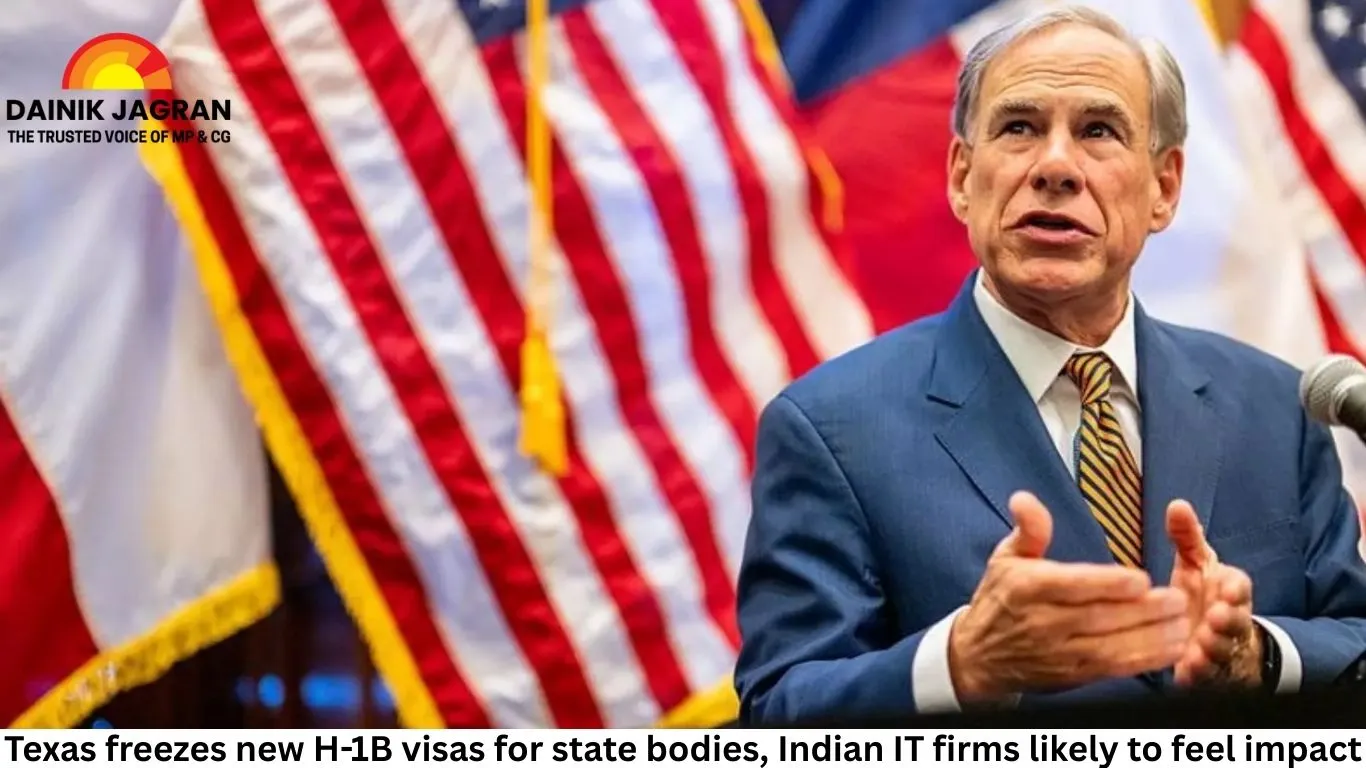
Texas freezes new H-1B visas for state bodies, Indian IT firms likely to feel impact
Digital Desk
Under the order, no state agency led by a governor-appointed official, nor any public higher education institution in Texas, can submit new H-1B visa petitions without written approval from the Texas Workforce Commission. Abbott said the move is aimed at ensuring that taxpayer-funded jobs benefit Texans first, especially at a time when the programme is under federal review.
“The Texas economy should work for Texans,” the governor said, arguing that state institutions must set an example by exhausting local hiring options before turning to foreign workers. He alleged that in some cases, employers had failed to make genuine efforts to recruit qualified American workers and had instead used the H-1B route to hire foreign employees at lower wages.
The H-1B visa programme allows US employers to hire foreign professionals for specialised roles that typically require at least a bachelor’s degree. In Texas, it has been widely used by public universities, academic medical centres and school districts to recruit professors, researchers, doctors and teachers in fields where local talent is limited. Each year, the programme caps visas at 65,000, with an additional 20,000 reserved for applicants holding advanced degrees.
Alongside the freeze, Abbott announced an inquiry into how Texas public institutions use H-1B visas and ordered all affected agencies and universities to submit a detailed report by March 27, 2026. The report must include data on petitions filed in 2025, current visa holders, their countries of origin, job roles, visa expiry dates and evidence of efforts to recruit qualified Texas candidates.
The governor also unveiled a separate ban on China-linked technology companies from Texas state systems, citing concerns over data security and potential exploitation of government networks.
The decision comes amid broader shifts in US immigration policy. In the 2024 financial year, Indian nationals accounted for about 71% of all H-1B approvals, with more than 2.83 lakh petitions. However, recent data for FY 2025 show approvals for traditional Indian IT services firms falling to a decade low, down 37% from the previous year, according to figures released by US Citizenship and Immigration Services and the National Foundation for American Policy.
With Texas home to major universities, research hospitals and technology hubs, the freeze is likely to affect recruitment pipelines and could further constrain opportunities for Indian professionals seeking US roles, while intensifying the debate over balancing local employment with global talent needs.
.jpg)




