


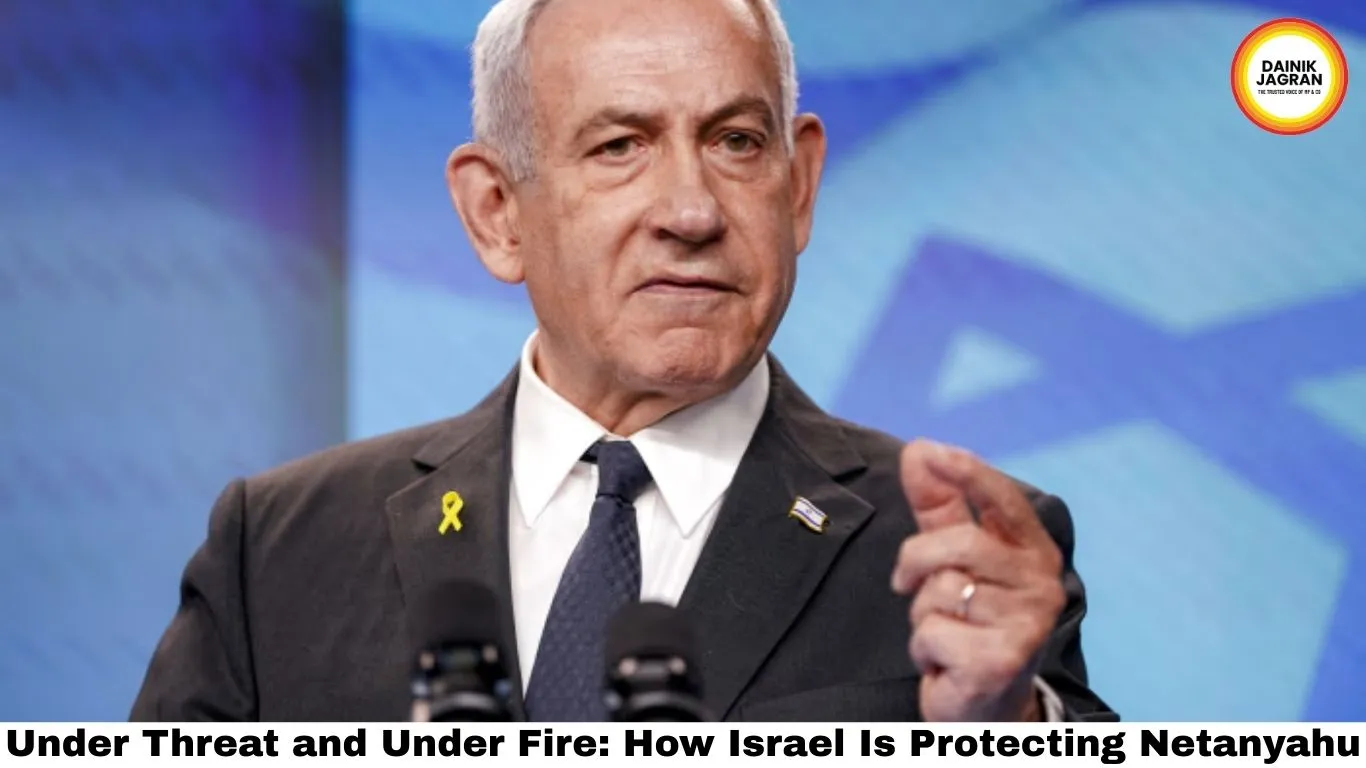
Under Threat and Under Fire: How Israel Is Protecting Netanyahu and Securing the Nation Amid the Iran War
Digital Desk
With Iran's Revolutionary Guard Corps publicly vowing to kill him, Benjamin Netanyahu is not just Israel's prime minister right now — he is also its most high-value target. As Operation Roaring Lion enters its third week with no end in sight, Israel has activated some of the most intensive personal and national security measures in its modern history. Here is a full breakdown of what Israel is doing to protect its leader, its people, and its strategic interests.
Netanyahu's Personal Security: Drones, Armoured Vehicles and Fortified Safe Houses
The threat to Netanyahu is not theoretical. In October 2024, Hezbollah launched a drone attack directly targeting his private residence in Caesarea. Two drones were intercepted; a third struck the building. Netanyahu himself was not home, but the message was unmistakable — the Israeli Prime Minister is a marked man.
Now, with Iran's IRGC making public assassination threats in March 2026, Israel's Shin Bet internal security agency has dramatically stepped up its protection operation. Surveillance drones have been deployed over Netanyahu's official Jerusalem residence around the clock. Senior ministers and cabinet security members have been issued armoured vehicles — a measure reserved only for those assessed to be at the highest threat level.
The protection does not stop there. Several senior ministers' families have been quietly moved out of their homes and relocated to fortified apartments. Others have been temporarily housed in hotels. Behind closed doors, ministers who were not included in these arrangements have reportedly voiced frustration over what they see as an unequal distribution of security resources.
The Shin Bet has also tightened instructions on mobile phone usage across the entire cabinet, citing assessments that Iranian intelligence may attempt cyberattacks and phishing operations targeting senior Israeli officials.
$827 Million Emergency Defence Budget: Israel Opens the Vault
Fighting a war on this scale costs money — and Israel is not holding back. On March 15, 2026, Israel approved an emergency budget allocation of 2.6 billion shekels, equivalent to approximately 827 million US dollars, specifically for urgent military purchases. The package was approved by cabinet ministers in a telephone meeting and will be drawn from Israel's total 2026 state budget of 222 billion dollars, which the Knesset is expected to formally adopt by March 31.
The government has not publicly specified which weapons systems or equipment the funds will cover, but the context makes the priorities obvious. Since February 28, Iran has launched over 250 ballistic missiles at Israeli territory. Israel's missile defence systems — Iron Dome, David's Sling, and the Arrow system — have intercepted the vast majority, but the relentless pace of attacks is placing enormous strain on interceptor stockpiles.
Foreign Minister Gideon Saar publicly dismissed reports suggesting Israel was running low on missile interceptors, saying clearly: the answer is no. But the emergency budget approval tells a different story — Israel is preparing for a long campaign and is ensuring its defence industrial pipeline stays fully stocked.
The Missile Shield: Three Lines of Defence
Israel's layered air defence architecture is the backbone of its civilian protection strategy. Each system targets a different category of threat.
Iron Dome intercepts short-range rockets and artillery shells at lower altitudes — the same system that protected Israeli cities during the Gaza conflict and the Lebanon war.
David's Sling handles medium to long-range ballistic missiles and cruise missiles — the primary threat from Iran's arsenal.
The Arrow System — Arrow 2 and Arrow 3 — targets long-range ballistic missiles at high altitudes, including exo-atmospheric interceptions outside the Earth's atmosphere.
Together, these three systems form a near-impenetrable shield. Since the war began, Iran has fired waves of ballistic missiles at Israeli cities daily, and the military has confirmed that the overwhelming majority have been intercepted. The civilian death toll, while not zero, has been dramatically lower than Iran likely intended.
Striking First: Degrading Iran's Launch Capability
Israel's security strategy is not purely defensive. The most effective protection, from Israel's perspective, is eliminating the threat at its source before missiles even launch.
The IDF has confirmed it killed two senior Iranian intelligence officials from the Khatam al-Anbiya Emergency Command — the nerve centre coordinating Iran's military operations. Netanyahu confirmed at his March 12 press conference that Israeli strikes had also eliminated a senior Iranian nuclear scientist.
Netanyahu framed it bluntly at the press conference: the February 28 strikes had prevented Iran from moving its nuclear and ballistic missile projects underground — a window that was closing rapidly and that Israel could not afford to miss. He declared Israel is now "stronger than ever," pointing to severe damage inflicted on the IRGC and Basij forces.
Nationwide Civil Defence: Shelters, Sirens and a Nation on Alert
For ordinary Israeli citizens, the security measures are deeply personal and daily. Air raid sirens have sounded across Tel Aviv, Jerusalem, Beit Shemesh, and large parts of southern and central Israel on a near-daily basis since February 28. Residents have become accustomed to rushing into bomb shelters — underground parking garages, reinforced stairwells, designated public shelters — within the 90-second warning window the missile alert system provides.
Schools in high-risk areas have moved classes to sheltered floors. Public events have been modified or cancelled. The national psyche has shifted into a wartime rhythm that older Israelis recognise from previous conflicts but that younger generations are experiencing for the first time at this scale.
An overwhelming 82 percent of the Israeli public, according to a March 2026 survey, supports the ongoing military operations — with 93 percent of Jewish Israelis behind the war effort. That domestic unity is itself a form of national security, giving Netanyahu the political cover to maintain the campaign without facing the kind of internal fracture that could weaken Israel's resolve.
What Comes Next
Israel's army chief has said plainly that this war will continue for a long time. The government shelved its controversial ultra-Orthodox draft exemption law to fast-track the 2026 defence budget — a sign that the entire political system, regardless of internal differences, understands the gravity of the moment.
Netanyahu told the Iranian people last week: "We are standing by your side." He told his own people: this war will be "recorded in the annals of Israel." Whether that record ultimately reads as a victory or a cautionary tale remains to be seen.
What is certain right now is this — Israel is spending every tool at its disposal, from surveillance drones outside the prime minister's bedroom window to 827 million dollars in emergency weapons procurement, to ensure it survives this war on its own terms.
The iron shield is up. The question is how long it can hold.
.jpg)




