

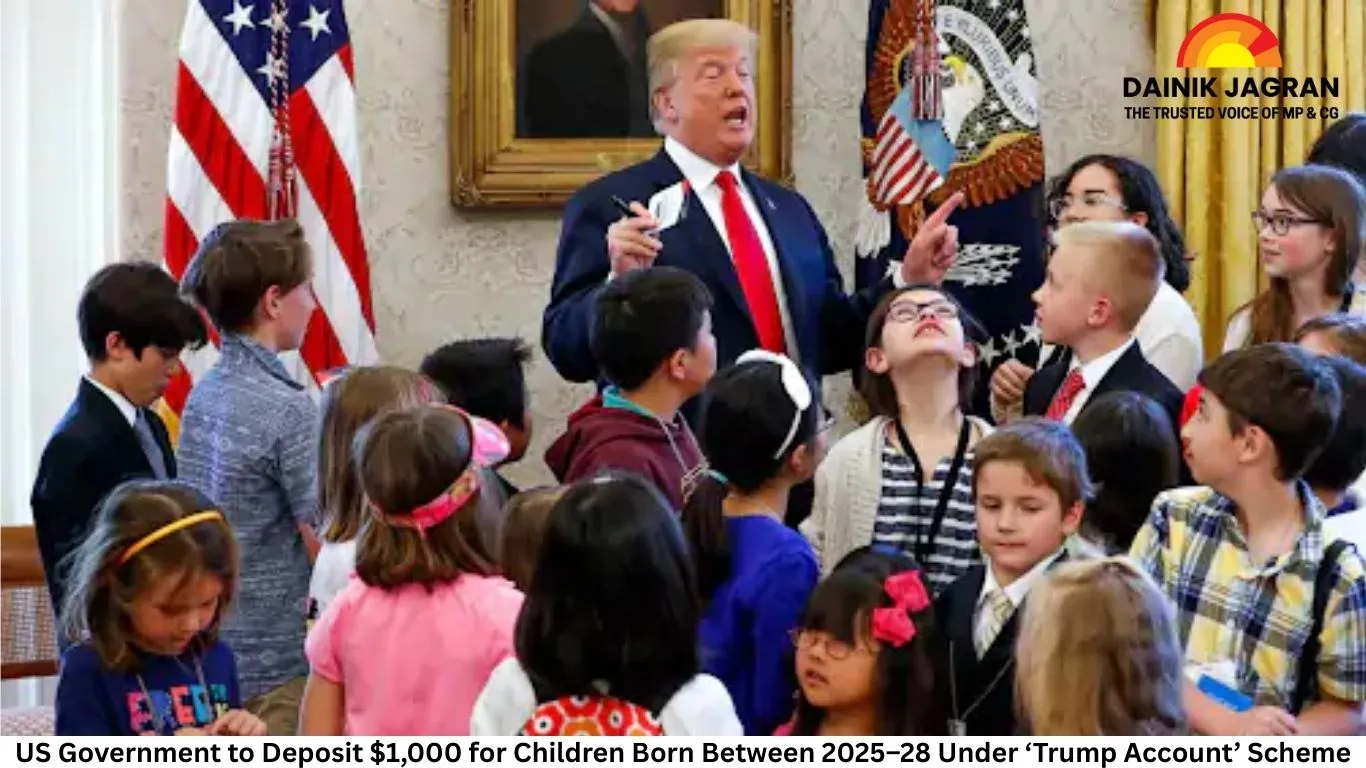
US Government to Deposit $1,000 for Children Born Between 2025–28 Under ‘Trump Account’ Scheme
Digital Desk
Children born in the United States between January 1, 2025 and December 31, 2028 will receive a $1,000 government contribution under a new savings and investment initiative launched by President Donald Trump, the White House announced on Wednesday. The amount, roughly ₹92,000, will be deposited into a special investment vehicle known as the ‘Trump Account’, designed to help children build long-term financial assets.
The programme, formally unveiled in December 2025, provides every eligible newborn with a government-funded starter investment, regardless of parents’ income or immigration status. Officials said the account will be opened in the child’s name and structured as a tax-free, market-linked savings plan.
According to the administration, the funds will be invested in the stock market and typically locked in until the beneficiary turns 18. The money can then be used for approved purposes such as higher education, starting a business or other long-term financial goals.
President Trump, speaking at a Treasury Department event, said the initiative aims to change how wealth is built across generations. “For decades, governments handed debt to the next generation. This gives every child a chance at real economic freedom,” he said, urging employers to support the scheme through matching contributions.
Several major US corporations have already pledged backing. Bank of America and JPMorgan Chase said they will match the government’s $1,000 contribution for the newborn children of their employees. Intel announced a similar policy, while Visa said its cardholders will be able to add funds to Trump Accounts using reward points. Firms including BlackRock, Charles Schwab, BNY and Charter Communications have also expressed support.
Families will be allowed to contribute up to $5,000 annually to each account. Officials said deposits by parents and employers can begin from July 4 this year. While accounts may be opened for older children, only those born during the eligibility window will receive the initial government contribution.
Supporters argue the programme will expand stock market participation and provide a financial foundation for children from low- and middle-income families. Investor Brad Gerstner said the initiative promotes capitalism by introducing ownership from birth.
Critics, however, contend the benefits will skew toward wealthier households that can afford higher annual contributions. They also argue the scheme does little to address childhood poverty, as funds are inaccessible during early years, and exposes families to market volatility. Some opponents point to recent welfare cuts as evidence that the policy prioritises investment over immediate social support.
In a significant boost to the programme, Dell Technologies founder Michael Dell and his wife Susan announced a pledge of $250 per child for 25 million American children, a commitment valued at $6.25 billion.
The administration says the Trump Account represents a long-term investment in future generations, though its broader economic impact is likely to remain a subject of political debate.
--------
🚨 Beat the News Rush – Join Now!
Get breaking alerts, hot exclusives, and game-changing stories instantly on your phone. No delays, no fluff – just the edge you need. ⚡
Tap to join:
🟢 WhatsApp Channel: Dainik Jagran MP CG
Crave more?
🅕 Facebook: Dainik Jagran MP CG English
🅧 Twitter (X): Dainik Jagran MP CG
🅘 Instagram: Dainik Jagran MP CG
Share the fire – keep your crew ahead! 🗞️🔥
US Government to Deposit $1,000 for Children Born Between 2025–28 Under ‘Trump Account’ Scheme
Digital Desk
The programme, formally unveiled in December 2025, provides every eligible newborn with a government-funded starter investment, regardless of parents’ income or immigration status. Officials said the account will be opened in the child’s name and structured as a tax-free, market-linked savings plan.
According to the administration, the funds will be invested in the stock market and typically locked in until the beneficiary turns 18. The money can then be used for approved purposes such as higher education, starting a business or other long-term financial goals.
President Trump, speaking at a Treasury Department event, said the initiative aims to change how wealth is built across generations. “For decades, governments handed debt to the next generation. This gives every child a chance at real economic freedom,” he said, urging employers to support the scheme through matching contributions.
Several major US corporations have already pledged backing. Bank of America and JPMorgan Chase said they will match the government’s $1,000 contribution for the newborn children of their employees. Intel announced a similar policy, while Visa said its cardholders will be able to add funds to Trump Accounts using reward points. Firms including BlackRock, Charles Schwab, BNY and Charter Communications have also expressed support.
Families will be allowed to contribute up to $5,000 annually to each account. Officials said deposits by parents and employers can begin from July 4 this year. While accounts may be opened for older children, only those born during the eligibility window will receive the initial government contribution.
Supporters argue the programme will expand stock market participation and provide a financial foundation for children from low- and middle-income families. Investor Brad Gerstner said the initiative promotes capitalism by introducing ownership from birth.
Critics, however, contend the benefits will skew toward wealthier households that can afford higher annual contributions. They also argue the scheme does little to address childhood poverty, as funds are inaccessible during early years, and exposes families to market volatility. Some opponents point to recent welfare cuts as evidence that the policy prioritises investment over immediate social support.
In a significant boost to the programme, Dell Technologies founder Michael Dell and his wife Susan announced a pledge of $250 per child for 25 million American children, a commitment valued at $6.25 billion.
The administration says the Trump Account represents a long-term investment in future generations, though its broader economic impact is likely to remain a subject of political debate.


