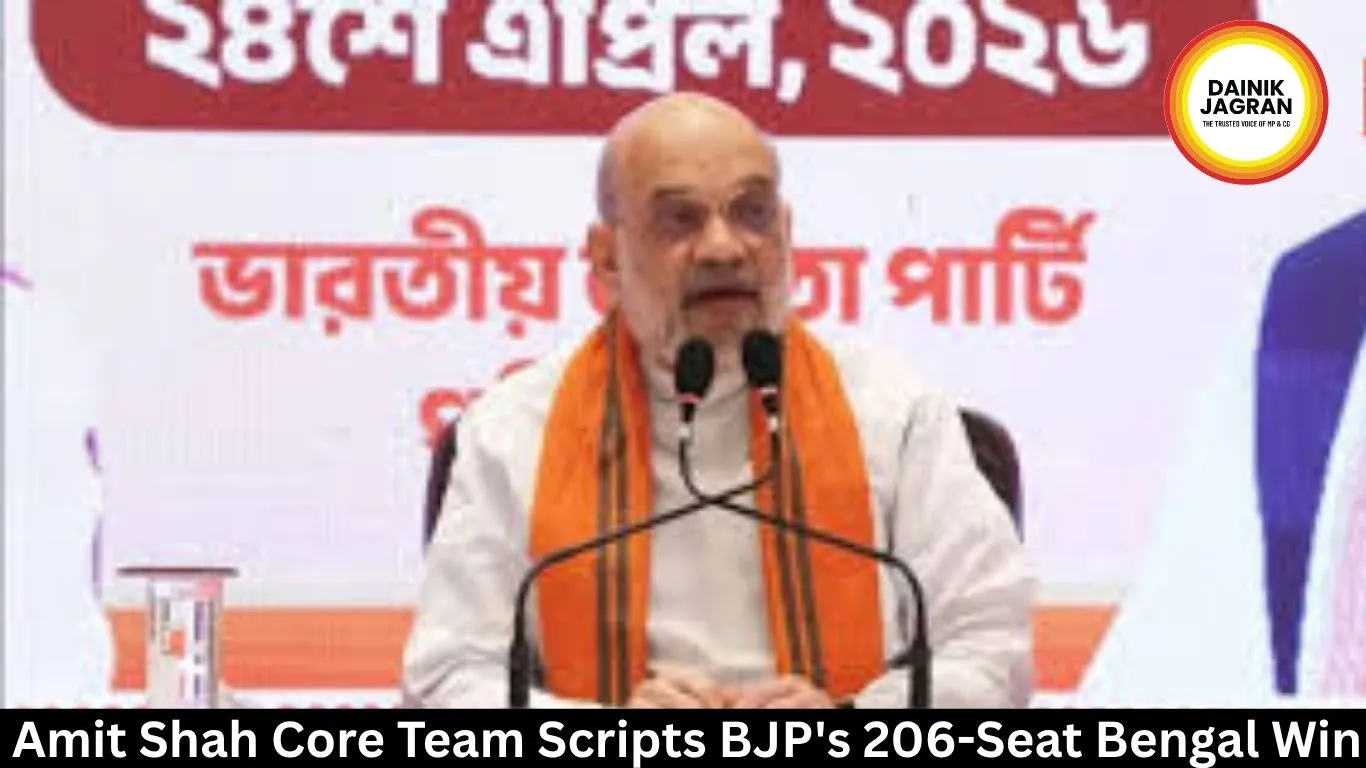
Amit Shah Core Team Scripts BJP's 206-Seat Bengal Win

Digital Desk

 Amit Shah Core Team Scripts BJP's 206-Seat Bengal Win

 Union Home Minister Amit Shah and a 5-member core team orchestrated BJP's historic 206-seat victory in West Bengal 2026 elections through rallies, micro-management, and RSS grassroots efforts, ending TMC rule.

Amit Shah's Core Team Scripts Historic BJP Sweep in Bengal  

Strategic day-night campaign and RSS groundwork deliver 206-seat majority, ending TMC's 15-year rule

In a landmark shift in West Bengal's political landscape, the Bharatiya Janata Party (BJP) has secured a decisive victory in the 2026 Assembly elections, winning around 206 seats and crossing the two-thirds majority mark. The triumph ends the Trinamool Congress's (TMC) 15-year dominance under Mamata Banerjee and marks the first time a non-Left, right-of-centre party forms the government in the state.

Union Home Minister Amit Shah emerged as the central architect of this transformation. Sources familiar with the campaign said Shah spent over 15 days in the state, turning the election into a meticulously planned mission. By day, he addressed rallies and roadshows; by night, he pored over seat-specific data with a tight-knit team.

Shah's Hands-On Micro-Management

Party insiders describe Shah's approach as a blend of high-energy public outreach and granular booth-level oversight. He is believed to have conducted more than 50 rallies and roadshows across key regions. A five-member core team of central leaders worked alongside him, focusing on real-time feedback, candidate selection, and resource allocation.

This dual strategy — visible momentum on the ground paired with behind-the-scenes seat-by-seat reviews — proved effective in converting long-standing discontent into votes. Issues like the teachers' recruitment scam, the RG Kar hospital incident, and allegations of violence in areas such as Sandeshkhali resonated strongly, particularly among women and the urban middle class.

RSS: The Quiet Force Behind the Surge

Complementing the BJP's high-profile campaign was nearly 15 years of sustained groundwork by the Rashtriya Swayamsevak Sangh (RSS). What began with around 530 shakhas in 2011 has grown to over 2,500 branches today, with 583 added in the past year alone.

Ahead of polling, the organisation facilitated more than one lakh small meetings, focusing on hyper-local outreach rather than large public events. Volunteers emphasised trust-building, especially in sensitive pockets.

Key elements of the Sangh's approach included:

- Providing support to victims of post-2021 violence through financial aid, legal help, and direct access to leadership.  

- Encouraging women in areas like Sandeshkhali to speak out via sustained dialogue.  

- Cultural integration efforts linking local icons such as Swami Vivekananda and Subhas Chandra Bose with broader narratives of development and identity.  

- Booth-level confidence-building to ensure voters could cast ballots without fear.  

- Connecting everyday governance failures to larger concerns of safety and future opportunities.

This invisible hand helped expand the BJP's reach into rural, semi-urban, and even some traditional TMC strongholds.

Ground Realities and Voter Sentiment

Counting trends on May 4-5 showed the BJP making deep inroads, including in several Muslim-majority areas, though the shift was more pronounced among other demographics. High voter turnout in phases held on April 23 and 29 reflected widespread desire for change after years of reported political violence and corruption scandals.

Local celebrations erupted in BJP-leaning neighbourhoods across Kolkata and districts like North and South 24 Parganas, Purba Bardhaman, and parts of North Bengal. Many residents spoke of a sense of relief and expectation for improved law and order and development.

TMC leaders, including Mamata Banerjee who retained her seat, alleged irregularities, but the Election Commission is yet to comment formally on such claims.

What Lies Ahead

With results clear, attention now shifts to government formation. Amit Shah has been named the BJP's central observer for West Bengal to facilitate the election of the legislative party leader. The swearing-in is expected around May 9.

Senior leaders like Suvendu Adhikari, currently Leader of Opposition, along with others such as Dilip Ghosh and emerging faces, are among those discussed for key roles. The party has so far avoided projecting a single chief ministerial candidate during the campaign.

The victory is being seen as a significant boost for the BJP nationally, demonstrating its ability to crack entrenched regional strongholds through persistent organisation and strategic leadership. For West Bengal, it signals the start of a new political chapter after a decade and a half of TMC rule.

How the new dispensation translates campaign promises into governance — particularly on women’s safety, employment, and curbing political violence — will define the coming months. For now, the focus remains on the remarkable journey that brought the BJP from 77 seats in 2021 to a commanding majority in 2026. 
--------

๐Ÿšจ Beat the News Rush โ€“ Join Now!

Get breaking alerts, hot exclusives, and game-changing stories instantly on your phone. No delays, no fluff โ€“ just the edge you need. โšก

Tap to join:ย 

๐ŸŸข WhatsApp Channel: Dainik Jagran MP CG

Crave more?

๐Ÿ…• Facebook: Dainik Jagran MP CG English

๐Ÿ…ง Twitter (X): Dainik Jagran MP CG

๐Ÿ…˜ Instagram: Dainik Jagran MP CG

Share the fire โ€“ keep your crew ahead! ๐Ÿ—ž๏ธ๐Ÿ”ฅ

english.dainikjagranmpcg.com
05 May 2026 By Abhishek Joshi

Amit Shah Core Team Scripts BJP's 206-Seat Bengal Win

Digital Desk

Amit Shah's Core Team Scripts Historic BJP Sweep in Bengal  

Strategic day-night campaign and RSS groundwork deliver 206-seat majority, ending TMC's 15-year rule

In a landmark shift in West Bengal's political landscape, the Bharatiya Janata Party (BJP) has secured a decisive victory in the 2026 Assembly elections, winning around 206 seats and crossing the two-thirds majority mark. The triumph ends the Trinamool Congress's (TMC) 15-year dominance under Mamata Banerjee and marks the first time a non-Left, right-of-centre party forms the government in the state.

Union Home Minister Amit Shah emerged as the central architect of this transformation. Sources familiar with the campaign said Shah spent over 15 days in the state, turning the election into a meticulously planned mission. By day, he addressed rallies and roadshows; by night, he pored over seat-specific data with a tight-knit team.

Shah's Hands-On Micro-Management

Party insiders describe Shah's approach as a blend of high-energy public outreach and granular booth-level oversight. He is believed to have conducted more than 50 rallies and roadshows across key regions. A five-member core team of central leaders worked alongside him, focusing on real-time feedback, candidate selection, and resource allocation.

This dual strategy — visible momentum on the ground paired with behind-the-scenes seat-by-seat reviews — proved effective in converting long-standing discontent into votes. Issues like the teachers' recruitment scam, the RG Kar hospital incident, and allegations of violence in areas such as Sandeshkhali resonated strongly, particularly among women and the urban middle class.

RSS: The Quiet Force Behind the Surge

Complementing the BJP's high-profile campaign was nearly 15 years of sustained groundwork by the Rashtriya Swayamsevak Sangh (RSS). What began with around 530 shakhas in 2011 has grown to over 2,500 branches today, with 583 added in the past year alone.

Ahead of polling, the organisation facilitated more than one lakh small meetings, focusing on hyper-local outreach rather than large public events. Volunteers emphasised trust-building, especially in sensitive pockets.

Key elements of the Sangh's approach included:

- Providing support to victims of post-2021 violence through financial aid, legal help, and direct access to leadership.  

- Encouraging women in areas like Sandeshkhali to speak out via sustained dialogue.  

- Cultural integration efforts linking local icons such as Swami Vivekananda and Subhas Chandra Bose with broader narratives of development and identity.  

- Booth-level confidence-building to ensure voters could cast ballots without fear.  

- Connecting everyday governance failures to larger concerns of safety and future opportunities.

This invisible hand helped expand the BJP's reach into rural, semi-urban, and even some traditional TMC strongholds.

Ground Realities and Voter Sentiment

Counting trends on May 4-5 showed the BJP making deep inroads, including in several Muslim-majority areas, though the shift was more pronounced among other demographics. High voter turnout in phases held on April 23 and 29 reflected widespread desire for change after years of reported political violence and corruption scandals.

Local celebrations erupted in BJP-leaning neighbourhoods across Kolkata and districts like North and South 24 Parganas, Purba Bardhaman, and parts of North Bengal. Many residents spoke of a sense of relief and expectation for improved law and order and development.

TMC leaders, including Mamata Banerjee who retained her seat, alleged irregularities, but the Election Commission is yet to comment formally on such claims.

What Lies Ahead

With results clear, attention now shifts to government formation. Amit Shah has been named the BJP's central observer for West Bengal to facilitate the election of the legislative party leader. The swearing-in is expected around May 9.

Senior leaders like Suvendu Adhikari, currently Leader of Opposition, along with others such as Dilip Ghosh and emerging faces, are among those discussed for key roles. The party has so far avoided projecting a single chief ministerial candidate during the campaign.

The victory is being seen as a significant boost for the BJP nationally, demonstrating its ability to crack entrenched regional strongholds through persistent organisation and strategic leadership. For West Bengal, it signals the start of a new political chapter after a decade and a half of TMC rule.

How the new dispensation translates campaign promises into governance — particularly on women’s safety, employment, and curbing political violence — will define the coming months. For now, the focus remains on the remarkable journey that brought the BJP from 77 seats in 2021 to a commanding majority in 2026. 

https://english.dainikjagranmpcg.com/national/-amit-shah-core-team-scripts-bjps-206-seat-bengal-win/article-17822

Latest News

Mahasamund LPG Scam: 2 Food Officers, Gas Agency Operator Arrested Mahasamund LPG Scam: 2 Food Officers, Gas Agency Operator Arrested
Chhattisgarh police arrest District Food Officer Ajay Yadav, Assistant Manish Yadav and Pankaj Chandrakar in Mahasamund LPG gas diversion case...
Balod Road Accident: Three Friends Killed in High-Speed Crash
BJP MLA Porte Blasts Officials at Sushasan Tihaar Balrampur
Korba Disneyland Fair Assault Video Sparks Police Action
Durg Municipal Corp staffer thrashed over religious comments
35 Women From Chhattisgarh Trapped in Jharkhand Nursing Centre
Rewa Youth Suicide After Mumbai Return