

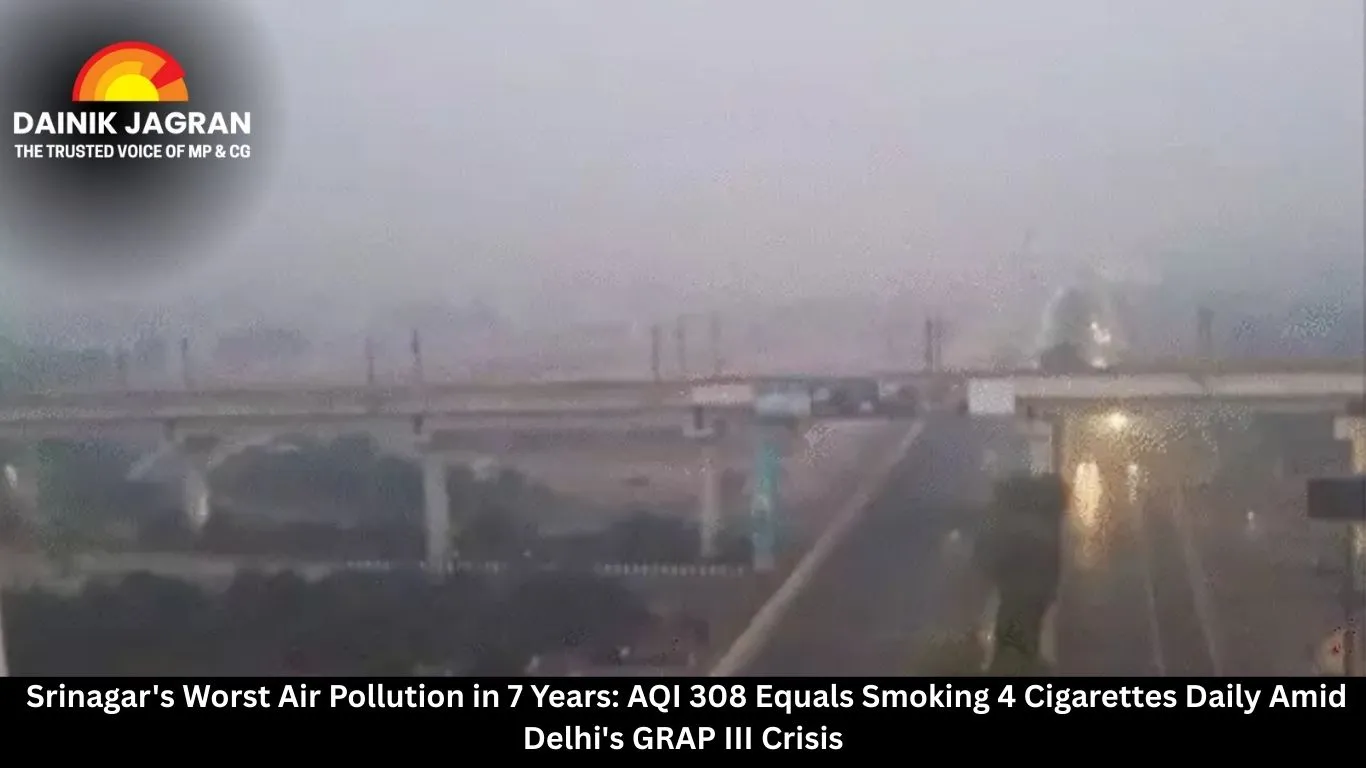
Srinagar's Worst Air Pollution in 7 Years: AQI 308 Equals Smoking 4 Cigarettes Daily Amid Delhi's GRAP III Crisis
Digital Desk
Srinagar faces worst air pollution in 7 years with AQI at 308—equivalent to smoking 4 cigarettes daily. Delhi's AQI hits 390 under GRAP III. Health risks and solutions explained.
Srinagar's Worst Air Pollution in 7 Years Hits Alarming Peak
Srinagar is choking under its worst air pollution in seven years, with the Air Quality Index (AQI) soaring to 308 on Wednesday. This crisis in Jammu and Kashmir equals exposure to smoking over four cigarettes daily, as PM2.5 levels hit 115 micrograms per cubic meter—far beyond WHO limits. Meanwhile, Delhi's AQI lingers at 339, peaking at 390 in Jahangirpuri, enforcing GRAP III measures.
Evening Surge Worsens Srinagar Air Pollution
Air quality in Srinagar stays breathable in mornings but plummets evenings, with AQI climbing to 228. Over the past week, it hovered above 100, hitting a shocking 415 on January 16. Since 2019, 2026 marks the most polluted year at an average AQI of 159, a stark contrast to 2023's clean 49. This winter spike, amid cold traps and stagnant winds, demands urgent action—especially as India battles a broader air crisis.
Delhi AQI Fuels GRAP III Emergency
Delhi's "very poor" air, now under GRAP III, restricts construction and vehicles to curb toxins. With AQI at 390 in hotspots, evenings amplify the haze. This ties into national trends, where winter inversions trap pollutants, making cities uninhabitable.
PM2.5 Health Risks: A Ticking Time Bomb
PM2.5 and PM10 particles—tiny enough to pierce lungs and enter blood—wreak havoc. Dr. Arup Halder from Calcutta Medical Research Institute warns they trigger heart attacks, headaches, dementia, and stunt child brain development. Dr. Rajesh Chawla of Indraprastha Apollo Hospital notes 10-15% lung capacity loss in kids aged 5-10, plus asthma, cancer, eye irritation, and skin issues.
-
India's SoGA 2024 report: 464 daily child deaths under 5 from air pollution—more than tobacco or diabetes.
-
University of Chicago study: 3-4 years shaved off life expectancy.
This isn't just data; it's a public health emergency amplified by current winter trends.
Why It Matters Now and Actionable Steps
With 2026 winters exposing urban vulnerabilities, Srinagar air pollution spotlights failed policies. My take: Governments must prioritize stubble burning bans, electric vehicle pushes, and real-time monitoring. Readers, act today:
-
Use N95 masks outdoors.
-
Install HEPA filters indoors.
-
Avoid evening travel; track AQI via apps like Sameer.
-
Push for green spaces—plant trees locally.
Ignoring this risks generations. Time for accountability before Delhi's smog engulfs more cities.
--------
🚨 Beat the News Rush – Join Now!
Get breaking alerts, hot exclusives, and game-changing stories instantly on your phone. No delays, no fluff – just the edge you need. ⚡
Tap to join:
🟢 WhatsApp Channel: Dainik Jagran MP CG
Crave more?
🅕 Facebook: Dainik Jagran MP CG English
🅧 Twitter (X): Dainik Jagran MP CG
🅘 Instagram: Dainik Jagran MP CG
Share the fire – keep your crew ahead! 🗞️🔥
Srinagar's Worst Air Pollution in 7 Years: AQI 308 Equals Smoking 4 Cigarettes Daily Amid Delhi's GRAP III Crisis
Digital Desk
Srinagar's Worst Air Pollution in 7 Years Hits Alarming Peak
Srinagar is choking under its worst air pollution in seven years, with the Air Quality Index (AQI) soaring to 308 on Wednesday. This crisis in Jammu and Kashmir equals exposure to smoking over four cigarettes daily, as PM2.5 levels hit 115 micrograms per cubic meter—far beyond WHO limits. Meanwhile, Delhi's AQI lingers at 339, peaking at 390 in Jahangirpuri, enforcing GRAP III measures.
Evening Surge Worsens Srinagar Air Pollution
Air quality in Srinagar stays breathable in mornings but plummets evenings, with AQI climbing to 228. Over the past week, it hovered above 100, hitting a shocking 415 on January 16. Since 2019, 2026 marks the most polluted year at an average AQI of 159, a stark contrast to 2023's clean 49. This winter spike, amid cold traps and stagnant winds, demands urgent action—especially as India battles a broader air crisis.
Delhi AQI Fuels GRAP III Emergency
Delhi's "very poor" air, now under GRAP III, restricts construction and vehicles to curb toxins. With AQI at 390 in hotspots, evenings amplify the haze. This ties into national trends, where winter inversions trap pollutants, making cities uninhabitable.
PM2.5 Health Risks: A Ticking Time Bomb
PM2.5 and PM10 particles—tiny enough to pierce lungs and enter blood—wreak havoc. Dr. Arup Halder from Calcutta Medical Research Institute warns they trigger heart attacks, headaches, dementia, and stunt child brain development. Dr. Rajesh Chawla of Indraprastha Apollo Hospital notes 10-15% lung capacity loss in kids aged 5-10, plus asthma, cancer, eye irritation, and skin issues.
-
India's SoGA 2024 report: 464 daily child deaths under 5 from air pollution—more than tobacco or diabetes.
-
University of Chicago study: 3-4 years shaved off life expectancy.
This isn't just data; it's a public health emergency amplified by current winter trends.
Why It Matters Now and Actionable Steps
With 2026 winters exposing urban vulnerabilities, Srinagar air pollution spotlights failed policies. My take: Governments must prioritize stubble burning bans, electric vehicle pushes, and real-time monitoring. Readers, act today:
-
Use N95 masks outdoors.
-
Install HEPA filters indoors.
-
Avoid evening travel; track AQI via apps like Sameer.
-
Push for green spaces—plant trees locally.
Ignoring this risks generations. Time for accountability before Delhi's smog engulfs more cities.


