


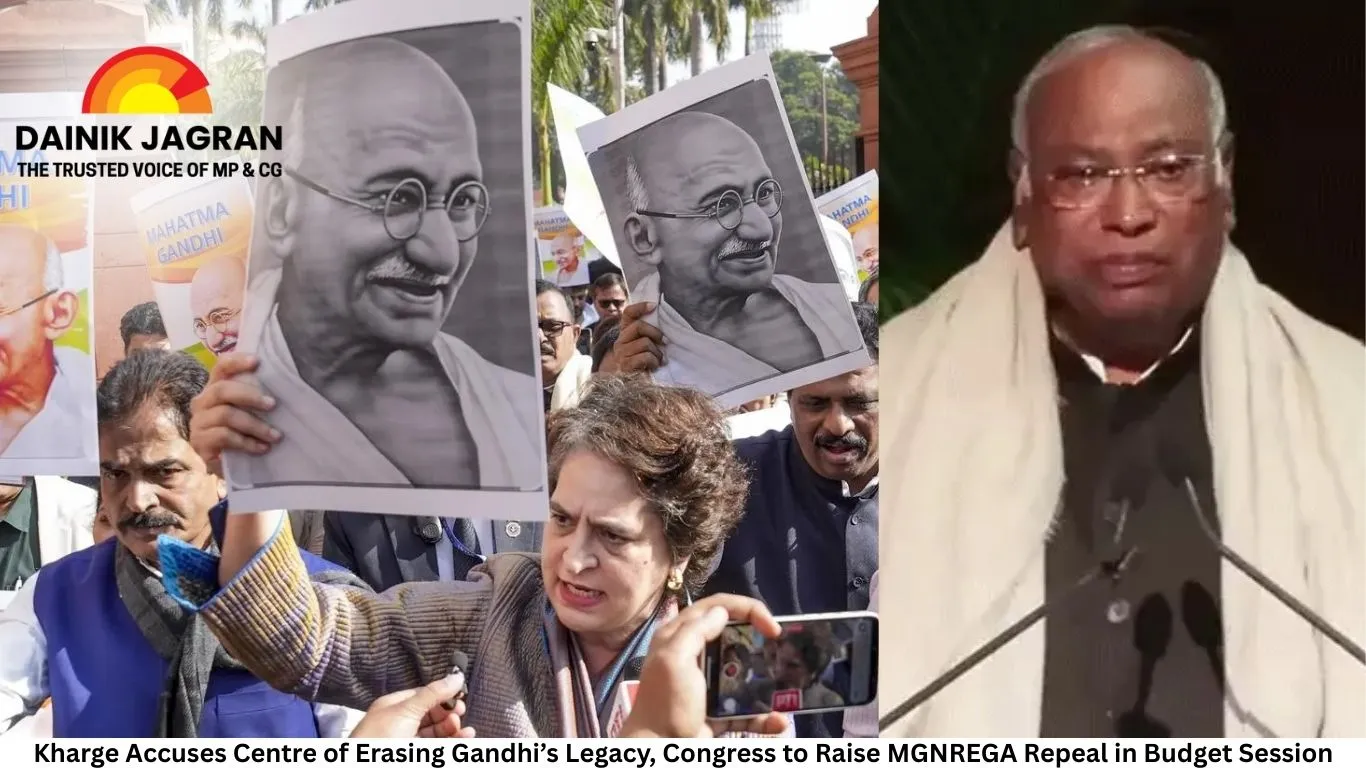
Kharge Accuses Centre of Erasing Gandhi’s Legacy, Congress to Raise MGNREGA Repeal in Budget Session
Digital Desk
Speaking at the National MGNREGA Workers’ Conference organised by the Rachnatmak Congress, Kharge asserted that the replacement of MGNREGA with the proposed Viksit Bharat–Rozgar Aajeevika Mission (Rural) Guarantee Act was not merely an administrative change but a political decision with long-term social consequences. He said the Congress would strongly oppose the move during the upcoming Budget Session of Parliament.
“The repeal of MGNREGA is an attempt to remove Mahatma Gandhi’s name from public memory and undermine the principles he stood for,” Kharge said, urging workers and citizens to unite against the implementation of the new law. He claimed that the original Act was designed as a legal guarantee of work and dignity for rural households, and any dilution of that right would directly impact the poor.
The conference saw participation from workers across several states. In a symbolic gesture, delegates brought soil from their worksites and placed it in saplings on stage, underscoring their connection to rural livelihoods and the land. Leader of Opposition in the Lok Sabha Rahul Gandhi was also present at the event.
The Congress has intensified its opposition through a 45-day nationwide agitation titled ‘MNREGA Bachao Sangram’, launched on January 10. The party argues that the proposed legislation weakens decentralisation by curtailing the role of panchayats and shifting decision-making away from local bodies.
According to party leaders, MGNREGA, introduced during the UPA government, remains one of the largest social security programmes in the world, providing employment to millions of rural families annually. They contend that replacing it with a mission-mode scheme could convert a legal entitlement into a discretionary welfare programme.
The government has not yet responded in detail to Kharge’s remarks. However, sources indicate that the proposed law is aimed at restructuring rural employment delivery in line with broader development goals.
With Parliament’s Budget Session approaching, the issue is expected to trigger sharp debate, setting the stage for a political confrontation over rural welfare, employment rights and the legacy of one of India’s most significant social legislations.
.jpg)




