
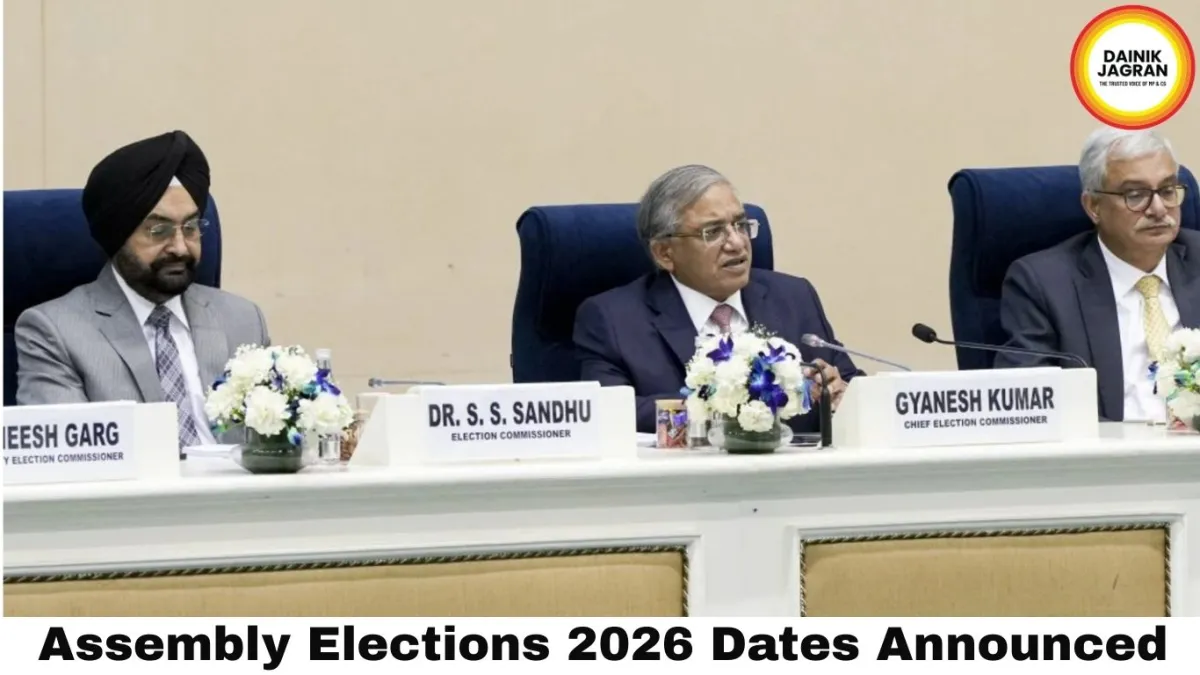

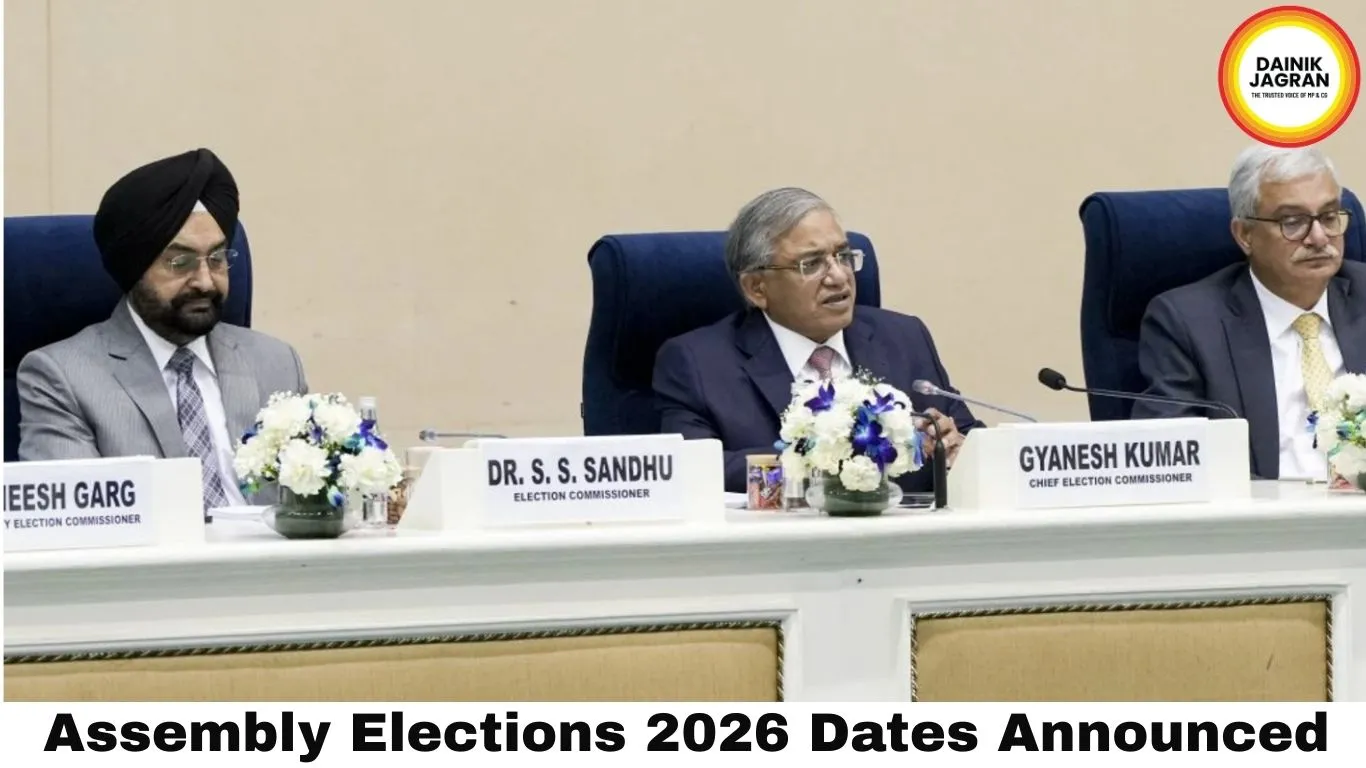
Assembly Elections 2026 Dates Announced: Assam, Kerala & Puducherry on April 9; Tamil Nadu on April 23; West Bengal in 2 Phases — Results May 4
Digital Desk
India's democratic calendar for 2026 is now set. The Election Commission of India on Sunday announced the schedule for the 2026 general elections to the legislative assemblies of Assam, Kerala, Puducherry, Tamil Nadu, and West Bengal — setting the stage for one of the largest democratic exercises in the country this year. Voting will be held between April 9 and April 29, 2026, with counting of votes scheduled for May 4, 2026 for all five regions. The Model Code of Conduct came into immediate effect across all poll-bound states from the moment of the announcement.
The Complete Schedule at a Glance
Assam (126 seats): Single phase — April 9. Counting: May 4. Assembly term ends May 20.
Kerala (140 seats): Single phase — April 9. Counting: May 4. Assembly term ends May 23.
Puducherry (30 seats): Single phase — April 9. Counting: May 4. Assembly term ends June 15.
Tamil Nadu (234 seats): Single phase — April 23. Counting: May 4. Assembly term ends May 10.
West Bengal (294 seats): Two phases — April 23 (152 seats) and April 29 (142 seats). Counting: May 4. Assembly term ends May 7.
The elections will cover 824 constituencies involving approximately 17.4 crore eligible voters and over 2.18 lakh polling stations across the five regions.
Why the Announcement Matters Right Now
The timing of this announcement has immediate consequences across India's political landscape. In Madhya Pradesh, BJP state ministers and party workers — including those in the Mohan Yadav cabinet — are expected to be deployed for campaigning in election-bound states, which is precisely why sources in Bhopal say the long-anticipated MP cabinet reshuffle has been deferred to the second week of May. The announcement has also effectively frozen key policy decisions in poll-bound states, with the Model Code of Conduct now prohibiting new government schemes, transfers of key officials, or announcement of fresh benefits designed to influence voters.
West Bengal: Two Phases, High Stakes
The elections in West Bengal will be conducted in two phases — 152 seats on April 23 and the remaining 142 constituencies on April 29. This marks a significant reduction from the eight phases used in previous Bengal elections. Responding to a question about the reduced number of phases, Chief Election Commissioner Gyanesh Kumar said it was necessary to reduce phases to make the election convenient for voters.
West Bengal's 294-seat assembly will see a fierce battle between the ruling Trinamool Congress, led by Chief Minister Mamata Banerjee since 2011, and the Bharatiya Janata Party. The state has 6,45,61,152 total electors, including 5,23,229 young voters aged 18–19 years, 4,16,089 electors with disabilities, and 3,78,979 senior citizens aged 85 and above.
Central forces are expected to be deployed extensively in West Bengal to ensure smooth polling. CEC Kumar issued a firm warning, stating the Commission will not tolerate political violence and will act wherever required.
The Mamata factor: The Chief Minister had announced a DA hike for state government employees just days before the MCC announcement. When asked, CEC Kumar stated clearly that actions taken before the Model Code of Conduct comes into force remain the prerogative of the concerned government — offering Mamata a degree of political cover while firmly signalling that no such moves will be permissible going forward.
Kerala: LDF Defends, BJP Eyes Historic Breakthrough
Kerala's 140-seat contest pits the incumbent Left Democratic Front under Chief Minister Pinarayi Vijayan against the United Democratic Front led by Congress. The BJP-led NDA is entering the race aggressively, planning to field candidates in around 100 seats — with allies Bharat Dharma Jana Sena and Twenty20 covering the remainder — in what party strategists describe as its most organised Kerala campaign to date.
Kerala's revised electoral roll includes 2,69,53,644 voters — 1,31,26,048 male, 1,38,27,319 female, and 227 third-gender voters — with 4,24,518 first-time voters in the 18–19 age group. The state votes on April 9.
Tamil Nadu: DMK's Incumbency Test
Tamil Nadu's 234 assembly seats go to the polls on April 23 in a single phase. The contest will test the DMK government's incumbency against a consolidated opposition. Chief Minister M.K. Stalin is seeking re-election on the back of welfare delivery and anti-Centre posturing, while the AIADMK and BJP — now in a renewed alliance — are attempting to capitalise on discontent over price rise and unemployment.
Tamil Nadu's assembly term expires on May 10, making elections constitutionally time-bound with no room for delay.
Assam: BJP Eyes Historic Third Term
In Assam, the BJP-led NDA government faces off against Congress for all 126 seats in a single-phase vote on April 9. The BJP is seeking a third consecutive term under Chief Minister Himanta Biswa Sarma, banking on development infrastructure, welfare schemes, and aggressive governance. Party leadership has indicated that committees have been established at every level — from the panchayat to the state — ahead of the poll.
Congress and its INDIA bloc partners are counting on anti-incumbency, inflation-related grievances, and a consolidated minority voter base to mount a credible challenge.
Puducherry: Small State, National Significance
Puducherry's 30-seat assembly votes on April 9. The Union Territory — governed by a Congress-led coalition — is often treated as an afterthought, but its result carries symbolic weight for the INDIA bloc's ability to hold onto governance in smaller territories. The BJP-AINRC alliance under N. Rangasamy is seeking to return to power after being ousted in 2021.
What the CEC Said
Chief Election Commissioner Gyanesh Kumar called the polls a "festival of pride," urging first-time voters: "You are about to step into one of the most important responsibilities of your life. Your vote is your choice in shaping the future of your state and the nation."
The Commission flagged concerns about misinformation and deepfakes, saying strict vigilance mechanisms are in place during the campaign period. The ECI has also directed social media platforms to fast-track the takedown of MCC-violating content within three hours of a complaint being filed.
By-Elections Also Announced
In addition to the five assembly elections, the Commission also announced by-elections for six seats across six states — Goa, Gujarat, Karnataka, Maharashtra, Nagaland, and Tripura — in two phases. The first phase covers Goa, Karnataka, Nagaland, and Tripura on April 9; the second phase covers Gujarat and Maharashtra on April 23. Counting for all by-elections is also on May 4.
Key Deployment Figures
Nearly 2.19 lakh polling stations will be set up and approximately 25 lakh personnel will be deployed to conduct the elections. An average of 750–900 electors per polling station is expected across all five regions. Observers from more than 20 countries will witness the elections — the largest single round of state assembly polling India has seen in 2026.
The National Verdict That Is Coming
The simultaneous announcement of elections in five politically diverse regions — from Bengal's TMC stronghold to BJP-governed Assam, from Congress-allied Tamil Nadu to the LDF's Kerala bastion — transforms April and May 2026 into a national political referendum.
For the BJP, which governs at the Centre and in Assam, these results will signal whether the momentum from its 2024 Lok Sabha victory has held through two years of governance and external shocks — the West Asia energy crisis, rising prices, and geopolitical turbulence. For the INDIA bloc, Bengal and Kerala are must-win. A Mamata sweep combined with an LDF retention would dramatically reshape opposition confidence heading into 2027–28 state cycles. For the DMK, the Tamil Nadu election is an existential test of incumbency management.
May 4 will answer all of it — and set the terms of Indian politics for the next two years.
.jpg)




