Officials stated that a handwritten note on a piece of tissue paper was found in the flight’s lavatory, claiming a bomb was on board. Following standard safety protocols, the plane was moved to an isolation parking area, and the Bomb Detection and Disposal Squad (BDDS) conducted a detailed sweep of the aircraft. After the completion of all safety checks, the flight was cleared for normal operations.
“The situation was managed according to established procedures. Passenger safety remained our top priority,” an IndiGo spokesperson said. The Air Traffic Control (ATC) had immediately alerted Apron Control, which coordinated with all relevant agencies to ensure a secure inspection.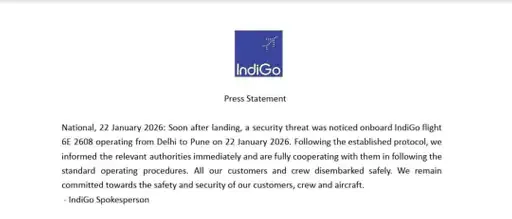
This incident is part of a broader pattern of bomb threats affecting Indian flights. On 18 January, a Delhi–Bagdogra flight was diverted to Lucknow after a threat was discovered on a napkin in the lavatory. Similarly, on 2 December, an IndiGo flight from Kuwait to Hyderabad made an emergency landing at Mumbai Airport due to a bomb threat received via email. On 12 November, an Air India Express flight from Mumbai to Varanasi faced a similar threat.
Data from the central government indicate that over 90 flights received bomb threats nationwide between 14 and 20 October, resulting in financial losses exceeding ₹2,000 crore due to diversions, increased fuel consumption, and passenger accommodations. Each threat triggers a protocol of emergency landing, detailed security sweeps, and coordination with fire, medical, and law enforcement agencies, with the overall cost of handling a single threat estimated at ₹3 crore.
Authorities continue to emphasize vigilance and adherence to protocol to ensure passenger safety, while airlines coordinate with airport security and law enforcement agencies to manage potential threats efficiently.


IndiGo Delhi-Pune Flight Receives Bomb Threat, No Explosives Found
Digital Desk
Officials stated that a handwritten note on a piece of tissue paper was found in the flight’s lavatory, claiming a bomb was on board. Following standard safety protocols, the plane was moved to an isolation parking area, and the Bomb Detection and Disposal Squad (BDDS) conducted a detailed sweep of the aircraft. After the completion of all safety checks, the flight was cleared for normal operations.
“The situation was managed according to established procedures. Passenger safety remained our top priority,” an IndiGo spokesperson said. The Air Traffic Control (ATC) had immediately alerted Apron Control, which coordinated with all relevant agencies to ensure a secure inspection.
This incident is part of a broader pattern of bomb threats affecting Indian flights. On 18 January, a Delhi–Bagdogra flight was diverted to Lucknow after a threat was discovered on a napkin in the lavatory. Similarly, on 2 December, an IndiGo flight from Kuwait to Hyderabad made an emergency landing at Mumbai Airport due to a bomb threat received via email. On 12 November, an Air India Express flight from Mumbai to Varanasi faced a similar threat.
Data from the central government indicate that over 90 flights received bomb threats nationwide between 14 and 20 October, resulting in financial losses exceeding ₹2,000 crore due to diversions, increased fuel consumption, and passenger accommodations. Each threat triggers a protocol of emergency landing, detailed security sweeps, and coordination with fire, medical, and law enforcement agencies, with the overall cost of handling a single threat estimated at ₹3 crore.
Authorities continue to emphasize vigilance and adherence to protocol to ensure passenger safety, while airlines coordinate with airport security and law enforcement agencies to manage potential threats efficiently.