


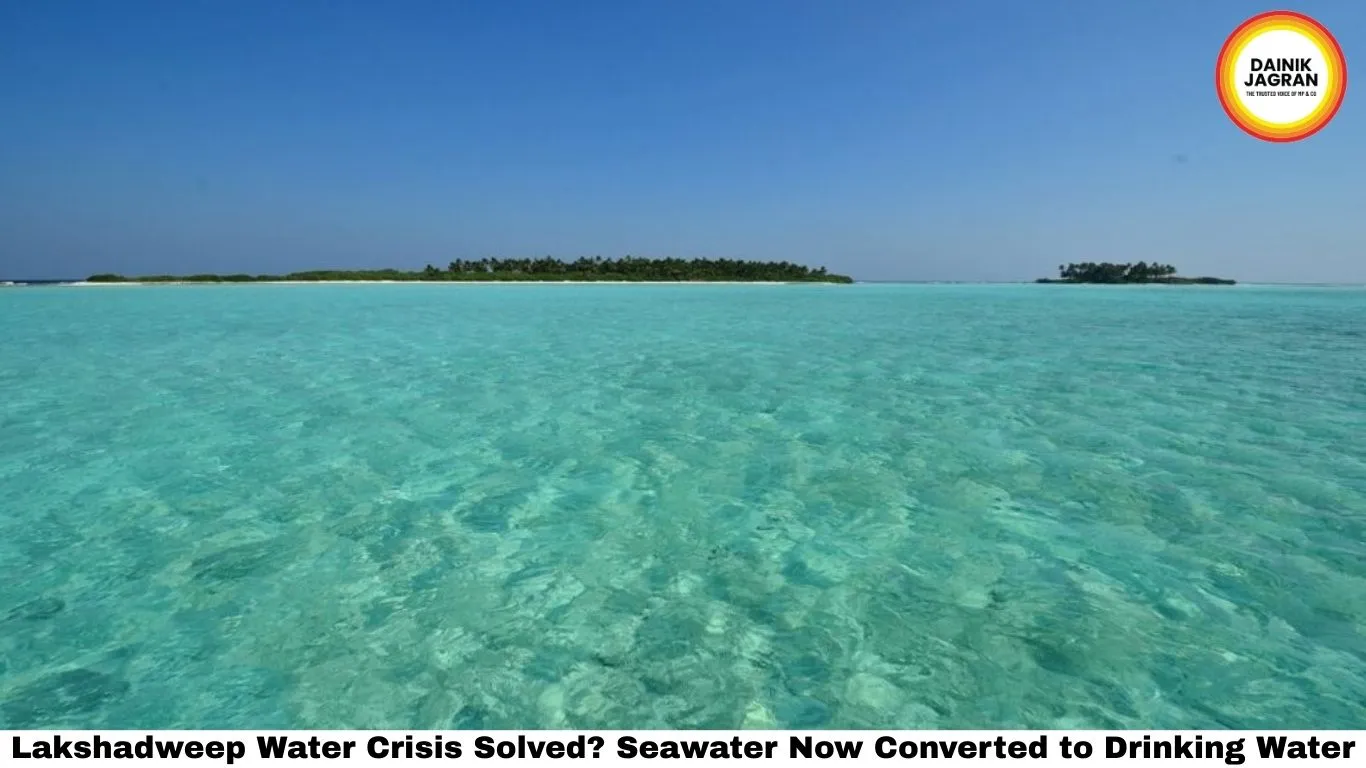
Lakshadweep Water Crisis Solved? Seawater Now Converted to Drinking Water on 8 Islands — OTEC Plant Coming in 2026, No Chemicals, No Brine Pollution
Digital Desk
Surrounded by the Arabian Sea on all sides, the people of Lakshadweep have historically had almost no access to fresh drinking water. There are no rivers, no lakes, and precious little groundwater — what little exists is heavily contaminated by saltwater intrusion. For decades, islanders drank from wells that tasted of brine, collected monsoon rainwater in tanks, and waited for government supply ships. That story is now changing — and the technology behind the change is entirely Indian.
The Problem: An Island Territory With No Freshwater
Lakshadweep has historically faced severe challenges related to drinking water availability due to limited groundwater resources, rampant salinity intrusion, and near-total dependence on seasonal rainfall. The archipelago — 36 islands scattered across 32 square kilometres of land in the Lakshadweep Sea — has no rivers, no perennial streams, and no natural reservoir system. Every litre of fresh water either fell from the sky or was shipped from the mainland at enormous logistical cost.
Residents of Kavaratti, the island territory's capital, recall drinking salty well water before the introduction of desalination. Abdul Rehman, a local resident, described the change simply: "Earlier we used to drink salty well water. Now everyone in our area is using desalinated water for drinking."
The Solution: LTTD — India's Own Ocean Technology
In 2005, India became the first country in the world to operationalise a Low Temperature Thermal Desalination plant for public drinking water supply — and it did it on a remote coral island with no heavy industry, no chemical inputs, and no harm to the surrounding reef ecosystem.
The technology, developed entirely by the National Institute of Ocean Technology (NIOT) under the Ministry of Earth Sciences, works on a beautifully simple principle. LTTD technology converts seawater into drinking water by using the natural temperature difference between warm surface water and cold deep-sea water drawn from depths of about 350–400 metres.
Under the LTTD process, warm seawater is flash-evaporated under low pressure, and the vapour produced is condensed using cold deep-sea water to generate potable water. The system does not require chemical additives or high-pressure membranes and avoids the discharge of concentrated brine — critically protecting the fragile coral reef ecosystems around the islands.
In practical terms: warm ocean surface water — heated by the sun — is pumped into a low-pressure chamber where it immediately vaporises. Cold water drawn from 350–400 metres below the surface then cools that vapour back into liquid form. What drips out is pure, salt-free drinking water. No chemicals. No membranes to replace. No toxic brine dumped back into the sea.
Where It Stands Today: 8 Islands, Millions of Litres Daily
LTTD plants are now operational in eight islands of Lakshadweep — Kavaratti, Minicoy, Agatti, Amini, Kalpeni, Kadamat, Chetlat, and Kiltan. Two more islands are expected to receive similar facilities in the near future.
The original Kavaratti plant was designed to produce nearly one lakh litres of drinking water daily when it was commissioned in 2005. Over the years, prolonged exposure to harsh marine conditions and ageing equipment have gradually reduced its output — a challenge that the Ministry of Earth Sciences is now actively addressing through technological renewal.
Union Minister for Earth Sciences Dr. Jitendra Singh visited the Kavaratti LTTD plant on March 7, 2026 to review its functioning and operational health. During the review, scientists briefed the minister on the operational aspects of the plants and their contribution to addressing freshwater shortages. Local authorities reported that the increased availability of clean water has contributed to a reduction in water-borne diseases and improved the reliability of year-round water supply for island communities.
Kadeeshomma, an 80-year-old resident of Kavaratti and former government school teacher who has lived on the island her entire life, summed it up: "Water now flows from the tap regularly, but that was not always the case. The desalination plant has been a game changer for us."
What Is Coming Next: The OTEC Revolution
The existing LTTD plants have one significant limitation: they still run on diesel generators — a fuel that must be shipped from the mainland, making them both expensive and environmentally imperfect. The next phase of Lakshadweep's water technology story is designed to fix exactly that.
The Ocean Thermal Energy Conversion plant designed and developed by NIOT is set to commence operations in 2026 at Kavaratti. The OTEC plant is expected to generate up to 60 kilowatts of power from ocean water, and use that power to run a desalination plant that will provide 1,50,000 litres of desalinated water every day.
OTEC technology goes one step further than LTTD — it does not just use the ocean's temperature difference to make water, it also generates electricity from that same process, making the entire facility self-powered and fossil-fuel free. This makes the Kavaratti OTEC plant an attempt at delivering clean water from a clean energy source — the first such integrated system of its kind in the world.
Dr. Jitendra Singh emphasised that technologies such as LTTD and OTEC are particularly well suited for island territories like Lakshadweep, where freshwater sources are scarce but seawater is abundant. He added that reducing dependence on diesel-based systems is critical, since diesel supply chains to remote islands are often disrupted — particularly during the monsoon season.
Why This Matters Beyond Lakshadweep
With reliable access to drinking water and electricity, the islands are expected to see major growth in tourism and the blue economy. The environmentally friendly and cost-effective indigenous technology will also strengthen India's self-reliance in ocean science.
But the implications stretch far beyond a 36-island Union Territory. India has over 1,300 islands along its coastlines. Dozens of coastal districts face acute groundwater stress. And in the context of the ongoing LPG crisis — where supply chains running through geopolitically volatile corridors have shown how exposed India's resource security can be — the ability to generate both clean water and clean energy from a local, inexhaustible resource sitting right at the doorstep is not just scientific achievement. It is strategic resilience.
The project's success and its potential for application in other water-stressed regions of India is now being actively studied — with coastal districts in Odisha, Tamil Nadu, Andhra Pradesh, and Gujarat among those being assessed for LTTD and OTEC deployment.
The Bigger Picture: India's Deep Ocean Mission
The Lakshadweep desalination programme sits at the heart of India's broader Deep Ocean Mission — a ₹4,077 crore multi-year initiative that aims to harness the ocean not just as a transport highway or a fishing ground, but as a source of minerals, energy, and fresh water. NIOT is now working to make the LTTD process fully emission-free — using the OTEC system to eliminate the last remaining diesel dependency from the island water supply chain.
When the OTEC plant switches on in Kavaratti in 2026, it will mark the completion of a 21-year journey: from the first desalination drops collected in a beaker in a Chennai laboratory in the early 2000s, to a fully self-powered, zero-emission, zero-chemical ocean water conversion plant serving thousands of citizens on a coral island in the Arabian Sea — built entirely with Indian science, Indian engineering, and Indian hands.
.jpg)




