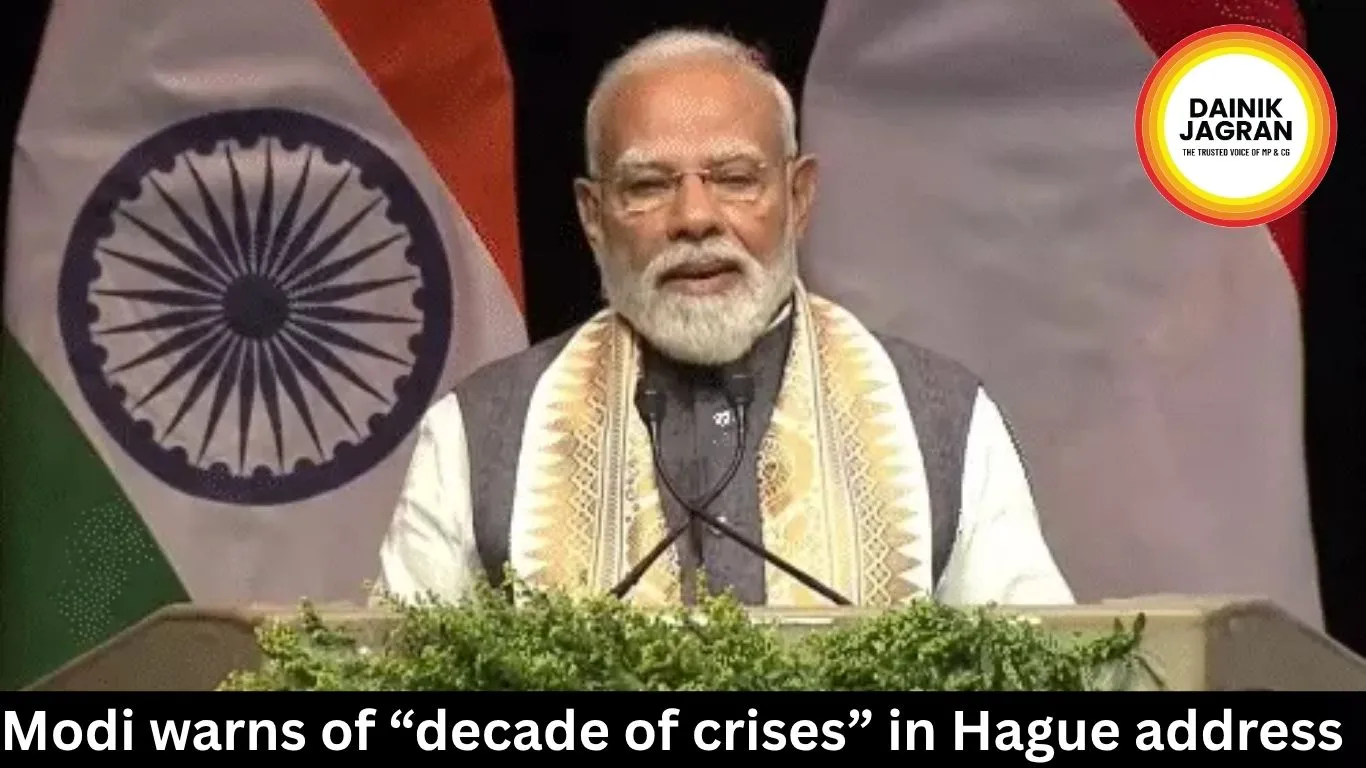
Modi warns of “decade of crises” in Hague address

Digital Desk

Modi warns of “decade of crises” in Hague address

PM Modi warned of a “decade of crises” in The Hague, urging global action as India showcases tech, trade and cultural ties during the Netherlands visit.


Modi warns of “decade of crises”, urges global action during Hague address

Prime Minister Narendra Modi said the world risks sliding into poverty if COVID, war and energy shocks persist.

The Hague — Prime Minister Narendra Modi on Saturday warned that the world is entering a “decade of crises” and urged collective global action to prevent large-scale reversals in development, during an address to the Indian community in The Hague as part of his Netherlands visit.

A stark opening

Speaking before a packed community event in the early afternoon, Mr Modi said the sequence of shocks — the COVID-19 pandemic, subsequent wars and now an energy crisis — has created conditions that could push millions back into poverty if not checked. According to officials, he used the phrase “decade of disasters” to underscore the scale of the challenge.

He delivered the warning roughly three hours after landing in the Netherlands late Friday night and ahead of scheduled bilateral meetings with King Willem-Alexander, Queen Máxima and Dutch leaders. Local sources said the address lasted over 40 minutes and drew applause and chants from the diaspora.

Key policy points

Modi highlighted India's domestic achievements as part of his argument for resilience. He noted that India recorded more than 20 billion UPI transactions in a year and touted the country’s rapid startup growth, saying the nation now hosts over 200,000 startups and 125 unicorns. He also referred to advances in semiconductor manufacturing, saying work is underway on 12 plants, with two already producing chips.

“Chips will also be Made in India,” he said, according to an official readout, linking economic self-reliance to broader global stability.

Cultural outreach and community ties

The Prime Minister praised the Indian diaspora in the Netherlands as a “trusted bridge” for Indian businesses seeking entry into Europe and highlighted the Surinamese-Indian community’s role in preserving Indian culture. Around 200,000 people of Surinamese-Hindustani origin live in the Netherlands; many trace their roots to Bihar, Uttar Pradesh and Bengal and speak Sarnami, a language linked to Bhojpuri and Awadhi.

Ground reports from The Hague described a warm reception: Dutch musicians performed a rendition based on raga Durga, Indian classical instruments were played, and cultural dances such as Kathak and Garba featured in the programme. A young Dutch-Indian presented the Prime Minister with a painting of the Ram Temple, attendees said.

Historic restitution announced

In another notable development during the visit, the Dutch government returned the 11th-century Anaimangalam copper plates — known in the Netherlands as the Leiden Plates — to India. Officials said the plates, thought to date from Raja Raja Chola I’s reign, contain inscriptions about land and tax grants to a Buddhist monastery in Nagapattinam and weigh about 30 kg in total. The return was described in New Delhi as an important cultural moment in bilateral ties.

Diplomacy and next steps

Mr Modi held talks with Dutch officials upon arrival and is slated for further discussions with Prime Minister Dick Schoof, focusing on supply chains, green energy cooperation and joint international projects. In his speech he described the Netherlands as a “natural gateway” for Indian firms entering Europe and compared India–Netherlands ties to a lotus and a tulip — rooted differently but growing strong when supported.

Local authorities confirmed the Prime Minister’s schedule includes a state-level reception and meetings on trade and technology. Sources familiar with the delegation said climate-resilient infrastructure and semiconductor cooperation will be priorities in formal talks.

Impact and public relevance

Analysts say Modi’s emphasis on the risk of global impoverishment frames India’s development push as not just national but globally stabilising. “The pitch is two-fold: showcase India’s resilience and mobilise partners to prevent a global backslide,” said a policy analyst in New Delhi who declined to be named. For diaspora audiences, the visit reinforced cultural connections at a time of wider geopolitical uncertainty.

What to watch

Observers will be watching for joint statements after Modi’s meetings with Dutch leadership and for any new agreements on energy, semiconductors or cultural restitution beyond the copper plates. Back in India, officials will closely monitor whether the visit yields concrete trade and technology commitments that can be translated into on-ground projects.


--------

🚨 Beat the News Rush – Join Now!

Get breaking alerts, hot exclusives, and game-changing stories instantly on your phone. No delays, no fluff – just the edge you need. ⚡

Tap to join: 

🟢 WhatsApp Channel: Dainik Jagran MP CG

Crave more?

🅕 Facebook: Dainik Jagran MP CG English

🅧 Twitter (X): Dainik Jagran MP CG

🅘 Instagram: Dainik Jagran MP CG

Share the fire – keep your crew ahead! 🗞️🔥

english.dainikjagranmpcg.com
17 May 2026 By Abhishek Joshi

Modi warns of “decade of crises” in Hague address

Digital Desk

Modi warns of “decade of crises”, urges global action during Hague address

Prime Minister Narendra Modi said the world risks sliding into poverty if COVID, war and energy shocks persist.

The Hague — Prime Minister Narendra Modi on Saturday warned that the world is entering a “decade of crises” and urged collective global action to prevent large-scale reversals in development, during an address to the Indian community in The Hague as part of his Netherlands visit.

A stark opening

Speaking before a packed community event in the early afternoon, Mr Modi said the sequence of shocks — the COVID-19 pandemic, subsequent wars and now an energy crisis — has created conditions that could push millions back into poverty if not checked. According to officials, he used the phrase “decade of disasters” to underscore the scale of the challenge.

He delivered the warning roughly three hours after landing in the Netherlands late Friday night and ahead of scheduled bilateral meetings with King Willem-Alexander, Queen Máxima and Dutch leaders. Local sources said the address lasted over 40 minutes and drew applause and chants from the diaspora.

Key policy points

Modi highlighted India's domestic achievements as part of his argument for resilience. He noted that India recorded more than 20 billion UPI transactions in a year and touted the country’s rapid startup growth, saying the nation now hosts over 200,000 startups and 125 unicorns. He also referred to advances in semiconductor manufacturing, saying work is underway on 12 plants, with two already producing chips.

“Chips will also be Made in India,” he said, according to an official readout, linking economic self-reliance to broader global stability.

Cultural outreach and community ties

The Prime Minister praised the Indian diaspora in the Netherlands as a “trusted bridge” for Indian businesses seeking entry into Europe and highlighted the Surinamese-Indian community’s role in preserving Indian culture. Around 200,000 people of Surinamese-Hindustani origin live in the Netherlands; many trace their roots to Bihar, Uttar Pradesh and Bengal and speak Sarnami, a language linked to Bhojpuri and Awadhi.

Ground reports from The Hague described a warm reception: Dutch musicians performed a rendition based on raga Durga, Indian classical instruments were played, and cultural dances such as Kathak and Garba featured in the programme. A young Dutch-Indian presented the Prime Minister with a painting of the Ram Temple, attendees said.

Historic restitution announced

In another notable development during the visit, the Dutch government returned the 11th-century Anaimangalam copper plates — known in the Netherlands as the Leiden Plates — to India. Officials said the plates, thought to date from Raja Raja Chola I’s reign, contain inscriptions about land and tax grants to a Buddhist monastery in Nagapattinam and weigh about 30 kg in total. The return was described in New Delhi as an important cultural moment in bilateral ties.

Diplomacy and next steps

Mr Modi held talks with Dutch officials upon arrival and is slated for further discussions with Prime Minister Dick Schoof, focusing on supply chains, green energy cooperation and joint international projects. In his speech he described the Netherlands as a “natural gateway” for Indian firms entering Europe and compared India–Netherlands ties to a lotus and a tulip — rooted differently but growing strong when supported.

Local authorities confirmed the Prime Minister’s schedule includes a state-level reception and meetings on trade and technology. Sources familiar with the delegation said climate-resilient infrastructure and semiconductor cooperation will be priorities in formal talks.

Impact and public relevance

Analysts say Modi’s emphasis on the risk of global impoverishment frames India’s development push as not just national but globally stabilising. “The pitch is two-fold: showcase India’s resilience and mobilise partners to prevent a global backslide,” said a policy analyst in New Delhi who declined to be named. For diaspora audiences, the visit reinforced cultural connections at a time of wider geopolitical uncertainty.

What to watch

Observers will be watching for joint statements after Modi’s meetings with Dutch leadership and for any new agreements on energy, semiconductors or cultural restitution beyond the copper plates. Back in India, officials will closely monitor whether the visit yields concrete trade and technology commitments that can be translated into on-ground projects.


https://english.dainikjagranmpcg.com/national/modi-warns-of-%E2%80%9Cdecade-of-crises%E2%80%9D-in-hague-address/article-18587

Latest News