

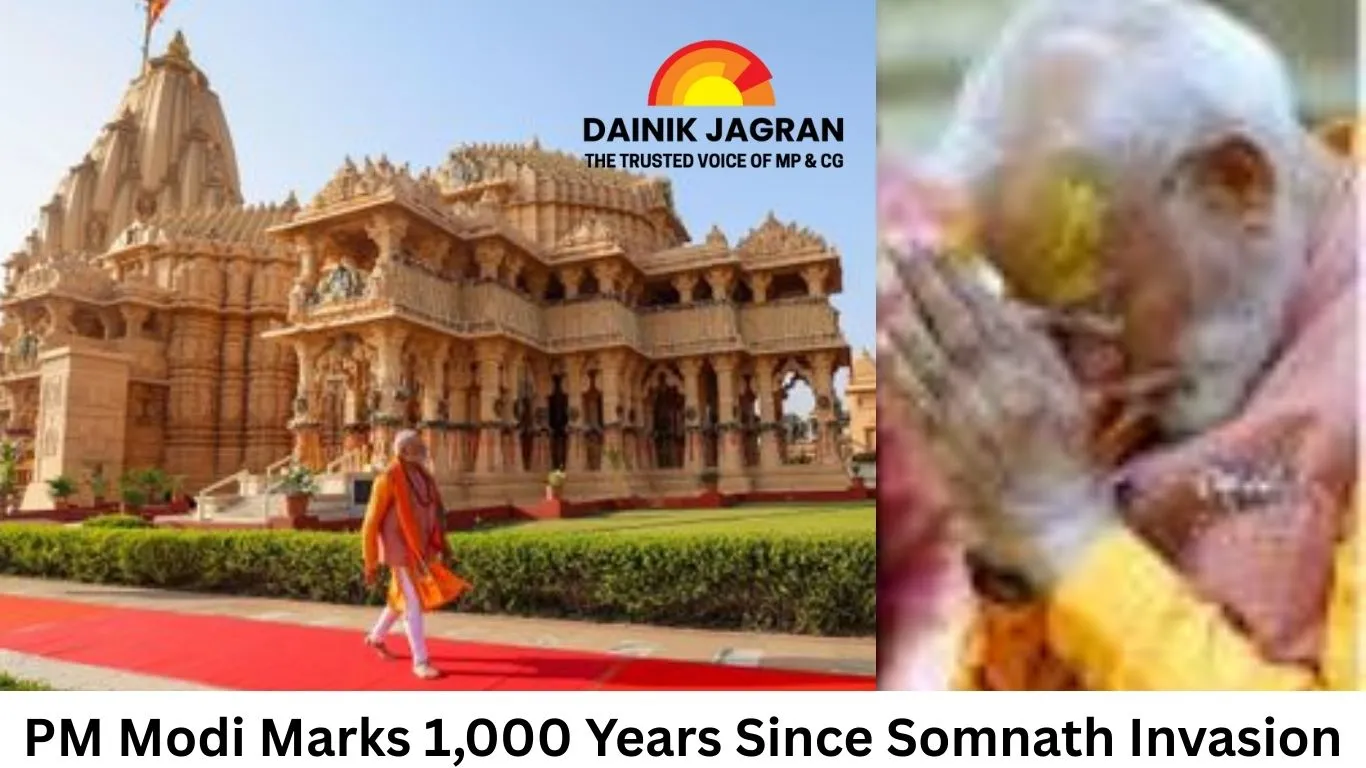
PM Modi Marks 1,000 Years Since Somnath Invasion, Calls Temple a Symbol of India’s Enduring Self-Respect
Digital Desk
Prime Minister Narendra Modi on Monday reflected on 1,000 years since Mahmud of Ghazni’s attack on the Somnath Temple, describing the shrine not as a symbol of destruction but as a continuing testament to India’s civilisational resilience and self-respect. In an article released on the occasion, Modi said Somnath represents the unbroken faith of generations that survived repeated assaults and rose again each time.
The Prime Minister’s remarks come as the country observes a millennium since the 1026 AD invasion of the Somnath Temple at Prabhas Patan in Gujarat. Modi termed the commemoration “Somnath Swabhiman Parv” (Somnath Self-Respect Festival), linking the historical milestone with the broader narrative of India’s cultural continuity.
In his article, Modi wrote that Somnath, the first among the 12 Jyotirlingas, has held a central place in India’s spiritual and cultural imagination. He noted that ancient scriptures place Somnath at the forefront of sacred geography and that the temple was historically a hub of faith, trade, and maritime exchange, with its renown carried across seas by Indian traders.
Recalling the destruction of the temple by Mahmud of Ghazni, Modi described the attack as an attempt to erase a civilisational symbol. “Those who came with a mentality of destruction plundered and left, but could not take away India’s faith,” he wrote, adding that Somnath’s repeated reconstruction reflects the nation’s refusal to surrender its cultural identity.
The Prime Minister traced the temple’s revival across centuries, citing contributions from figures such as Ahilyabai Holkar and Swami Vivekananda, who visited Somnath in the late 19th century. He also highlighted the post-Independence reconstruction led by Sardar Vallabhbhai Patel, who announced plans to rebuild the shrine after visiting the site in 1947. The present structure was completed in 1951, a milestone that will mark its 75th anniversary in 2026.
Modi also referred to differences of opinion within the leadership at the time, noting that then Prime Minister Jawaharlal Nehru was hesitant about official participation in the inauguration, while President Rajendra Prasad went ahead with the visit. He acknowledged the role of K.M. Munshi, whose efforts were instrumental in realising the reconstruction.
Concluding his article, Modi said Somnath’s survival carries a message for the present and the future: that a civilisation rooted in faith and ideas cannot be erased by force. He urged citizens to draw inspiration from Somnath’s history in building a developed and confident India.
--------
🚨 Beat the News Rush – Join Now!
Get breaking alerts, hot exclusives, and game-changing stories instantly on your phone. No delays, no fluff – just the edge you need. ⚡
Tap to join:
🟢 WhatsApp Channel: Dainik Jagran MP CG
Crave more?
🅕 Facebook: Dainik Jagran MP CG English
🅧 Twitter (X): Dainik Jagran MP CG
🅘 Instagram: Dainik Jagran MP CG
Share the fire – keep your crew ahead! 🗞️🔥
PM Modi Marks 1,000 Years Since Somnath Invasion, Calls Temple a Symbol of India’s Enduring Self-Respect
Digital Desk
The Prime Minister’s remarks come as the country observes a millennium since the 1026 AD invasion of the Somnath Temple at Prabhas Patan in Gujarat. Modi termed the commemoration “Somnath Swabhiman Parv” (Somnath Self-Respect Festival), linking the historical milestone with the broader narrative of India’s cultural continuity.
In his article, Modi wrote that Somnath, the first among the 12 Jyotirlingas, has held a central place in India’s spiritual and cultural imagination. He noted that ancient scriptures place Somnath at the forefront of sacred geography and that the temple was historically a hub of faith, trade, and maritime exchange, with its renown carried across seas by Indian traders.
Recalling the destruction of the temple by Mahmud of Ghazni, Modi described the attack as an attempt to erase a civilisational symbol. “Those who came with a mentality of destruction plundered and left, but could not take away India’s faith,” he wrote, adding that Somnath’s repeated reconstruction reflects the nation’s refusal to surrender its cultural identity.
The Prime Minister traced the temple’s revival across centuries, citing contributions from figures such as Ahilyabai Holkar and Swami Vivekananda, who visited Somnath in the late 19th century. He also highlighted the post-Independence reconstruction led by Sardar Vallabhbhai Patel, who announced plans to rebuild the shrine after visiting the site in 1947. The present structure was completed in 1951, a milestone that will mark its 75th anniversary in 2026.
Modi also referred to differences of opinion within the leadership at the time, noting that then Prime Minister Jawaharlal Nehru was hesitant about official participation in the inauguration, while President Rajendra Prasad went ahead with the visit. He acknowledged the role of K.M. Munshi, whose efforts were instrumental in realising the reconstruction.
Concluding his article, Modi said Somnath’s survival carries a message for the present and the future: that a civilisation rooted in faith and ideas cannot be erased by force. He urged citizens to draw inspiration from Somnath’s history in building a developed and confident India.


