

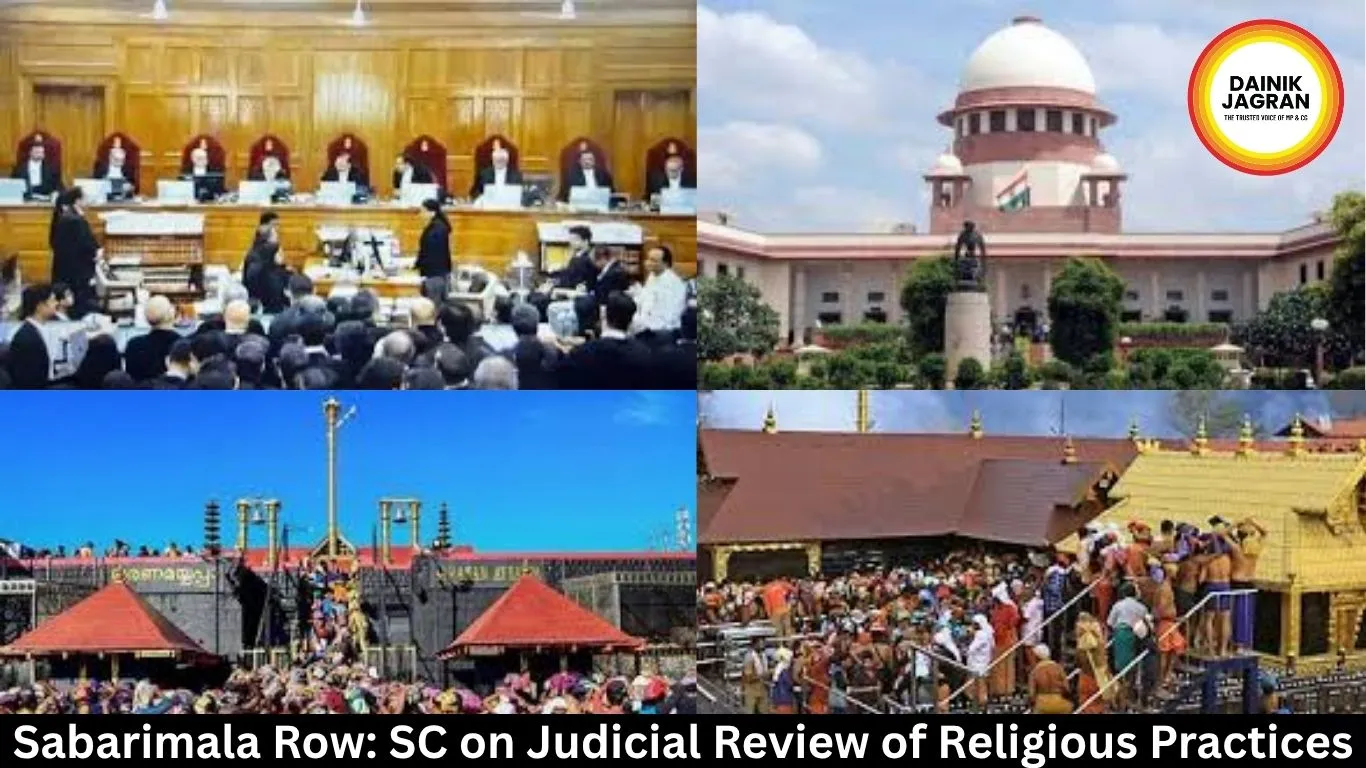
Sabarimala Row: SC on Judicial Review of Religious Practices

Digital Desk

Sabarimala Row: SC on Judicial Review of Religious Practices

Sabarimala row hearing continues as Supreme Court asserts judicial review over religious practices amid Centre’s objections on superstition claims.


Sabarimala row: SC asserts judicial review over religious practices

In the ongoing Sabarimala row, the Supreme Court and Centre differ on courts’ role in assessing religious practices and alleged discrimination

Hearing Continues in SC

The Supreme Court of India on Wednesday continued hearing the long-standing Sabarimala row, focusing on whether courts can examine religious practices and label them as superstition. The proceedings, before a nine-judge Constitution bench, saw sharp exchanges between the Centre and the judiciary on the scope of judicial review.

Solicitor General Tushar Mehta argued that secular courts lack the expertise to determine what constitutes superstition in matters of faith. However, the bench maintained that constitutional courts retain the authority to examine such practices, especially where fundamental rights are involved.

Govt vs Court Stand

Presenting the Centre’s position, Mehta said religious practices vary widely across India’s diverse communities and should not be judged by courts using a uniform standard. He cautioned that labelling practices as superstition could lead to unintended consequences in a plural society.

The bench, however, pushed back. Justice Amanullah observed that courts have the power of judicial review and cannot be excluded entirely from examining religious practices. “The final determination cannot rest solely with the legislature,” the court noted during the exchange.

Debate on Discrimination

A key issue in the Sabarimala row remains alleged discrimination against women. The bench repeatedly underlined that constitutional guarantees of equality cannot be ignored.

Justice B. V. Nagarathna questioned whether denying entry to women on the basis of menstruation could be equated with untouchability, which is abolished under Article 17 of the Constitution.

The government countered that the Sabarimala tradition cannot be equated with caste-based untouchability and argued that not all religious restrictions violate fundamental rights.

Essential Religious Practice

The hearing also revisited the doctrine of “Essential Religious Practice” (ERP), which determines whether a practice qualifies for constitutional protection.

Mehta argued that courts should refrain from deciding what is essential to a religion, as this would require interpreting scriptures and beliefs—tasks beyond judicial competence.

The bench acknowledged the complexity but indicated that courts may still examine practices if they conflict with public order, morality, or health.

Background of Case

The Sabarimala row dates back decades, centred on the Sabarimala Temple in Kerala, where women aged 10 to 50 were traditionally barred from entry.

In 2018, the Supreme Court of India, in a 4:1 majority verdict, allowed entry of women of all ages, calling the ban unconstitutional. The ruling triggered widespread protests across Kerala.

Subsequently, over 50 review petitions were filed, leading to the current hearings before a larger bench examining broader constitutional questions.

Wider Constitutional Questions

The present proceedings extend beyond Sabarimala and include issues such as women’s entry into mosques, Parsi fire temples, and practices in other religions.

The bench is examining how Articles 25 and 26—guaranteeing religious freedom—interact with Articles 14, 15, and 17, which ensure equality and prohibit discrimination.

Judges indicated that while religious autonomy is protected, it cannot override constitutional morality in cases of clear discrimination.

What Lies Ahead

The hearings are scheduled to continue until April 22, with different sets of petitioners presenting arguments in phases. A final ruling is expected to clarify the balance between religious freedom and fundamental rights.

The outcome of the Sabarimala row is likely to have far-reaching implications for similar cases across India, shaping how courts interpret faith-based practices in the context of constitutional values.

As the debate unfolds, the case remains a significant public interest story and a key India News Update, closely tracked across legal and policy circles.

--------

🚨 Beat the News Rush – Join Now!

Get breaking alerts, hot exclusives, and game-changing stories instantly on your phone. No delays, no fluff – just the edge you need. ⚡

Tap to join: 

🟢 WhatsApp Channel: Dainik Jagran MP CG

Crave more?

🅕 Facebook: Dainik Jagran MP CG English

🅧 Twitter (X): Dainik Jagran MP CG

🅘 Instagram: Dainik Jagran MP CG

Share the fire – keep your crew ahead! 🗞️🔥

english.dainikjagranmpcg.com
08 Apr 2026 By Abhishek Joshi

Sabarimala Row: SC on Judicial Review of Religious Practices

Digital Desk

Sabarimala row: SC asserts judicial review over religious practices

In the ongoing Sabarimala row, the Supreme Court and Centre differ on courts’ role in assessing religious practices and alleged discrimination

Hearing Continues in SC

The Supreme Court of India on Wednesday continued hearing the long-standing Sabarimala row, focusing on whether courts can examine religious practices and label them as superstition. The proceedings, before a nine-judge Constitution bench, saw sharp exchanges between the Centre and the judiciary on the scope of judicial review.

Solicitor General Tushar Mehta argued that secular courts lack the expertise to determine what constitutes superstition in matters of faith. However, the bench maintained that constitutional courts retain the authority to examine such practices, especially where fundamental rights are involved.

Govt vs Court Stand

Presenting the Centre’s position, Mehta said religious practices vary widely across India’s diverse communities and should not be judged by courts using a uniform standard. He cautioned that labelling practices as superstition could lead to unintended consequences in a plural society.

The bench, however, pushed back. Justice Amanullah observed that courts have the power of judicial review and cannot be excluded entirely from examining religious practices. “The final determination cannot rest solely with the legislature,” the court noted during the exchange.

Debate on Discrimination

A key issue in the Sabarimala row remains alleged discrimination against women. The bench repeatedly underlined that constitutional guarantees of equality cannot be ignored.

Justice B. V. Nagarathna questioned whether denying entry to women on the basis of menstruation could be equated with untouchability, which is abolished under Article 17 of the Constitution.

The government countered that the Sabarimala tradition cannot be equated with caste-based untouchability and argued that not all religious restrictions violate fundamental rights.

Essential Religious Practice

The hearing also revisited the doctrine of “Essential Religious Practice” (ERP), which determines whether a practice qualifies for constitutional protection.

Mehta argued that courts should refrain from deciding what is essential to a religion, as this would require interpreting scriptures and beliefs—tasks beyond judicial competence.

The bench acknowledged the complexity but indicated that courts may still examine practices if they conflict with public order, morality, or health.

Background of Case

The Sabarimala row dates back decades, centred on the Sabarimala Temple in Kerala, where women aged 10 to 50 were traditionally barred from entry.

In 2018, the Supreme Court of India, in a 4:1 majority verdict, allowed entry of women of all ages, calling the ban unconstitutional. The ruling triggered widespread protests across Kerala.

Subsequently, over 50 review petitions were filed, leading to the current hearings before a larger bench examining broader constitutional questions.

Wider Constitutional Questions

The present proceedings extend beyond Sabarimala and include issues such as women’s entry into mosques, Parsi fire temples, and practices in other religions.

The bench is examining how Articles 25 and 26—guaranteeing religious freedom—interact with Articles 14, 15, and 17, which ensure equality and prohibit discrimination.

Judges indicated that while religious autonomy is protected, it cannot override constitutional morality in cases of clear discrimination.

What Lies Ahead

The hearings are scheduled to continue until April 22, with different sets of petitioners presenting arguments in phases. A final ruling is expected to clarify the balance between religious freedom and fundamental rights.

The outcome of the Sabarimala row is likely to have far-reaching implications for similar cases across India, shaping how courts interpret faith-based practices in the context of constitutional values.

As the debate unfolds, the case remains a significant public interest story and a key India News Update, closely tracked across legal and policy circles.

https://english.dainikjagranmpcg.com/national/sabarimala-row-sc-on-judicial-review-of-religious-practices/article-16657

Latest News


