


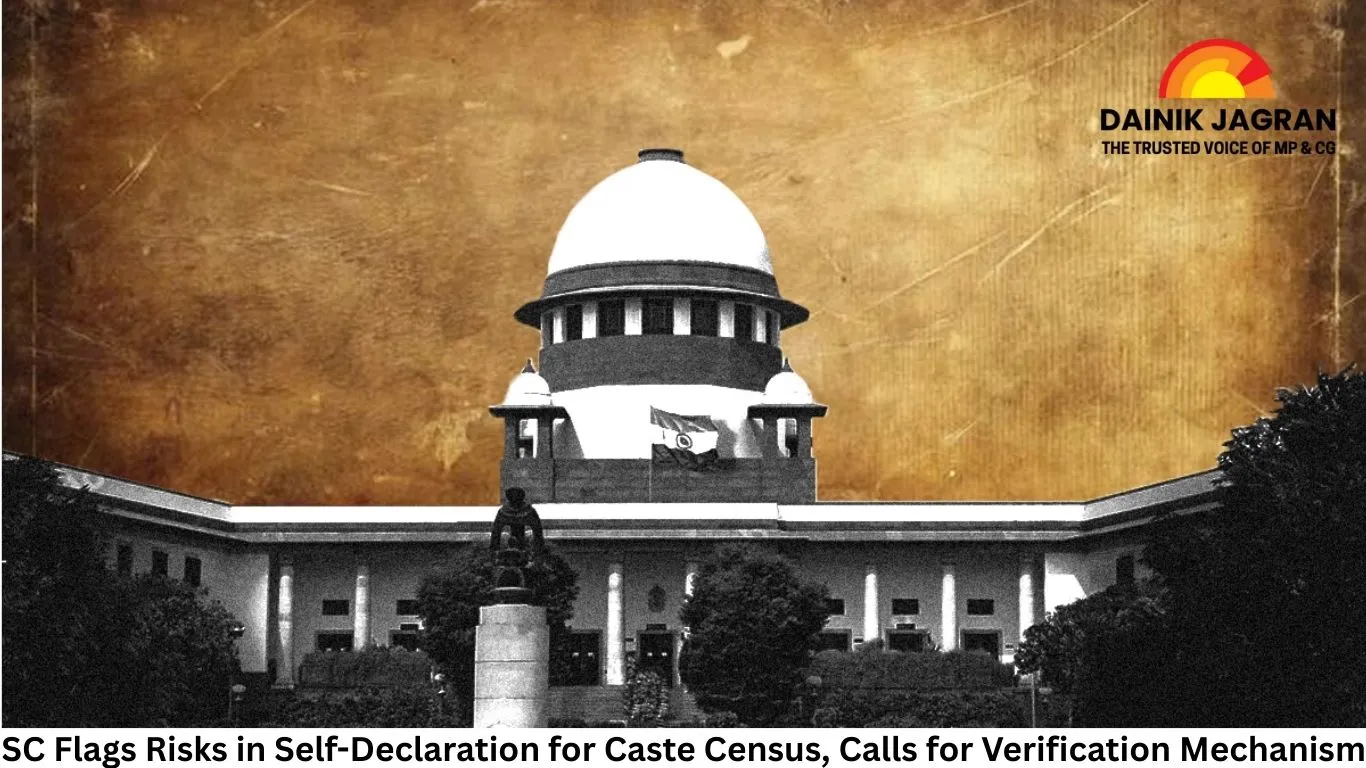
SC Flags Risks in Self-Declaration for Caste Census, Calls for Verification Mechanism
Digital Desk
A Bench comprising Chief Justice Suryakant and Justice Joymalya Bagchi said that individuals should neither be included nor excluded from caste categories on the basis of unchecked certificates or declarations. The court noted that caste data would significantly influence welfare schemes, reservation policies and governance decisions for decades, making accuracy critical.
The court was hearing a petition filed by Akash Goyal, represented by senior advocate Mukta Gupta, who clarified that the plea did not oppose a caste census. Instead, it sought safeguards to ensure credibility of the data. Gupta argued that while complete verification of every certificate may not be practically feasible, reliance purely on self-declaration carries serious risks, as it opens the process to misuse and inaccuracies that would be difficult to correct later.
In a series of observations, the Bench stressed that the census is a specialised and technical exercise governed by the Census Act, 1948 and the Census Rules, 1990. Under this framework, the authority to decide the methodology and parameters lies with census officials and subject-matter experts, not the judiciary. However, the court said the concerns raised by the petitioner could be treated as a formal representation to the authorities.
“We trust that the authorities, with the assistance of experts, will put in place a robust system that minimises the possibility of errors,” the Bench said, adding that the court could only direct the Centre to consider these issues while finalising procedures.
The Union Home Ministry has already clarified that the caste census will be conducted in the second phase of Census 2027, which is scheduled to begin nationwide from February 2027. The exercise is estimated to cost around ₹13,500 crore and will be conducted entirely in digital mode for the first time, with nearly 30 lakh enumerators using mobile applications for real-time data collection.
Caste-based data will also be collected digitally, marking the first nationwide caste enumeration since Independence. The last such exercise was conducted in 1931 during British rule. The Cabinet Committee on Political Affairs, chaired by Prime Minister Narendra Modi, approved the inclusion of caste enumeration in April last year.
The Home Ministry has also stated that in snow-bound and non-concurrent regions of Jammu and Kashmir, Himachal Pradesh and Uttarakhand, census operations will be completed by September 2026. Officials maintain that clear protocols are being developed to ensure consistency and accuracy.
The Supreme Court’s remarks are expected to add momentum to discussions within the government on balancing administrative feasibility with the need for credible, verifiable caste data in a census that will shape public policy for years to come.
.jpg)




