


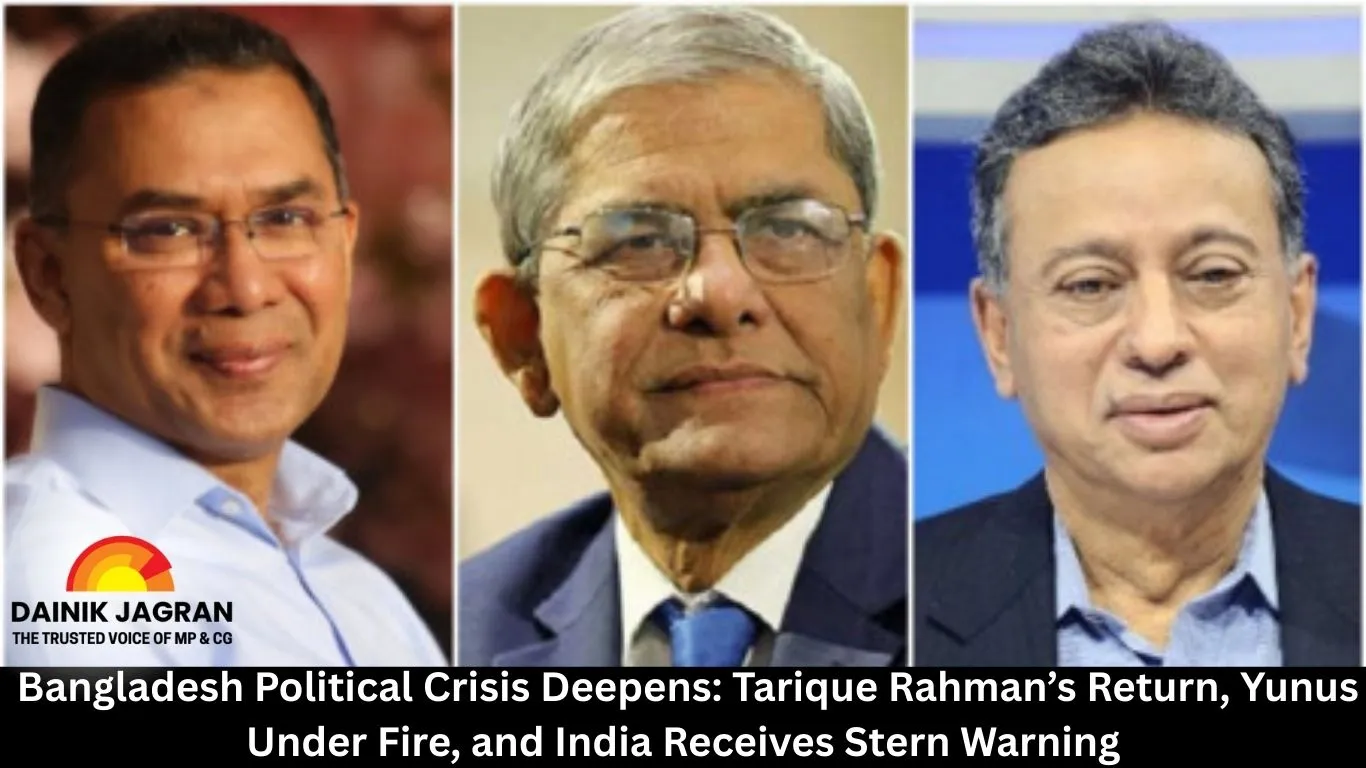
Bangladesh Political Crisis Deepens: Tarique Rahman’s Return, Yunus Under Fire, and India Receives Stern Warning
Digital Desk
Bangladesh’s Crisis Escalates as Tarique Rahman Returns
Bangladesh is witnessing one of its most turbulent political phases in recent history. As violent protests erupt across Dhaka, the country’s fragile stability is under grave threat. The latest twist comes with the return of Tarique Rahman, son of former Prime Minister Khaleda Zia, after nearly 17 years in exile — a move that could reshape the nation’s power landscape.
On Wednesday, a bomb explosion in Dhaka University triggered fresh waves of violence, leaving the capital in chaos. Student groups clashed with police, and protests intensified against Nobel laureate Mohammad Yunus, whom the current regime blames for fueling unrest and “encouraging extremism.”
Sheikh Hasina’s Student Wing Warns India
In an unexpected and alarming turn, Sheikh Hasina’s Bangladesh Chhatra League (BCL) issued a warning to India, urging caution and restraint in its engagement with the Yunus-led government.
BCL Secretary Sheikh Enan said during a press interaction,
“India must remember who stood by Bangladesh in 1971. But the way current developments are moving, our friendship is being tested.”
Enan accused Yunus of collaborating with foreign forces and destabilizing the region to maintain control. He further warned that any attempt to “interfere” in Bangladesh’s internal matters could strain bilateral relations.
This caution comes amid growing suspicion in Dhaka that Yunus’s administration is leaning toward China and Pakistan — a shift with serious geopolitical consequences for India.
India Expresses Concern, Diplomatic Tensions Grow
In New Delhi, officials are closely monitoring the developments. The Ministry of External Affairs has summoned Bangladesh’s High Commissioner, seeking clarification over violent attacks targeting Hindu minorities and the suspension of visa services.
Sources told Jagran Digital Desk that India views the situation as a potential “regional flashpoint,” given Yunus’s proximity to Beijing and Islamabad.
Security analysts warn that any escalation could disrupt border stability and affect India’s northeastern states, already sensitive due to cross-border movement.
Global Response: China, Pakistan, and the US Observe Closely
The growing chaos has caught international attention.
According to a recent Pentagon report, China is expanding its military presence in South Asia, with plans to establish bases in Bangladesh and at least 20 other strategic locations. Meanwhile, U.S. lawmakers have voiced concerns about the democratic backsliding in Dhaka ahead of February’s elections.
Russia, in contrast, backed India’s position, urging Dhaka to defuse tensions and restore political stability.
Expert View: “A Power Chess Game in South Asia”
Political observers believe the unfolding crisis is not just about street violence but a larger contest for power.
Analyst Rehan Qureshi notes, “Yunus’s alignment with foreign interests and Rahman’s return together point to a recalibration of Bangladesh’s power equation. New Delhi is watching closely because Dhaka’s drift toward China could tilt the regional balance.”
Conclusion
As Bangladesh moves toward national elections, political uncertainty, sectarian violence, and foreign interference continue to destabilize the region. For India, this is not just a neighborhood issue but a strategic concern — where diplomacy, security, and regional partnerships will be tested in the weeks ahead.
.jpg)




