


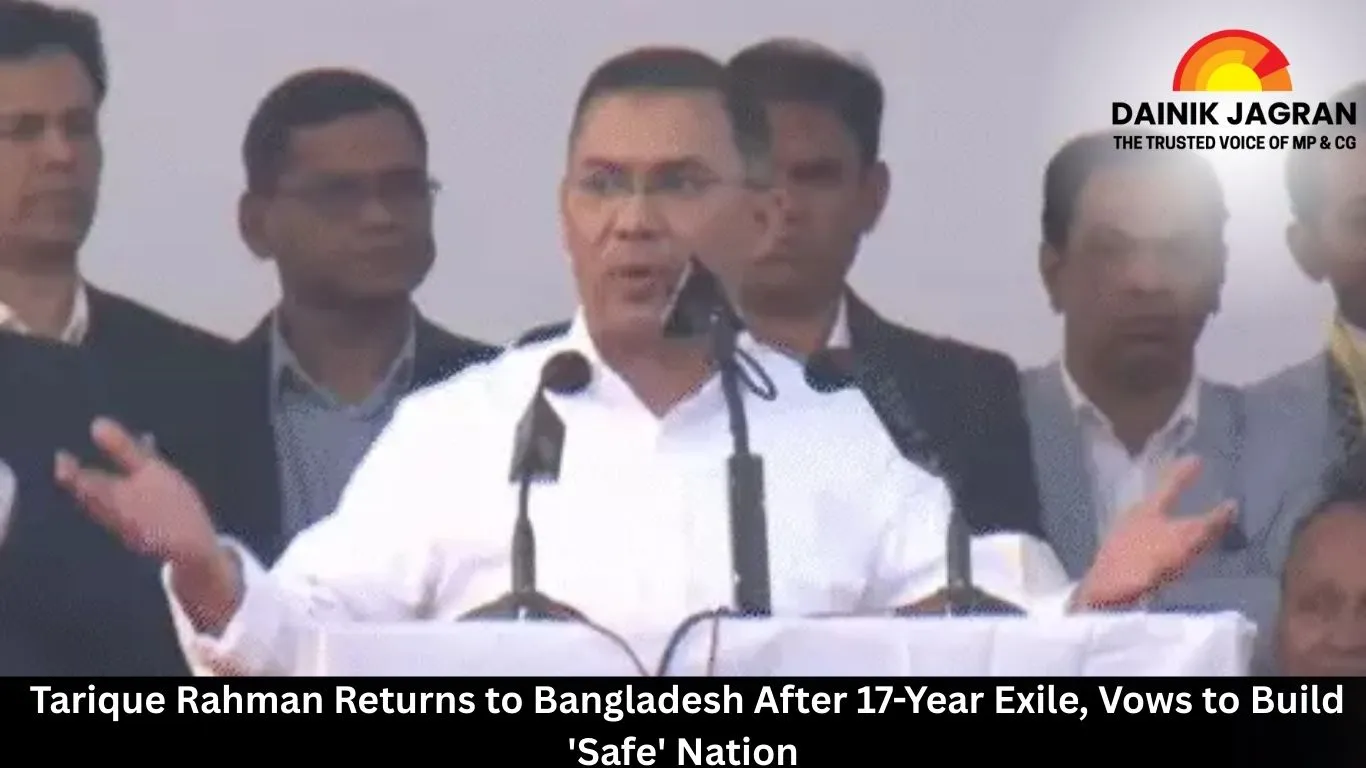
Tarique Rahman Returns to Bangladesh After 17-Year Exile, Vows to Build 'Safe' Nation
Digital Desk
Tarique Rahman, the acting chairman of the Bangladesh Nationalist Party (BNP), stepped onto Bangladeshi soil for the first time in 17 years on Thursday, marking a seismic shift in the nation's politics. His return from exile in London comes just weeks before pivotal general elections and amid a fresh wave of deadly unrest.
The 60-year-old heir to the country's most prominent political dynasty was met by a massive crowd of supporters. In a symbolic gesture, he removed his shoes upon arrival at Dhaka's Hazrat Shahjalal International Airport, standing barefoot before a sea of party flags.
A Nation in Turmoil
Rahman's homecoming occurs against a backdrop of severe political violence and instability. The country has been gripped by protests and mob attacks following the December 18 death of Sharif Osman Hadi, a prominent student leader and critic of former Prime Minister Sheikh Hasina.
Recent days have seen:
Attacks on Media and Culture: Mobs vandalized and set fire to the offices of major newspapers Prothom Alo and The Daily Star, as well as cultural organizations like Chhayanaut.
Religious Tensions: The lynching and burning of a 25-year-old Hindu man, Dipu Chandra Das, on allegations of blasphemy has heightened fears among religious minorities.
Diplomatic Strain: Protesters have targeted Indian diplomatic missions, leading India to suspend visa services in several Bangladeshi cities.
Rahman's Political Resurrection
For nearly two decades, Rahman was the exiled "prince" of Bangladeshi politics, living in London since 2008. He left to seek medical treatment after what he described as torture during detention under a military-backed caretaker government. During Sheikh Hasina's 15-year rule, he was convicted in absentia on charges ranging from money laundering to involvement in a deadly 2004 grenade attack targeting Hasina herself. The BNP has consistently labeled these charges as politically motivated.
With Hasina ousted in a 2024 student-led uprising and now living in exile in India, an interim government under Nobel laureate Muhammad Yunus has cleared Rahman's legal hurdles, acquitting him of all convictions and paving the way for his return.
Election Landscape and Challenges
The interim government has announced elections for February 12, 2026, in what analysts call one of the most consequential votes in the country's history. With Hasina's Awami League barred from participating, the BNP is positioned as the frontrunner.
A December poll by the U.S.-based International Republican Institute (IRI) showed the BNP leading with approximately 30% support, followed by the Islamist Jamaat-e-Islami party at 26%. This sets the stage for a direct contest between the two former allies.
"The upcoming election is BNP’s to lose," said Jon Danilowicz, a former U.S. diplomat who worked in Bangladesh. He noted that Rahman's return is "the last piece of the puzzle" for election preparations.
A Call for Unity
In his first address to a packed rally in Dhaka, Rahman struck a conciliatory tone. Echoing Martin Luther King Jr.'s famous "I Have a Dream" speech, he declared, "I have a plan for the people of my country". He repeatedly called for peace and outlined a vision for an inclusive nation.
"We have people from the hills and the plains in this country – Muslims, Hindus, Buddhists and Christians," Rahman stated. "We want to build a safe Bangladesh, where every woman, man and child can leave home safely and return safely".
He also urged all citizens, regardless of political or religious affiliation, to join hands to maintain law and order—a direct appeal amid the ongoing violence.
What's Next?
Following his speech, Rahman headed to Evercare Hospital to visit his ailing mother, former Prime Minister Khaleda Zia, who remains in critical condition. His return is expected to galvanize the BNP's campaign as he transitions from an exiled figurehead to a hands-on leader on the ground.
With six weeks until the vote, Rahman's ability to unify his party, navigate a tense relationship with the interim government, and present a compelling alternative to a population weary of violence will determine not just his political future, but the next chapter for Bangladesh.


.jpg)




